Lithium-Air Might Be The Better Battery

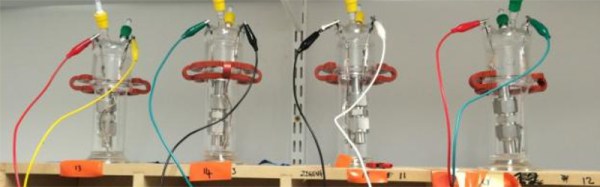
Researchers at Cambridge University demonstrated their latest version of what is being called the Lithium-Air battery. It can be more accurately referred to as a Lithium-Oxygen but Air sounds cooler.

The early estimates look pretty impressive with the energy density being 93% efficient which could be up to 10 times the energy density of Lithium-Ion and claims to be rechargeable up to 2,000 times.  Recent improvements toward Lithium-Air batteries include a graphene contact and using lithium hydroxide in place of lithium peroxide which increased both stability and efficiency.

Here’s the rub: Lithium-Air batteries are still years away from being ready for commercial use. There are still problems with the battery’s ability to charge and discharge (kind of a deal breaker if the battery won’t charge or discharge right?) There are still issues with safety, performance, efficiency, and the all too apparent need for pure oxygen.

Do batteries get you all charged up? Check out our coverage of MIT’s solid state battery research, or have a look at the Nissan Leaf and/or Tesla battery packs.

Thanks to [Jimmy] for the tip.

Who Said FORTRAN Is Dead?

NASA has an urgent need for a FORTRAN developer to support the Voyager spacecraft. Popular Mechanics interviewed Voyager program manager [Suzanne Dodd] who is looking to fill [Larry Zottarell’s] shoes when he retires.

We had a lot of people comment on my recent Hackaday article, “This Is Not Your Father’s FORTRAN”, who studied the language at some point. Maybe one of you would like to apply? You need to do so soon! NASA is hoping to give the new hire six to twelve months with [Zottarell] for on-the-job training. You’ll need to brush up on your vintage assembly language too.

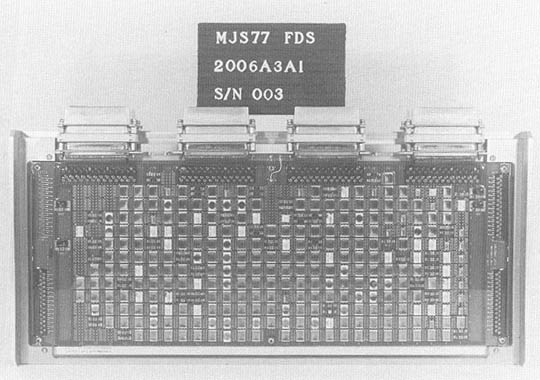
light data system hwThe two Voyagers were some of the first NASA spacecraft to use computers. The resources are limited in the three 40 year-old computers found on each probe. They handle the spacecraft’s science and flight software. The software is a little more recent having been updated only 25 years ago in 1990.

A big problem is a lot of the engineering design materials are no longer in existence. People’s memories of the events and reasons for decisions made that long ago are bit hazy. But NASA does have an emergency list of those former engineers when questions arise. That means this could be more than just a job where you program for ancient hardware, you could find a lot of reasons to interact with the people who pioneered this field!

This will be an awesome hack. Anyone up to doing remote computing at a distance of 12 billion miles?

A video on the history of the two voyagers is found after the break.

Continue reading “Who Said FORTRAN Is Dead?”

Hyperloop Test Track To Be Built In California

Next year Hyperloop Transportation Technologies is planning on breaking ground on a five mile test track for the Hyperloop concept as originally proposed by [Elon Musk] back in 2013.

It’s being built around Quay Valley, which is a large real-estate development in California. In addition to serving as a test-bed for different pod designs and to further the technology as a whole, they’re planning on being able to transport passengers at mind-boggling speeds (how’s 760mph sound?) by as soon as 2018. While [Elon Musk] has no real involvement in the company, he is extremely supportive of the company and seeing his idea come to life — who wouldn’t? He once described the Hyperloop concept rather eloquently…

If the Concorde, a rail gun and an air-hockey table had a three-way, the Hyperloop would be the love child.

That’s certainly one love child we’d like to see. Oh and the cost? Apparently only $150 million. Seems about right.

[via Popular Science]

EFF Granted DMCA Exemption: Hacking Your Own Car Is Legal For Now

The Digital Millennium Copyright Act (DMCA) is a horrible piece of legislation that we’ve been living with for sixteen years now. In addition to establishing a de-facto copyright for the design of boat hulls (don’t get us started!), the DMCA includes a Section 1201 which criminalizes defeating encryption in cases where such could be used to break copyright law.

Originally intended to stop the rampant copying of music in the Napster era, it’s been abused to prevent users from re-filling their inkjet cartridges and to cover up rootkits. In short, it’s scope has vastly exceeded its original aims. And we take it personally, because we like to take stuff apart and see how it works.

EFF_LogoThe only bright light in this otherwise dark, dark tunnel is the possibility to petition for exemptions to Section 1201 for certain devices and purposes. Just a few days ago, the EFF won a slew of DMCA exemptions, including the contentious exemption for bypassing automobiles’ encryption to check out what’s going on in the car’s firmware. The obvious relevance of the ability for researchers to inspect cars’ firmware in light of the VW scandal may have helped overcome strong pushback from the car manufacturers and the EPA.

The other exemption that caught our eye was the renewal of protection for people who need to hack old video games to keep them playable, jailbreak phones so that you can run an operating system of your choosing on it, and even the right to copy content from a DVD for remixes and excerpts.

This is all good stuff, but it’s a little bit sad that the EFF has to beg every three years to enable us all to do something that wasn’t illegal until the DMCA was written. But don’t take my word for it, have a listen to Cory Doctorow’s much more eloquent rant.

(Banner image courtesy [Kristoffer Smith], who we covered on car hacking way back when.)

Mergers And Acquisitions: TI Looks To Snatch Up Maxim

BloombergBusiness is reporting rumors that Texas Instruments is in talks to acquire Maxim Integrated. Both companies have declined to respond to this leaked information. Earlier this year there were rumors that the two companies had been in talks in 2014 that didn’t result with an agreement.

We find it interesting that the article mentions Maxim doesn’t need to scale — yet we often find Maxim parts in short supply. If TI were to acquire the company this could change for some Maxium parts. Still, this move looks a lot like TI trying to bolster its hold on the portions of the analog chip market which both companies currently occupy.

Already this year we’ve seen Dialog acquire Atmel, Avago acquire Broadcom, and the merger agreement between Freescale and NXP. We probably missed a few, and this has us wonder who is next. Let us know what you think in the comments below.

[Thanks Kumar]

Don’t Look Now, Nothing Will Happen –Zeno Of Elea

The Greek philosopher [Zeno of Elea] proposed that an arrow in flight was in fact not in motion and its visible movement is only an illusion. A simple example of this is to glance at an arrow in flight, doing this causes our mind to store a snapshot of a motionless arrow. [Zeno] further defended this argument by stating that if an object has to travel a finite distance to reach a destination then the finite distance can be divided in half and the object must first reach this halfway point before arriving at the destination. This process can be repeated an infinite number of times, creating an infinite number of points that the object must occupy before reaching the destination thus it can never arrive at the destination.

Whoa, that’s a bit heavy. Let’s take a second here to think about this and never arrive at the conclusion, shall we?

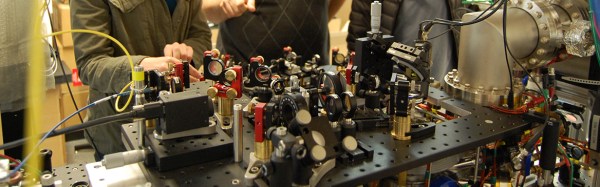
So what does a fancy mathematics parlor trick have to do with the fact that we have all seen an arrow arrive at its destination? Recent experiments conducted at Cornell University have in fact verified the Zeno Effect. Researchers were able to achieve this by having atoms suspended between lasers in temperatures ~1 nano degree above absolute zero so that the atoms arrange themselves in a lattice formation. As per usual in quantum mechanics when observed, the atoms had an equal possibility of being anywhere within the space of the lattice. However, when they were observed at high enough frequencies the atoms remain motionless, bringing the quantum evolution to a halt.

A More Correct Horse Battery Staple

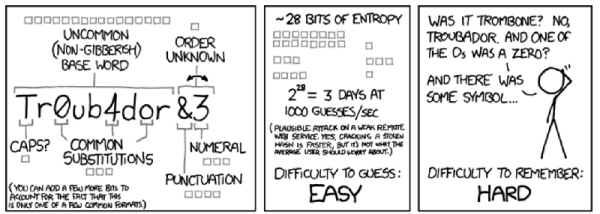
Passwords are terrible. The usual requirements of a number, capital letter, or punctuation mark force users to create unmemorable passwords, leading to post-it notes; the techniques that were supposed to make passwords more secure actually make us less secure, and yes, there is an xkcd for it.

[Randall Munroe] did offer us a solution: a Correct Horse Battery Staple. By memorizing a long phrase, a greater number of bits are more easily encoded in a user’s memory, making a password much harder to crack. ‘Correct Horse Battery Staple’ only provides a 44-bit password, though, and researchers at the University of Southern California have a better solution: prose and poetry. Just imagine what a man from Nantucket will do to a battery staple.

In their paper, the researchers set out to create random, memorable 60-bit passwords in an English word sequence. First, they created an xkcd password generator with a 2048-word dictionary to create passwords such as ‘photo bros nan plain’ and ’embarrass debating gaskell jennie’. This produced the results you would expect from a webcomic. The best ‘alternative’ result was found when creating poetry: passwords like “Sophisticated potentates / misrepresenting Emirates” and “The supervisor notified / the transportation nationwide” produced a 60-bit password that was at least as memorable as the xkcd method.

Image credit xkcd