Arduino.cc Expands European Manufacturing

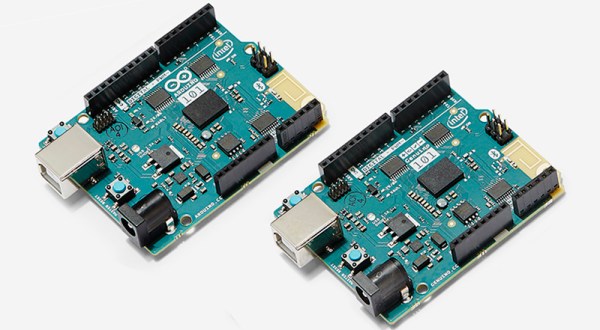
Maker Faire Rome is over, and that means it’s time for the Arduino media blitz. Arduino has already had a big announcement this week with the introduction of the Arduino / Genuino 101 board powered by the Intel Curie module. Team .cc hasn’t forgotten all their Atmel-powered boards though. The latest news is that Arduinos will be manufactured in Germany by Watterott Electronics (.de, Google Translate).

Right now, Arduino.cc boards are manufactured in China by Seeed, and in the US by Adafruit and Sparkfun. Watterott Electronics is one of the premier hobby electronics distributors in Germany.

Boards made by Watterott will carry the Genuino mark; Arduino.cc seems to anticipate a loss in the Arduino vs. Arduino trademark dispute outside the US. All boards produced under license from Arduino.cc sold outside the US will carry the Genuino trademark, whereas boards produced for the US market will carry the Arduino trademark. Interestingly, this Arduino vs. Arduino split began with a former manufacturer, with a maelstrom of pettiness stemming from that trademark dispute. In any case, the licensing for boards manufactured by Watterott is most assuredly worked out by now. The new manufacturing partner guarantees a greater supply of Arduinos for all.

Smart Cards Used To Hack Smart Cards

Back in the day, true hackers – the kind that would build VCRs out of 555 chips only to end up in the Hackaday comments section in their twilight years – would steal satellite TV feeds with the help of tiny little microcontrollers embedded in a credit card. This was the wild west, when a parallel port was the equivalent of a six-shooter and Jnco jeans were a ten gallon hat.

The backdoors that enabled these satellite pirates have long been closed, but these devices for stealing HBO have now evolved into stealing €600,000 worth of goods using a most unlikely source: chip and pin card terminals. A gang of criminals in Belgium have successfully broken chip and pin, and although the exploit has now been closed, the researchers behind the investigation have published their war story for one of the most interesting hacks in recent memory.

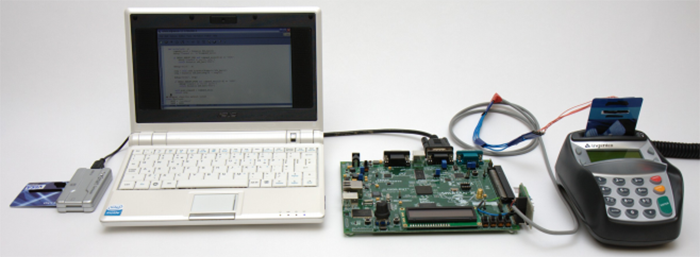
Chip and pin verification for Point of Sale (PoS) transactions are a relatively simple process; during a transaction, the PoS system asks for the user’s PIN and transmits it to the card. The card then simply answers ‘yes’ or ‘no’. In 2010, a vulnerability to this system was discovered, making it a simple matter for anyone to break chip and pin systems. This system used an FPGA with a backpack worth of modified hardware – executing it in a store would raise more than a few eyebrows.

The 2010 exploit hardware

The problem of implementing this system into something that was easily concealable was simply a matter of miniaturization. Thanks to the proliferation of smart cards over the last 20 years, very tiny microcontrollers are available that could manage this man-in-the-middle attack on a chip and pin system. What is a gang of criminals to do? Simply program a smart card with all the smarts required to pull of the hack, of course.

To pull off this exploit, an engineer in the gang of criminals used a FUNcard, a development platform for smart cards loaded up with an Atmel AVR AT90S8515 microcontroller and an EEPROM packaged in a small golden square. By removing the chip from this chipped card and replacing the chip in a stolen credit card, the criminals were able to reproduce the 2010 exploit in the wild, netting them €600,000 in stolen merchandise before they were caught.

How were they caught? The ‘buyer’ of the gang kept shopping at the same place. Rookie mistake, but once security researchers got their hands on this illegal hardware, they were amazed at what they found. Not only did the engineer responsible for this manage to put the code required for the exploit in an off-the-shelf smart card, the gold contact pads from the original credit card were rewired to the new microcontroller in an amazing feat of rework soldering.

Before this exploit was made public, the researchers developed a countermeasure for this attack that was swiftly installed in PoS terminals. They also came up with a few additional countermeasures that can be deployed in the future, just in case. In any event, it’s an amazing bit of reverse engineering, soldering, and craftsmanship that went into this crime spree, and as usual, it only took a massive loss for retailers to do anything about it.

The First 5nm Chip

For almost forty years, integrated circuits have become smaller and smaller. These chips started out with massive transistors in the early 1970s. They shrank to less than 1μm by 1990, and shrank yet again to less than 100nm by the turn of the last century. Now, Imec and Cadence are experimenting with 5nm technology – the smallest technology available for any mass-produced integrated circuit.

The history of microelectronic fabrication over the last decade is a story of failure. Something happened in 2005, and although chips could be designed at ever-smaller technologies, the transition to these smaller manufacturing processes didn’t go as smoothly as in the 70s, 80s, and 90s. Just a few years ago, Intel said 10nm chips would ship by 2015. These chips are nowhere to be found, and even 14nm technology is still catching up to the yields found in 22nm technology. In 2009, Nvidia said their flagship graphics card would be built with a 11nm process. The current Nvidia flagship desktop graphics card is built with 28nm technology. Moore’s law isn’t 18 months anymore.

While Imec and Cadence have completed the tapeout on a 5nm device, it’s just a test chip. Before starting manufacturing on a single process node, Intel and others will tapeout a simple test chip to verify their latest process. This 5nm tapeout will not become a manufactured chip, but it does mean we’ll see more talk about the 5nm process in the future.

Rod Logic And Graphene: Elusive Molecule-Scale Computers

I collect slide rules. You probably know a slide rule is a mechanical calculator of sorts. They usually look like a ruler (hence the name) and have a sliding part (hence the name) and by using logarithms you can multiply and divide easily by doing number line addition and subtraction (among other things).

It is easy to dismiss old technology like that out of hand as being antiquated, but mechanical computing may be making a comeback. It may seem ancient, but mechanical adding machines, cash registers, and even weapon control computers were all mechanical devices a few decades ago and there were some pretty sophisticated techniques developed to make them work. Perhaps the most sophisticated of all was Babbage’s difference engine, even though he didn’t have the technology to make one that actually functioned (the Computer History Museum did though; you should see it operating in person, but this is good too).

Continue reading “Rod Logic And Graphene: Elusive Molecule-Scale Computers”

Breaking: Drone Registration Will Be Required Says US DoT

Today, the US Department of Transportation announced that unmanned aerial systems (UAS) will require registration in the future.

The announcement is not that UAS, quadcopters, or drones would be required to be registered immediately. This announcement is merely that a task force of representatives from the UAS industry, drone manufacturers, and manned aviation industries would provide recommendations to the Department of Transportation for what types of aircraft would require registration. The task force is expected to develop these recommendations and deliver a report by November 20.

A Short History of FAA Model Aircraft Regulation

Introduced in 1981, AC 91-57 was the model aircraft operating standards for more than 30 years. This standard suggested that model pilots not fly higher than 400 feet, and to notify a flight service station or control tower when flying within three miles of an airport.

The FAA Modernization And Reform Act Of 2012 (PDF) required the FAA to create a set of rules for unmanned aerial systems, however the FAA is expressly forbidden from, ‘promulgating any rule or regulation regarding model aircraft.’ The key term being, ‘model aircraft’. This term was defined by the FAA as being, “an unmanned aircraft that is capable of sustained flight in the atmosphere; flown within visual line of sight of the person operating the aircraft; and flown for hobby or recreational purposes.” Anything outside of this definition was an unmanned aerial system, and subject to FAA regulations.

While this definition of model aircraft would have been fine for the 1980s, technology has advanced since then. FPV flying, or putting a camera and video transmitter on a quadcopter, is an extraordinarily popular hobby now, and because it is not ‘line of sight’, it is outside the definition of ‘model aircraft’.

This interpretation has not seen a great deal of countenance from the model aircraft community; FPV flying is seen as a legitimate hobby and even a sport. The entire domain of model aircraft aviation is expanding, and the hobby has never been as popular as it is now.

The Safety of Model Aviation

The issue of drone regulation focuses nearly entirely on the safety of airways in the United States; model aviators flying within five miles of an airport must ask the airport or control tower for permission to fly. To that end, the FAA created the B4UFLY app that takes the trouble out of reading sectional charts and checking up on the latest NOTAMs and TFRs.

However, the FAA is increasingly concerned with drones, multicopters, and model aircraft. In a report issued last summer, the FAA cited a marked increase in the number of ‘close calls’ between manned aircraft and model aircraft. The Academy of Model Aeronautics went over this data and found a different story: only 3.5% of sightings were ‘close calls’ or ‘near misses’. The FAA data is questionable – the reports cited include a drone flying at 51,000 feet over Washington DC. Not only is this higher than any civilian passenger aircraft capable of flying, the ability for any civilian remote-controlled aircraft to operate at this altitude is questionable at best.

Nevertheless, the requirement for registration has been greatly influenced by the perceived concerns of regulators for mid-air collisions.

What exactly will require registration?

The group of industry representatives responsible for delivering the recommendations to the Department of Transportation will take into account what aircraft should be exempt from registration due to a low safety risk. Most likely, small toy quadcopters will be exempt from registration; it’s difficult to fly a small Cheerson quadcopter outside anyway. Whether this will affect larger quadcopters and drones such as the DJI Phantom, or 250 class FPV racing quadcopters remains to be seen.

C++ Turns 30 – Looking Forward To The Future

[Bjarne Stroustrup] introduced C++ to the world on Monday 14th October 1985 at the ACM annual conference on “The Range of Computing”. On its 30th anniversary [Bjarne] reviewed the history, his experience, and his thoughts on the future of the language in an interview. Also on that day the first edition of his book, “The C++ Programming Language” was released. It’s now available in a 4th edition. The title differed only in the “++” from the classic C book by [Kernighan] and [Ritchie] that graced the desktops of a multitude of C programmers.

The first versic++ bjarneons of C++ were compiled with CFront, a compiler that generated C code which was then compiled as normal. Around the 1990s, it’s unclear when, numerous native compilers became available, notably for PCs, which lead to explosive growth from 400,000 users to an estimated 4.4 million today.


One of the frustrations [Stroustrup] expresses is how C++ is viewed by developers,

… a problem that has plagued C++ forever: Poor teaching and poor understanding of C++ even among its practitioners. There has always been a tendency to describe C++ as some odd variant of something else.

Soon the standards committee is meeting to discuss C++17 in Hawaii. Fair winds and bright skies look to be in the future of C++.

You Might Want To Buy A Quadcopter Now

NBC News has reported the US Government may implement regulations in the coming days that would require anyone who buys an unmanned aircraft system to register that device with the US Department of Transportation.

The most simplistic interpretation of this news is that anyone with a DJI Phantom or a model aircraft made out of Dollar Tree foam board would be required to license their toys. This may not be the case; the FAA – an agency of the US DoT – differentiates between unmanned aircraft systems and model aircraft.

This will most likely be the key thing to watch out for in any coming regulation. The FAA defines model aircraft as, “an unmanned aircraft that is capable of sustained flight in the atmosphere; flown within visual line of sight of the person operating the aircraft; and flown for hobby or recreational purposes.” Additionally, the FAA may not make any regulations for model aircraft. While this means planes and quads flown without FPV equipment may be left out of this regulation, anything flown ‘through a camera’ would be subject to regulation.