Building Memristors For Neural Nets

Most electronic components available today are just improved versions of what was available a few years ago. Microcontrollers get faster, memories get larger, and sensors get smaller,  but we haven’t seen a truly novel component for years or even decades. There is no electronic component more interesting with more novel applications than the memristor, and now they’re available commercially from Knowm, a company that is on the bleeding edge of putting machine learning directly onto silicon.

The entire point of digital circuits is to store information as a series of ones and zeros. Memristors as well store information, but do so in a completely analog way. Each memristor changes its own resistance in response to the current going through it; ‘writing’ a positive voltage lowers the resistance, and ‘writing’ a negative voltage puts the device back into a high resistance state.

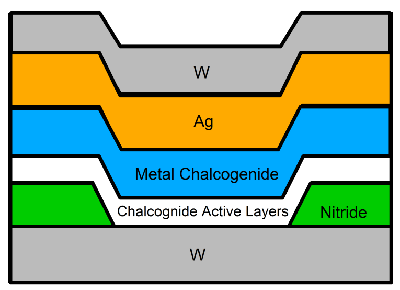
Cross section of the metal chalcogenide memristor. Source: Knowm.org

This new memristor is based on research done by [Dr. Kris Campbell] of Boise State University – the same researcher responsible for silver chalcogenide memristors we saw earlier this year. Like these earlier devices, the Knowm memristror is built using silver chalcogenide molecules. To lower the resistance of the memristor, a positive voltage ‘pulls’ silver ions into the metal chalcogenide layer. The silver ions stay in this chalcogenide layer until they are ‘pushed’ back with the application of a negative voltage. This gives the memristor it’s core functionality – being able to remember how much current has gone through it.

This technology is different from the first memristors made by HP in 2008, and has allowed Knowm to create functional memristors on silicon with a relatively high yield. Knowm is currently selling a ‘tier 3’ memristor part that only has two out of eight devices failing QC testing. A ‘tier 1’ part, with all eight memristors working, is available for $220 USD.

As for applications for this memristor, Knowm is using this technology in something they call Thermodynamic RAM, or kT-RAM. This is a small coprocessor that allows for faster machine learning than would be possible with a computer with a much more traditional architecture. This kT-RAM uses a binary tree layout with memristors serving as the links between nodes.

While it’s much too soon to say if a kT-RAM processor will be better or more efficient at performing machine learning tasks in real life, a machine learning coprocessor does have a faint echo of the machine learning silicon developed during the 80s AI renaissance. Thirty years ago, neural nets on a chip were created by a few companies around Boston, until someone realized these neural nets could be simulated on a desktop PC much more efficiently. The kT-RAM is somewhat novel and highly parallel, though, and with a new electronic component it could be just what is needed to push machine learning directly into silicon.

Continue reading “Building Memristors For Neural Nets”

Hack The Steam Controller?

[willrandship] sent in a conversation from Reddit discussing the programming ports inside the Steam controller and their potential for hacking. From the posts and the pictures it seems the radio/SoC and the MCU can be programmed on the board, or at least they both have JTAG headers. The JTAG headers are in the form of “Tag-Connect” pads on the board so it will require the dedicated cable or soldering some hardware to the board temporarily.

From the pictures we can see a NXP LPC11U37F ARM Cortex-M0 and a Nordic nRF51822 ARM Cortex-M0 SoC with integrated Bluetooth low energy. There are only a limited number of Steam Controllers in the wild at this time so we don’t expect much in the way of hacking them thus far. There is a Steam Controller hackaday.io project just started for anyone who would like to contribute to the Steam Controller hacking.

Continue reading “Hack The Steam Controller?”

Stellarator Is Germany’s Devilishly Complex Nuclear Fusion

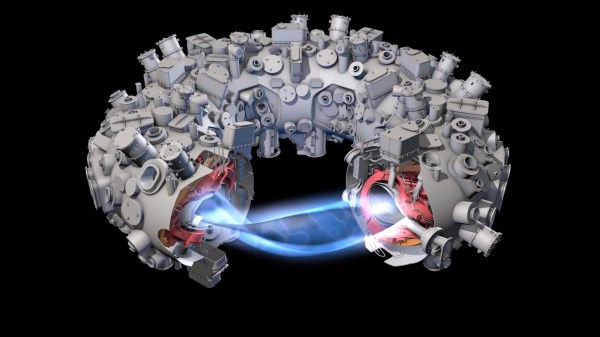
You may not have heard of a Stellarator before, but if all goes well later this month in a small university town in the far northeast of Germany, you will. That’s because the Wendelstein 7-X is finally going to be fired up. If it’s able to hold the heat of a fusion-capable plasma, it could be a huge breakthrough.

So what’s a stellarator? It’s a specific type of nuclear fusion containment geometry that, while devilishly complex to build and maintain, stands a chance at being the first fusion generator to achieve break-even, where the energy extracted from the fusion reaction is greater or equal to the energy used in creating the necessary hot plasma.

There’s an awesome video on the W7-X, and some of the theory behind the reactor just below the break.

Continue reading “Stellarator Is Germany’s Devilishly Complex Nuclear Fusion”

Lithium-Air Might Be The Better Battery

Researchers at Cambridge University demonstrated their latest version of what is being called the Lithium-Air battery. It can be more accurately referred to as a Lithium-Oxygen but Air sounds cooler.

The early estimates look pretty impressive with the energy density being 93% efficient which could be up to 10 times the energy density of Lithium-Ion and claims to be rechargeable up to 2,000 times.  Recent improvements toward Lithium-Air batteries include a graphene contact and using lithium hydroxide in place of lithium peroxide which increased both stability and efficiency.

Here’s the rub: Lithium-Air batteries are still years away from being ready for commercial use. There are still problems with the battery’s ability to charge and discharge (kind of a deal breaker if the battery won’t charge or discharge right?) There are still issues with safety, performance, efficiency, and the all too apparent need for pure oxygen.

Do batteries get you all charged up? Check out our coverage of MIT’s solid state battery research, or have a look at the Nissan Leaf and/or Tesla battery packs.

Thanks to [Jimmy] for the tip.

Who Said FORTRAN Is Dead?

NASA has an urgent need for a FORTRAN developer to support the Voyager spacecraft. Popular Mechanics interviewed Voyager program manager [Suzanne Dodd] who is looking to fill [Larry Zottarell’s] shoes when he retires.

We had a lot of people comment on my recent Hackaday article, “This Is Not Your Father’s FORTRAN”, who studied the language at some point. Maybe one of you would like to apply? You need to do so soon! NASA is hoping to give the new hire six to twelve months with [Zottarell] for on-the-job training. You’ll need to brush up on your vintage assembly language too.

light data system hwThe two Voyagers were some of the first NASA spacecraft to use computers. The resources are limited in the three 40 year-old computers found on each probe. They handle the spacecraft’s science and flight software. The software is a little more recent having been updated only 25 years ago in 1990.

A big problem is a lot of the engineering design materials are no longer in existence. People’s memories of the events and reasons for decisions made that long ago are bit hazy. But NASA does have an emergency list of those former engineers when questions arise. That means this could be more than just a job where you program for ancient hardware, you could find a lot of reasons to interact with the people who pioneered this field!

This will be an awesome hack. Anyone up to doing remote computing at a distance of 12 billion miles?

A video on the history of the two voyagers is found after the break.

Continue reading “Who Said FORTRAN Is Dead?”

Hyperloop Test Track To Be Built In California

Next year Hyperloop Transportation Technologies is planning on breaking ground on a five mile test track for the Hyperloop concept as originally proposed by [Elon Musk] back in 2013.

It’s being built around Quay Valley, which is a large real-estate development in California. In addition to serving as a test-bed for different pod designs and to further the technology as a whole, they’re planning on being able to transport passengers at mind-boggling speeds (how’s 760mph sound?) by as soon as 2018. While [Elon Musk] has no real involvement in the company, he is extremely supportive of the company and seeing his idea come to life — who wouldn’t? He once described the Hyperloop concept rather eloquently…

If the Concorde, a rail gun and an air-hockey table had a three-way, the Hyperloop would be the love child.

That’s certainly one love child we’d like to see. Oh and the cost? Apparently only $150 million. Seems about right.

[via Popular Science]

EFF Granted DMCA Exemption: Hacking Your Own Car Is Legal For Now

The Digital Millennium Copyright Act (DMCA) is a horrible piece of legislation that we’ve been living with for sixteen years now. In addition to establishing a de-facto copyright for the design of boat hulls (don’t get us started!), the DMCA includes a Section 1201 which criminalizes defeating encryption in cases where such could be used to break copyright law.

Originally intended to stop the rampant copying of music in the Napster era, it’s been abused to prevent users from re-filling their inkjet cartridges and to cover up rootkits. In short, it’s scope has vastly exceeded its original aims. And we take it personally, because we like to take stuff apart and see how it works.

EFF_LogoThe only bright light in this otherwise dark, dark tunnel is the possibility to petition for exemptions to Section 1201 for certain devices and purposes. Just a few days ago, the EFF won a slew of DMCA exemptions, including the contentious exemption for bypassing automobiles’ encryption to check out what’s going on in the car’s firmware. The obvious relevance of the ability for researchers to inspect cars’ firmware in light of the VW scandal may have helped overcome strong pushback from the car manufacturers and the EPA.

The other exemption that caught our eye was the renewal of protection for people who need to hack old video games to keep them playable, jailbreak phones so that you can run an operating system of your choosing on it, and even the right to copy content from a DVD for remixes and excerpts.

This is all good stuff, but it’s a little bit sad that the EFF has to beg every three years to enable us all to do something that wasn’t illegal until the DMCA was written. But don’t take my word for it, have a listen to Cory Doctorow’s much more eloquent rant.

(Banner image courtesy [Kristoffer Smith], who we covered on car hacking way back when.)