Thailand Residents Use Hacks To Make The Best Of A Horrible Situation

Thailand is dealing with horrible flooding right now. Despite the hardship, people still need to get around and go on with life so many have come up with clever hacks to make this disaster more manageable. [Jan] wrote in to let us know about this collection of flood-related hacks which he’s put together. They are wide-ranging, and many brought a smile to our faces, starting this the plastic-bag enclosed cars (not pictured).

We pulled out three of them to highlight above. On the top left is a canine life vest fashioned out of empty drinking bottles mounted on some type of harness. We hope the pets can stay out of the flood waters but this is a nice precaution. Speaking of precautions, the rubber-ducky to the right of that image is an electrical hazard detector. Float it in the water and an alarm and LED will go off if AC current is detected.  Finally, the image on the bottom shows a bridge constructed in front of a shopping center by turning carts on their backs and lining the pathway with wooden pallets.

There are several floating and amphibious vehicle hacks in the collection. So far we haven’t seen any drill-powered trolling motors though.


mykeepon-hacking

Reverse Engineering MyKeepon

[qDot] recently got his hands on a MyKeepon toy and after messing with it a bit, decided to tear it down to see what was inside. He had hopes of easily modding the toy, but like most adventures in hacking, things might take a while longer than he first imagined.

In his teardown you can see the various components that make up the MyKeepon, including a trio of motors for movement, along with a series of buttons and a microphone used to interact with the toy. Of course, the part that interested him the most was MyKeepon’s circuit board, since that’s where the real work would begin.

There, he discovered two main processor Padauk processor chips, described as “Field Programmable Processor Arrays” in their data sheets. He says that the brand is well known for lifting text verbatim from PIC data sheets, so he doesn’t have a ton of faith in what’s printed there. Sketchy documentation aside, he poked around on the I2C bus connecting the two chips and was able to sniff a bit of traffic. He is documenting his findings as he goes along, which you can see more of on his Github project site.

He has made a few simple modifications to the toy already, but there’s plenty more to do before he has complete control over it. His work is bound to make tons of MyKeepon fans happy, including our own [Caleb Kraft], whose love for the toy can be seen in the video below taken at last year’s CES.

Continue reading “Reverse Engineering MyKeepon”

A Tesla Coil That Delivers Shocking Candy

shocking-candy-tesla-coil

Even though Halloween was a week ago, we are still seeing plenty of cool stuff coming our way. Take for instance this Tesla coil that [JJ] sent us.

He got the idea to build a coil for his Halloween display about a week before the event, but he figured it would be easy enough to do since he had a lot of the parts on hand already. He originally started with some neon transformers and a primary/secondary pair he used in a previous Tesla coil build, but when things were fully assembled he wasn’t completely happy with the results.

He returned to the drawing board, winding a new primary/secondary coil pair, which performed much better. The rest of the coil was pieced together with random parts he procured at IKEA along with other items he had sitting around.

He donned a mad scientist’s outfit, and with a large set of grounded tongs acting as a Faraday cage he proceeded to electrocute trick or treaters’ candy with his Tesla coil, much to the delight of the neighborhood children.

Be sure to swing by his page to see more construction details, and for a sneak peek at the candy zapping process, check out the video below.

Continue reading “A Tesla Coil That Delivers Shocking Candy”

Hackaday Now Officially Has A G+ Page

There was a recent announcement that G+ opened the doors to businesses and organizations for g+ pages. This means we can have an official G+ page with google’s blessing. We’ve opened one up here. We plan on having “hangouts” from time to time so people can show off what they’ve done. Don’t worry if you’re not into the g+ thing. All stories will still be published here on the site. Maybe we can take a page from Adafruit’s book and record some online “show and tell” sessions to share with you guys.

Of course, sometimes it can be more fun to follow the writers individually, since we are more prone to post opinions and things that aren’t official hackaday info, you can find me,( Caleb Kraft ), pretty easily. For the others, you’ll have to search for their names. None of them are online right now so I can ask permission to link to them.

Announcing Our Next Theme: Kitchen Hacks

Here’s a theme that has the Hackaday staff quite excited; Kitchen hacks. This is a wide-ranging subject that can include anything having to do with food, food preparation, kitchen implements, and enhancements.

We’ve seen quite a few fantastic examples of this theme already. How about a kitchen island the mixes cocktails to order? Perhaps you’d prefer an AI that keeps track of your shopping list or just a computer kiosk that’s nicely integrated. Of course there’s already an iPod dock for that! You might be looking to supe up a pressure cooker, or add a Sous Vide machine to your culinary arsenal. We shouldn’t leave out the ability to ‘print’ images on toast.

Speaking of toast… we’re still waiting for someone to build a laser bread slicer that toasts as it goes. You get the point. Ladies and Gentleman, grab a computer, document your Kitchen hacks, and send them our way!

Weekly Roundup 11/5/11

In case you missed them the first time, here are this week’s most popular posts:

Our most popular post is about an octocopter that is big enough to hover a person who is perched perilously in the center of an angry array of blades that are counting on Murphy’s law for their chance to taste a little human blood.

Next up is a post about an interesting clock made out of Legos that uses a mechanism similar to the one inside of a combination lock to display the time.

In third place is a post about [Lizzie] and her ‘ball of dub’ that is hard to explain but interesting to listen to.

Next we have a post about how some Occupy Wall Street protesters are generating electricity despite having their generators confiscated. This one is about the hack folks, not the protest. Let’s try to keep the comments civil…

Finally, we have one about a new circuit board put out by the folks who brought us the Beagleboard. This one is called the Beaglebone and it is packing some serious firepower for just $89! We can’t wait to see what our readers come up with these puppies (pun intended)!

DIY Binary Alarm Clock Small Enough To Fit In Your Pocket

portable-binary-clock

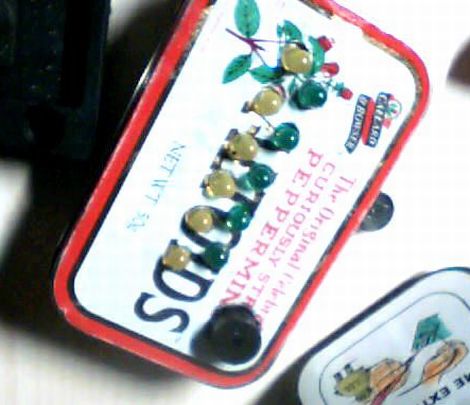
[linux-dude] always wanted to have a binary clock, but he didn’t want to pay someone else to make it for him. Additionally, he was looking for a compact alarm clock he could take on the road, rather than relying on the one in his hotel room.

Inspired by other binary clock projects he has seen over the years, he set off to build his own, which he wanted to fit inside an Altoids tin. His binary clock uses an Arduino Duemilanove (which fits perfectly in the tin) to keep time and control the indicator LEDs. The LEDs are arranged in two rows as you would expect, representing hours and minutes. A small piezo speaker serves as the alarm buzzer, which should be sufficient to wake up most people, though something bigger might be required for heavy sleepers.

We didn’t see any sort of battery pack or power plug mentioned, so we’re not quite sure how [linux-dude] keeps his clock juiced up. Additionally, the lack of an real time clock is something we’re puzzled by. While the Arduino does have a clock function that can be used, an RTC might serve him better – then again if he’s gone for just a day or two at a time, a small amount of drift may not be an issue.