Google’s Secret Perk? A Private Hackerspace

google_hackerspace

Working for Google has always had many perks, and most of them are pretty well known. Google employees enjoy free food, on-site workout facilities, and one free day a week to work on whatever they like – but you knew that already. One Google perk however, has been kept pretty quiet until just recently.

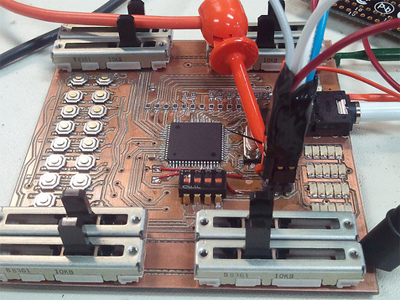
Google has provided a hackerspace on their campus for about four years now, which is open to any employee that meets some pretty strict requirements. A written test is given before an employee can access the facilities, and even then they must be deemed worthy of working on particular pieces of equipment.

The idea behind the hackerspace was to help Google stay rooted in the philosophy that, “all good things start in the garage”. While a lot of the employees embark on fun personal projects, several pieces of familiar Google technology were born in the workshop. For instance, the Google Streetview “trikes” were created there, along with a few smartphone prototypes, autonomous car components, and even some secret projects Google declines to speak about at the moment.

It’s an unbelievably cool job perk, and we would be lying if we said we weren’t jealous. For now, we will just have to be happy with stale coffee from the break room.

[via the Adafruit Blog]

[Image via AP]
The Silicon IC 50th Anniversary

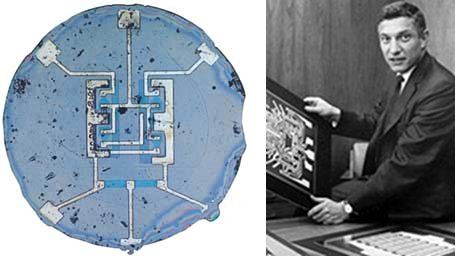
Today marks the 50th anniversary of the first silicon integrated circuit patent. We should not have to explain how important the integrated circuit to this crowd, but it is the biggest thing in electronics since sliced bread.

[Robert Noyce] received the landmark patent on April 25th 1961, and went on to found a little known company you might of heard of (along with [Gordon Moore]), Intel Corporation. He was not the first to invent the IC, that privilege goes to [Jack Kilby] of Texas Instruments, though that design was using a germanium wafer. Silicon has many advantages over previous technology and has become the main technology of IC’s even 50 years later fueling the electronics, computer and mobile industries.

Check out the little article above, and also be sure to check out this video on IC construction we posted about a few months ago from the other company [Robert Noyce] help co-found, Fairchild Semiconductor.

The LayerOne Hacking Conference Is Around The Corner

We just wanted to give a heads up to everyone to remind them that the annual layerOne hacking and security conference is coming up soon. They have announced their speaker line-up which includes talks on home monitoring, lockpicking, mobile malware and tons more. The event is located in Anaheim California on May 28-29.

They sent us sort of a press release with some information on the event and some details on the badge. You can read their email after the break.

Continue reading “The LayerOne Hacking Conference Is Around The Corner”

OSHW Logo Announced

The results are in and the new Open Hardware logo has been selected! After tallying nearly 9,000 votes it has been decided that “Golden Orb” by Macklin Chaffe will now represent the OSHW definition v1.0.

Rest assured that despite earlier controversy regarding a few users that had submitted a very large number of duplicate votes (over 3,100 in all), the results have been cleaned up and validated prior to announcing the winner.

If you agree with the definition you can now go ahead and use the logo on your creations! Some creative individuals at this Open Hardware Summit forum have made it easy for you with logos of varying sizes, colors, and fill – perfect for application on any background. Here you will also find vector-based versions and even an Eagle parts library for inclusion on your next board’s silkscreen!

[Jason] at MrDecals.com has also generously offered 3 free decals of the new logo to anyone who asks – just pay for shipping. Please note that this is not a paid advertisement, [Jason] received permission from opensourcehardware.org to run the promotion and $1 for US shipping seems very reasonable. We are guessing from the responses to previous giveaways that many HackaDay readers might be interested!

We personally love the way that the new logo keeps with the feel of the Open Source Intiative logo and can’t wait to see what hardware it starts showing up on!

Sony Ericsson Promotes Android Bootloader Unlocking

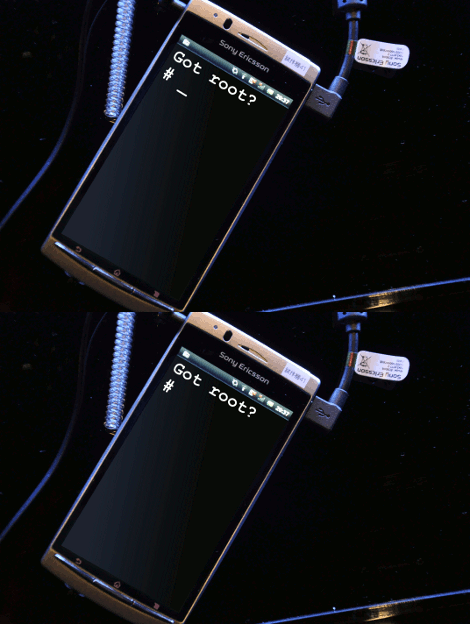
Sony Ericsson recently added a new section to their developer world portal called Unlocking the boot loader. They provide all the information and tools needed to root some of their newer Android phones.

Of course, this information comes from Sony Ericsson dripping with warnings, disclaimers and warranty-voiding rhetoric. Once you’ve waded through all of that, you’ll have to enter your phone’s IMEI number, your name and email address in order to get your phone’s unique bootloader unlock key. Here’s hoping they don’t use the form information to instantly void warranties.

Unlocking doesn’t come without consequences, but from UI tweaks and performance improvements to custom apps and tethering, there are probably more reasons to unlock your Android device than there are reasons to leave it alone. In an age where people are making a fuss about companies adding stumbling blocks for would-be jailbreakers, it’s good to see that at least one of them is doing what they can to help hackers take the plunge. Anyone want to clear up why Sony Ericsson feels like supporting hackers but Sony sues people for doing similar things on the ps3?

Thanks to [flip] | remixed image credit (cc by-sa 2.0): [taka@p.p.r.s]

Real-time GPS Tracker With Mobile Phone Uplink

[jayesh] wasn’t actually trying to solve any clever problems when we built his homebrew GPS tracker. He just had the hacker mentality and wanted to build something fun and useful while geeking out with electronics and software.

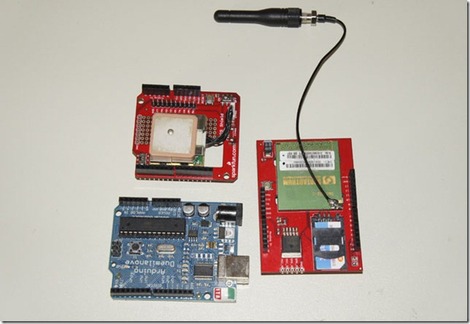
On the hardware side, he started with an Arduino, then added a GPS module for location detection and a GMS/GPRS module for the data uplink to his server over AT&T’s network. The Arduino uses several libraries and plenty of custom code. On the server, he worked up some wizardry with open-source packages and the Google Maps API. All of the source code and hardware details are well-documented. Put together, it’s a GPS tracker that can update a map in real-time. Sure, there are commercial products that do roughly the same thing, but where’s the fun in that? The principles here can also be put to good use in other microcontroller-based projects.

According To Pete – New Online Video Series

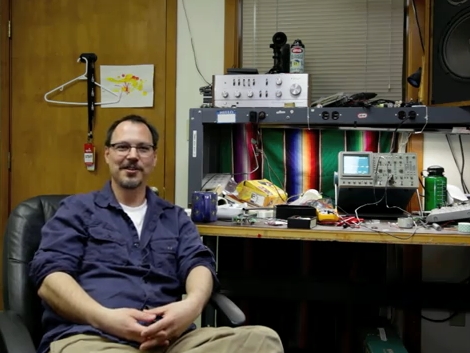
This is [Pete Dokter], the fourth employee that Sparkfun ever had and currently Director of Engineering there. As you can see, they’re not letting [Peter] come out of his hole. Instead of designing new breakout boards they’ve given him a camera that he’ll be using to record his occasional pontifications. ‘According to Pete’ will become a regularly occuring online show where he answers questions from around the Internets. We’ll admit that the first episode, embedded after the break, is a bit content thin – serving only as an introduction. But we think [Pete] has a pleasant manner and we look forward to what blossoms out of this modest beginning.

We’ve long been fans of engineering-oriented online shows such as [Dave Jones’] EEVBlog, [Bill Hammack’s] The Engineer Guy, A collaboration between [Chris Gammell, Dave Jones, and Jeff Keyzer] call The Amp Hour, [Jeri Ellsworth’s] A-Z Videos and her upcoming series, [Ben Heck’s] The Ben Heck Show…. and we could go on.

With offerings like these you don’t need to wait for traditional TV to transition to IP delivery. Just stop watching crap and start watching these interesting shows.

Continue reading “According To Pete – New Online Video Series”