How Did The Nintendo Virtual Boy Work?

What do you know about the Nintendo Virtual Boy? Everybody knows that it was the console giant’s mid-90s foray into 3D graphics and VR, and that it was a commercial flop. Sickness and headache-inducing graphics are probably first to mind, and that’s it. But since most of us will never have handled one in real life, all we have on this legendary console is this Received Opinion. What was it Really like? [Rodrigo Copetti] has put up a detailed technical examination, and it reveals a machine well ahead of its time in more than just the market it was trying to create.

The first surprise is that this machine eschews the expected LCD screens that were the norm on handheld consoles of the day, instead using a persistence-of-vision display with a single vertical bar of LEDs facing a vibrating mirror through a lens system. He goes into significant detail on how this system worked, and in doing so gives us a new respect for the console.

The meat of this article lies though in a detailed look at the console’s architecture. The NEC V810 CPU was significantly more powerful than those in other portable consoles of the day, and we get a peek of how it and the custom silicon handled the graphics. The GPU had dual framebuffers for each display to ensure each frame could be delivered smoothly while the next one was being created.

Everything that can be said about the Virtual Boy in the marketplace has been done to death, leading to the received opinion we mentioned at the start of the article. This write-up provides new information on one of Nintendo’s rarer machines and casts it in an entirely new light.

There have been understandably few Virtual Boy projects that have made it to these pages. One that has, was a VGA interface for the console.

Via Hacker News.

Cosmic Ray Flips Bit, Assists Mario 64 Speedrunner

We’ve all heard about cosmic rays flipping bits here and there, but by and large, it occurs rarely enough that we don’t worry too much about it on a day-to-day basis. However, it seems just such a ray happened to flip a crucial bit that assisted a speedrunner in the middle of a competition.

The flip happened to [DOTA_Teabag], who suddenly found Mario flying upward to a higher part of a level, completely unexpectedly. Testing by [pannenkoek12] seems to indicate that this may have been due to a single-bit change to Mario’s height value, from C5837800 to C4837800, leading to the plucky Italian plumber warping upwards through the level. The leading theory is that this bit flip was caused by a cosmic ray event, though the likelihood of such an event is exceedingly rare.

It’s possible that there remains another cause for the flip, though after much work from the community replicating the situation in emulation, none has been found. Other suggestions involve electrical noise or other malfunctions causing the flip, though one would rarely expect such an occurrence to change just one bit of RAM. For now, the jury remains out, but who knows – maybe in the future we’ll find out it was a hidden, undiscovered exploit all along. Of course, if Nintendo doesn’t get you going, try speedrunning Windows 95.  Video after the break.

Continue reading “Cosmic Ray Flips Bit, Assists Mario 64 Speedrunner”

Android 10 Ported To The Nintendo Switch

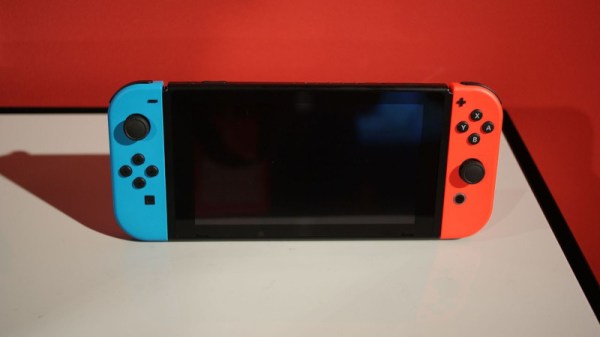
Nintendo’s Switch is perhaps most famous for blurring the lines between handheld consoles and those you plug into a TV. However, the tablet-esque device can also run Android if you’re so inclined, and it recently got an upgrade to version 10.

It’s an upgrade that brings many new features to the table, most of which you might consider must haves for regular use. The newer port brings support for USB Power Delivery, as well as deep sleep modes that enable the unit’s battery to last for several weeks. There’s also support for over-the-air updates which should ease ongoing maintenance, and improvements for Bluetooth compatibility and the touch screen as well.

Like most console hacks to run custom code, you’ve got to have the right hardware version with the right firmware, as Nintendo have been regularly iterating to try and lock out hacks where possible. The install has a few hurdles to jump through, but nothing too strenuous that would scare away the average Hackaday reader. Just be sure to not attempt this on a cherished console, as there’s always the chance that it all ends in tears. If you pull it off, you can then go about turning your Nintendo Switch into a networking switch. Net…tendo… Switch? Come up with a better pun in the comments. Continue reading “Android 10 Ported To The Nintendo Switch”

This Joy-Con Grip Steers Its Way To Sweaty Victory

Here at Hackaday we’re always exited to see hacks that recycle our favorite childhood consoles into something new and interesting. In that context, it’s not so uncommon to see mods which combine new and unusual control methods with old devices in ways that their manufacturers never intended. What [Mike Choi] has built with the Labo Fit Adventure Kit is the rare hack that combines radically new control schemes with a modern console: without actually modifying any hardware.

Face button pusher in blue

In short, the Labo Fit Adventure Kit lets the player play Mario Kart on the Nintendo Switch by riding a stationary exercise bike, steering with a wheel, and squeezing that wheel to use items. The Fit Kit combines the theme of Labo, Nintendo’s excellent cardboard building kit for the Nintendo Switch with the existing Ring-Con accessory for the unrelated Nintendo game Ring Fit Adventure plus a collection of custom hardware to tie it all together. That hardware senses cadence on the stationary bike, watches for the user to squeeze the handheld wheel controller, and translates those inputs to button presses on the controller to play the game.

Shoulder button pusher in green

The most fascinating element of this project is the TAPBO module which adapts the Joy-Con controller to remote input. The module includes electronics, actuators, and a clever mechanical design to allow it to be mounted to the Ring-Con in place of an unmodified Joy-Con. Electrically the components will be familiar to regular Hackaday readers; there is a breakout board for a Teensy which also holds an XBee module to receive inputs remotely and drive a pair of servos. The entire module is described in detail starting at 4:42 in the video.

Mechanically the TAPBO relies on a pair of cam-actuated arms which translate rotational servo motion into linear action to press shoulder or face buttons. The module directly measures flex of the Ring-Con with an added flexible resistor and receives cadence information from another module embedded in the stationary bike via Zigbee. When these inputs exceed set thresholds they drive the servos to press the appropriate controller buttons to accelerate or use an item.

We’ve focused pretty heavily on the technical aspects of this project, but this significantly undersells the level of polish and easy to understand documentation [Mike] has produced. It includes a TAPBO Amiibo in customized packaging, and more. Check out the full video to get the complete scope of this project.

Continue reading “This Joy-Con Grip Steers Its Way To Sweaty Victory”

Super Mario Original Sound Tracks Get High Quality Remaster Thanks To Gigaleak

2020 saw many gigabytes of internal Nintendo data leaked on the broader internet. Known as the “Gigaleak”, it contained source codes and assets from many games. Using data from this leak, a group of enthusiasts has put together high-quality renditions of the SNES Super Mario World Original Sound Tracks (OST).

The work was made possible when source code from the Gameboy Advance remake of Super Mario World was found in the leaked data. The source code included the names of the samples, which were the same as were used in the original SNES game. This allowed the team to find the original samples amongst the gigabytes of leaked files.

We wondered what would be done with all that code, speculating that it would be a poison pill for the emulator scene. This type of hack wasn’t even on our radar and we’re delighted to see the project come to light. The reproduced songs have an altogether different quality than the original SNES soundtrack. This is largely due to the samples not having to be compressed or cut down to fit on a cartridge and work with the console’s sound chip. Other variances in the sound also come from the fact that unlike in the game, the samples in these renditions don’t match the play lengths in the original game.

Regardless of the changes, it’s interesting to hear a more full, rounded sound of these classic video game tunes. It reminds us somewhat of the later CD console era, when sound designers were able to break free of the limitations of earlier hardware. Of course, we still bow at the alter of chiptune, though — and this MIDI Gameboy mod is a great place to start if you’re curious. Video after the break.

Continue reading “Super Mario Original Sound Tracks Get High Quality Remaster Thanks To Gigaleak”

Your NES Classic Mini Controller, On Your Desktop Computer

The NES Classic Mini was one of the earlier releases in what became a wider trend for tiny versions of classic retro consoles to be released. Everybody wanted one but numbers were limited, so only the lucky few gained this chance to relive their childhood through the medium of Donkey Kong or Mario Brothers on real Nintendo hardware. Evidently [Albert Gonzalez] was one of them, because he’s produced a USB adapter for the Mini controller to allow it to be used as a PC peripheral.

On the small protoboard is the Nintendo connector at one end, an ATtiny85 microcontroller, and a micro-USB connector at the other. The I2C interface from the controller is mapped to USB on the ATtiny through the magic of the V-USB library, appearing to the latter as a generic gamepad. It’s thought that the same interface is likely to also work with the later SNES Classic Mini controller. For the curious all the code and other resources can be found in a GitHub repository, so should you have been lucky enough to lay your hands on a NES Classic Mini then you too can join the PC fun.

The mini consoles were popular, but didn’t excite our community as much as could be expected. Our colleague Lewin Day tool a look at the phenomenon last summer.

Game Boy Replica Built In Brass

Nintendo’s Game Boy is legendary for being the meat in the handheld gaming revolution, as well as being nigh-on indestructible whether in the custody of children or soldiers in the Gulf War. However, [Jiri] decided to see if he could whip up a tribute of his own, in brass instead of plastic.

The hardware is based on the Odroid GO emulator firmware for the ESP32, running on a 2.2″ color TFT screen. It’s a great base for a custom build, which avoids gutting any precious classic hardware. It’s then assembled behind front plate milled out of brass, with delicate point-to-point brass wires giving it an artistic circuit sculpture look. The brass did prove difficult to work with at times, acting as a heat sink which prevented easy soldering of the standoffs in place. To get around this, [Jiri] used a hotplate to heat the plate from below, keeping it warm enough so that a hand iron could do the job.

The final result is a fun Game Boy emulator in a stylish case – though one you shouldn’t throw in a back pack lest it short out the exposed conductors. It would make a great gift for any lifelong Nintendo fan. [Jiri] is no strange to circuit sculpture, as we well know – we’ve featured his tools and methods before. Video after the break.

Continue reading “Game Boy Replica Built In Brass”