Midi Gloves

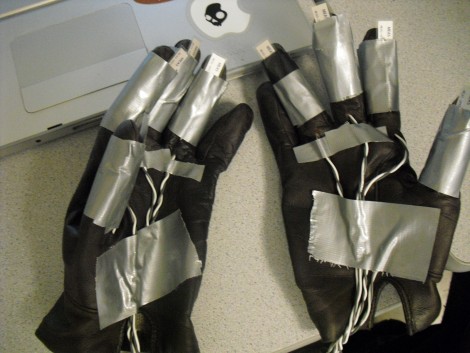
We’re being inundated with glove-based peripheral hacks. This is another final project from Cornell, keyboard out of the equation by adding 8 piezo sensors to a pair of gloves thereby shunning the pinky finger. We like this one because it’s easy to build and the midi interface implementation is well documented if you want to build your own.

As you can see after the break, this is easy to use with music software like Garage Band because it is a standard MIDI device. In addition, a MATLAB interface allows for custom mapping in case you want to change what each finger does.

We remember our first introduction to glove-based performances with Tod Machover’s Bug Mudra many years ago. We hope the music input hacks we’re seeing will lead to a whole new generation of music innovators.
Continue reading “Midi Gloves”

More Glove-based Interfaces

You may remember seeing the golf glove air guitar hack last month. Here’s two more uses for gloves with sensors on them.

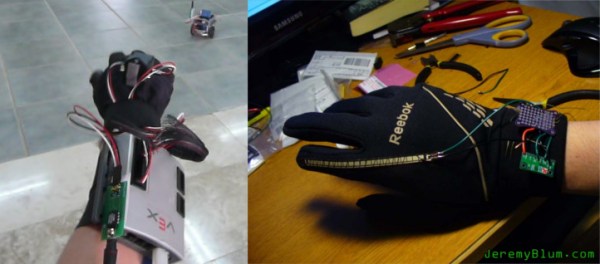
On the left is a glove interface with flex sensors on each digit as well as an accelerometer. The VEX module reads the sensors to detect sign language as a command set. A shake of the hand is picked up by an accelerometer to delineate between different command sets. See it controlling a little robot after the break. This comes from [Amnon Demri] who was also involved in the EMG prosthesis.

Straight out of Cornell we have the SudoGlove, seen on the right. [Jeremy Blum] and his fellow engineering students bring together a mess of different sensors, sourcing an Arduino and a XBee module to control a small RC car with added lights and a siren. There’s embedded video after the break. You may want to jump past the music video for the description that starts at about 3:52.

Continue reading “More Glove-based Interfaces”

FPS Controller Hacks Getting Easier

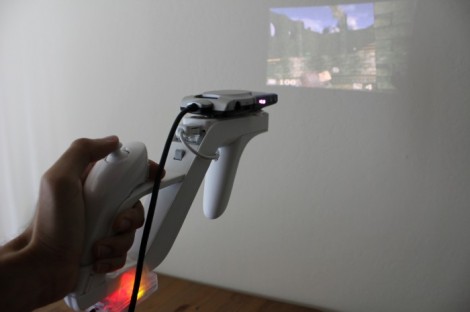
It used to be a major production to build a gun-form-factor FPS controller but commercial tech has adopted many of those traditional hacks over the years. Now, [Nirav Patel] is playing Cube with a Wii zapper and a SpacePoint. All that was really required to make this happen is a patch to Cube, the open source FPS.

[Nirav] has plans to make this controller wireless using a BeagleBoard. We’re wondering if there’s support for using the Wii motion plus? We’ve seen motion plus Arduino connectivity, as well as direct PC connectivity. The Wii remote already connects to Linux, what about pulling that data down from the Bluetooth connection? If you’ve done this, send us a tip about it.

Making A Bluetooth SNES Controller

[youtube=http://www.youtube.com/watch?v=OP8JgqmVES8&]

[MODDEDbyBACTERIA] has posted this instructible on how to make a bluetooth SNES controller. The bulk of the parts come from a bluetooth MSI game pad, so this isn’t a scratch build, but the amount of modifications required definitely qualify this as a hack. We were quite surprised that he managed to stuff all of that back into the case as well as he did. Great job.

Reuse That PDA As A WRT Terminal

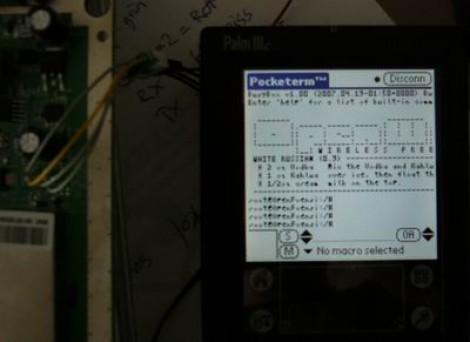
[Michu] used his old Palm IIIc to make a serial interface for his OpenWRT router. It’s a matter of cracking open both the router and the Palm device, then connecting the TTL lines from the router to the MAX 3386e level converter chip inside the Palm. From there, Pocketterm can connect to the router’s serial terminal.

A lot of us have old electronics lying around that work perfectly well. It’s nice to find hacks that make them useful again.

[Thanks Isama]

Custom Headphones Solve Wire Tangles

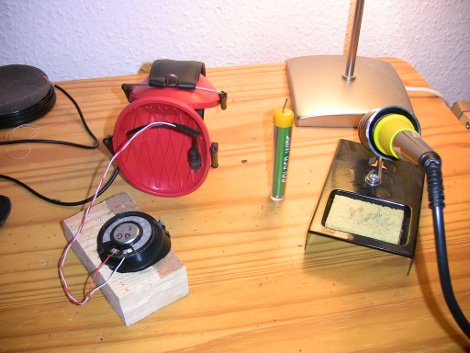
One complaint we hear about often is ear-bud’s cables getting tangled within backpacks. [Andrew] was having this “spaghetti” wire problem, and also wanted to listen to his music with ear protection on – where ear-buds are usually uncomfortable. The latter problem is fixed by placing speakers inside of folding ear protectors, and the cable is managed with a 3.5mm disconnect.

For those who can’t make disconnect-able headphones but still suffer from tangled headphone wire, we recommend proper wrapping technique for your wire, and a small carrying pouch. With the combination of the two, we’ve never had a tangled cable.

USB VU-meter

[youtube http://www.youtube.com/watch?v=jsg24MGNpRc&feature=player_embedded%5D

WaitingForFriday’s [Simon Inns] is quite possibly the USB interface and PIC master. This week he let us know about his VU-meter repurposed as a computer performance monitor using a PIC18F2550 and his open source USB Generic HID communication class. With PWM the meter’s needles and RGB LED can be accurately set and even dampened for CPU usage, network usage, HDD utilization, and even memory usage. Oddly enough, in his software we didn’t find the ability to use the device as a VU-meter – go figure.