27 MHz Transmitter/receiver Pair Made With 555 Timers

Get your feet wet with radio frequency transmitters and receivers by working your way through this pair of tutorials. [Chris] built the hardware around a couple of 555 timers so you don’t need to worry about any microcontroller programming. He started by building the transmitter and finished by constructing a receiver.

Apparently the 27 MHz band is okay to work with in most countries as long as your hardware stays below a certain power threshold. The carrier frequency is generated by the transmitter with the help of a 27.145 MHz crystal. The signal is picked up by the receiver which uses a hand-wrapped inductor made using an AL=25 Toroid Core. We’d say these are the parts that will be the hardest to find without putting in an order from a distributor. But the rest of the build just uses a couple 555 timer chips and passive components, all of which will be easy to find. The video after the break shows the project used to receive a Morse-code-style message entered with a push button. It would be fun to interface this with your microcontroller of choice and implement your own one-way error correction scheme.

Still More Software Defined Radio Fun On The Mac

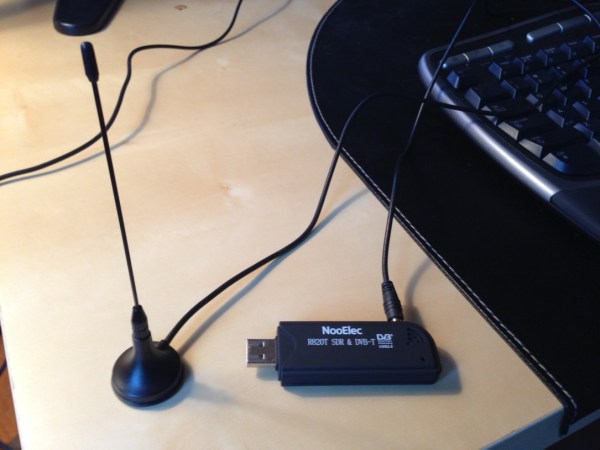
Even though the world of software defined radio started out as a Linux-only endeavor, several recent software releases have put the ball fully into the court of OS X users. [hpux735]’s new Cocoa Radio release provides a (nearly) fully functional software defined radio for anyone with a USB TV tuner and a mac.

Earlier this week, we saw (and tested)  [Elias]‘ port of gqrx and were reasonably impressed. [hpux735]’s app does the same job and also provides the source so you can compile it yourself.

Previously, [hpux735] ported the osmocom driver for these RTL2832U-based USB TV tuner dongles to the Mac and wrote a small Cocoa driver. The new Cocoa Radio software uses this driver and adds all the features you’d expect from a software radio package; in the title pic for this post, you can see a top 40 radio station near my house and their insipid hatred of dynamic range.

[hpux735] posted a few videos of his development process. You can check those out after the break.

Continue reading “Still More Software Defined Radio Fun On The Mac”

OS X Port Of Gqrx Is The Easiest Way To Get Into Software Defined Radio

Many have tried to put together an easy package for running software defined radio packages on the Mac. Not many have succeeded the way [Elias]’ port of the gqrx SDR package has. It’s simply the easiest way to get a software defined radio up and running on the mac.

gqrx is a front end for the very popular GNU Radio software defined radio toolkit. Originally designed for the FUNcube SDR dongle, gqrx can also be made to work with one of the many, many USB TV tuners that have come out of China this past year for use as a software radio.

[Elias]’ port of gqrx isn’t the first app to put software defined radio on the Mac, but it certainly is the easiest. Simply by downloading [Elias] disk image, plugging in a TV tuner dongle, and starting the app, I was able to have a software radio receiver on my MacBook Air in less than a minute.

Everything required by GNU Radio and gqrx is already included, making this the easiest way to get SDR on a Mac. Very awesome work from [Elias], and we thank him.

Communicating With A Beam Of Light

Last weekend, ARRL, the national association of amateur radio, held a contest called, “10 GHz and up” with the goal of communicating via radio or microwaves over long distances. [KA7OEI] and a few friends decided to capitalize on the “and up” portion of the ’10 GHz and up” contest by setting up a full-duplex voice link over a distance of 95 miles. They used the 478 THz band, also known as red LEDs and laser pointers.

With [Ka7OEI]’s friends [Ron] and [Elaine] perched atop a 5700 foot-high mountain near Park City, Utah, [Gordon], [Gary] and [KA7OEI] trudged up a hill about 10 miles north of Salt Lake City. With the help of a pair of 500,000 candlepower spotlights, the two teams found each other and began pointing increasingly higher power LEDs at each other.

The teams started off with 3 Watt red LEDs before moving up to 30 Watt LEDs and a photodetector at each end. Even though the teams weren’t working with a true line-of-sight – refraction of the atmosphere allowed them to transmit this far – they were able to transmit tone-modulated Morse and even full-duplex voice.

Not bad for a transmission that bends the FCC’s “275 GHz and up” amateur band to its breaking point.

Remote Control Does Everything

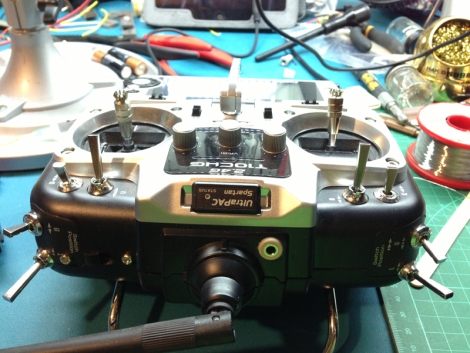
After a year of development, the OSRC is ready to hit a manufacturing plant. This transmitter (and receiver) for remote control cars, airplanes, quadcopters, and semi-autonomous drones features modular everything and allows you to transmit video from the cockpit and display it on a screen in the palm of your hands.

This isn’t the first time we’ve posted something on the OSRC, but since then [Demetris], the team lead has released a ton of information on the capabilities of the OSRC main unit, the clip-on FPV display, and the receiver and transmitter modules made to operate with the OSRC.

Unfortunately, [Demetris] spent a good deal of money developing the OSRC and is now doing a pseudo-kickstarter, ostensibly to gauge interest and allay a bank’s fears when applying for a small business loan. If all goes as planned, the OSRC base unit should cost somewhere around €300, a significant sum, but really not that bad considering the OSRC simply does more than other high-end RC transmitters.

We’re hoping enough people will step up and promise to buy the OSRC after it goes into manufacturing, otherwise we’ll be waiting a few more years before the big names in the RC transmitter game manage to come out with a similar product.

Teensy Board Used As An AM Radio Transmitter

[Angus McInnes] has been working on AM radio transmission techniques. He tried out a method of using a VGA port for the task but found the vertical blanking was audible. His latest experiments use a Teensy microcontroller board as an AM transmitter.

This is not a standalone solution, but rather a hardware extension for his laptop. This is because the microprocessor doesn’t have enough cycles to do much more than read bytes over USB and push their bits out one of the I/O pins.

To get a steady stream of data he’s using isochronous mode to push a steady data stream via the USB connection. Bulk transfer is another option but [Angus] found that it caused some jitter in the audio. Each byte is fed to the AVR SPI hardware once every eight clock cycles. His transmission can be picked up from across the room, but that’s the limit since the AVR doesn’t put out that strong of a signal. But it should be a rather trivial exercise to build a simple amplifier.

More Small Radio Modules For Your Wireless Needs

In the never-ending pursuit of cheap wireless communication for your microcontroller projects, [kiu] came up with a small board that allows for serial communication via a 433MHz radio link.

[kiu]’s transceiver uses an RFM12 wireless module available online for just a few dollars. Alongside this module is an ATMega8 and a USB to serial FTDI chip. When [kiu] plugs this board into his computer, he’s able to run a terminal, connect to this board, and receive and transmit hex values at 115,200 bps from another one of these boards.

According to [kiu]’s BOM, 10 boards only cost him 180 Euros, or about $225 USD. Considering off-the-shelf solutions such as an XBee could easily cost twice as much, we’re thinking [kiu] did a very nice job here.

[kiu] put all the board files, schematics, and code up on his GitHub, ready for your perusal. A very cool build, and very useful for a high altitude balloon, rocket, or wireless sensor build.