Retro-radio: Building On Another WiFi Radio Hack

[Jay Collett] likes listening to Internet radio stations and decided to build his own standalone hardware that lets him listen without being at his computer. But he wasn’t starting from square one on this project. [Jay] built on the epic instruction set that [Mighty Ohm] published when he first built his own WiFi radio.

Both of these radios used the same method of getting onto the internet; a hacked router. We kind of like this because it means you should be able to use the radio as a bridge for wired Ethernet devices. But we digress. [Jay] departs from the instructions by using an Arduino and its IDE to interface an LCD screen with a different line/column orientation than the original, and to implement a different control scheme. This makes the project a bit more approachable if you prefer not to roll your own electronics.

Take a look at the video after the break. The router takes quite a while to boot, but once it does it seems that the controls are both intuitive and responsive.

Continue reading “Retro-radio: Building On Another WiFi Radio Hack”

2005 Subaru Aux-in Hacking

2005_subaru_outback_aux_in

The CD player in [mukmuk’s] 2005 Subaru Outback gave up the ghost, and faced with a long road trip ahead of him, he was desperate to find a way to listen to something other than static-filled radio. He considered a 3rd party auxiliary input solution, but after seeing a similar aux-in hack here, he figured he could give it a go himself.

The stereo head unit design was changed between the 2004 and 2005 model years, so while he had a good idea of what to look for, he had to find the proper components on his own. Once he identified the radio module, he was able to locate the left an right input pins through trial and error. He carefully soldered a 3.5” audio jack to the head unit’s input lines, wiring it to cut off the audio signal from the radio whenever his Zune was plugged in.

Everything was reassembled, and the input jack was inconspicuously mounted in a cubby hole just above the stereo. [mukmuk] is quite happy with his modification, and we’re guessing his road trip was far more pleasurable as a result of his work.

A Suitcase For All Your Wardriving Needs

[Corrosion] sent in a tip about the Weaponised Auditing Response System he built inside a suitcase that, “has all the tools (and then some) for a wireless assault”.

The WARS is equipped with two WiFi adapters and two bluetooth adapters for all the wardriving and bluejacking anyone could ever want. [Corrosion] also included a 4 channel, 2.4GHz video scanner for warviewing. Everything runs off of a 12 inch netbook that will eventually run linux, and we’re really liking the 1970s suitcase aesthetic the WARS has – it looks like [Corrosion] is about to step into the set of a Beastie Boys video.

We were wondering about including a long range RFID sniffing antenna (PDF warning) behind the monitor of the suitcase’s monitor and asked [Corrosion] about it. He said it sounded doable, but is out of funds at the moment, so if you know how to build a cheap RFID antenna with a 50 foot range, drop [Corrosion] a line.

There’s a video demo with some stills of the build included after the break.

Continue reading “A Suitcase For All Your Wardriving Needs”

Experimenting With A Permeability Tuned Oscillator

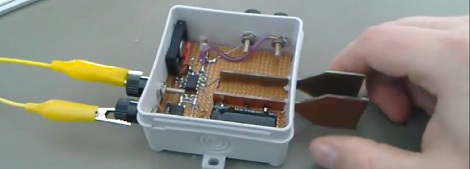
[Scott Harden] has been working through a design for a variable inductor to use as a PTO, or permeability tuned oscillator. What you see above is the most recent fruit of these efforts. The variable inductor is made up of the green coil of wire with a threaded bolt in the core. Turning that bolt moves the tip in or out of the coil, affecting its inductance.

Traditionally, tuning RF oscillator circuits has been a function of an adjustable capacitor. But capacitance is only part of the circuit, with inductance being the other important portion. Since variable capacitors that are capable of affecting a large change on the frequency of a circuit can be quite expensive he set out to find another way. This is what prompted the development of his first PTO project.

[Scott] produced a demo video of the hardware seen above which we’ve embedded after the break.

Continue reading “Experimenting With A Permeability Tuned Oscillator”

Radio Packets…from Spaaaace!

space_radio

[Bill Meara] was watching the International Space Station and the Shuttle Discovery pass overhead a few weeks ago, which rekindled an interest he gave up long ago – sending and receiving radio packets from space.

Years ago, he used to send APRS packets into space with a small rig powered by a 286 computer and HandiTalkie. These packets would drift off into space most of the time, but occasionally they would bounce back to Earth whenever the space station or PC Sat would fly by. The packets were often captured by other ham operators across the globe, who happened to be tuned to 145.825 MHz.

His interest renewed, he dug out his old HandieTalkie and Kantronics Terminal Node, aiming them towards the sky via an antenna situated in his back yard. When he returned 10 hours later, he found that he had collected all sorts of “space packets” from across the globe.

While not exactly a hack, it is definitely a neat exercise in ham radio operation. We can imagine slinging data packets off the space station would be an exciting experience for any budding operator (and OMs as well!)

Aux-in Hacking An ’04 Subaru Radio

[Jordan] writes in to show us his hacked up car stereo. [Jordan]’s 2004 Subaru, like many of our cars, does not offer any kind of auxiliary input, and aux-in/mp3 adapters tend to run on the not so cheap side of the price scale. Even a replacement head unit was too rich for his blood. So it was time to wire something to the old head unit.

On inspecting the radio’s PCB [Jordan] managed to locate the traces that carry audio from the FM receiver to the stereo’s amplifier.  Most aux input hacks we have seen involve fooling the stereo into thinking some media is inserted, even if interfacing with the audio lines on the PCB. These require that the tape/CD functionality be altered, perhaps permanently. Even worse you may have to shlep around a blank CDR with a bunch of tracks on it! All just to fool the stereo into enabling audio output.

Instead [Jordan] targets the audio lines from the FM stereo, since radio is always enabled when active. Once the audio traces are located they are severed  and bypassed with a 1/8″ stereo plug. This setup allows the FM audio signal to pass through the connector when disconnected, and cuts off any radio audio once your mp3 player is. We have seen this same method used on a vintage stereo hack as well. Nice work!

Simple FM Transmitter That Shows Off Its Own Circuitry

[Sean Michael Ragan] built this FM transmitter which shows off its circuitry via a clear plastic dome. The device is electrically identical to one we looked at in September. That version championed a construction method that used small squares of copper clad as solder points which were each super-glued to a large copper-clad platform serving as a ground plane. [Sean] is using a printed circuit board that was laid out by Sonodrome. You can check out their own glass-jar transmitter build where the board artwork is available for download.

One of the tips we enjoyed from [Sean’s] step-by-step build is the coil wrapping. He used the threads of a 1/4-20 bolt to guide copper wire as he wrapped a total of four turns. Once the bending is done, just unthread the bolt to separate it from the coil and gently stretch the wire for a 12mm distance between the two leads. Not only is this visually pleasing, but it will help with transmission clarity.