Mon Dieu! French Parent Kills Cell Service For An Entire Town To Stop Kids Surfing

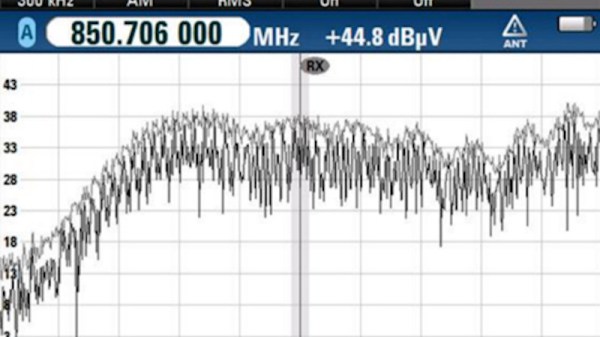
It used to be that having technical skills meant that fixing the computer problems of elderly relatives was a regular occurrence. Over the last few years this has been joined by another request on our time; friends with teenage children requesting help configuring their routers such that Internet access is curtailed when the kids should sleeping. In France a desperate parent took more extreme measures, buying a wideband frequency jammer to ensure les petits anges can’t waste the night away on social media sites through their cellular connections. It had the intended effect, but sadly it also interrupted cellular coverage over a wide area The French spectrum regulator ANFR sent in their investigators (French, Google Translate link), and now the unfortunate parent faces the prospect of up to 6 months imprisonment and €30,000 fine for owning and using a device that’s illegal in France.

A cursory search of everybody’s favourite online electronics bazaars will find plenty of these devices, so perhaps what’s surprising is that we don’t see more of these devices even if it’s not the first tale of interference tracking that we’ve seen. Judging by the strategies our friends with kids take, we’d suggest meanwhile to the unfortunate French person, that they simply equip their kids with restricted data plans.

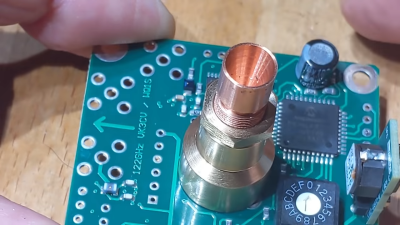
Machining Waveguides For 122 GHz Operation Is Delicate Work

Millimeter-wave Radars used in modern cars for cruise control and collision avoidance are usually designed to work at ranges on the order of 100 meters or so. With some engineering nous, however, experimenters have gotten these devices sending signals over ranges of up to 60 km in some tests. [Machining and Microwaves] decided to see if he could push the boat out even further, and set out machining some waveguide combiner cavities so he could use the radar chips with some very high-performance antennas.

Precision-machined components are required to successfully use these 122 GHz components for long-range transmissions.

The end goal of the project is to produce a 53 dBi antenna for the 122GHz signal put out by the mmWave radar chips commonly found in automotive applications. Working at this frequency requires getting tolerances just so in order to create an antenna that performs well.

Plenty of fine lathe work and cheerful machining banter later, and the precision waveguide is done. It may not look like much to the untrained eye, but much careful design and machining went on to make it both easy to attach to the radar and parabolic antenna system, and to make it perform at a high enough level to hopefully break records set by other enterprising radio experimenters. If that wasn’t all hard enough, though, the final job involved making 24 of these things!

There aren’t a whole lot of microwave antenna-specific machining channels on YouTube, so if you’ve been thirsty for that kind of content, this video is very much for you. If you’re more interested in antennas for lower frequencies, though, you might find some of our other stories to your liking. Video after the break.

Continue reading “Machining Waveguides For 122 GHz Operation Is Delicate Work”

Ask Hackaday: What’s Going On With Mazdas In Seattle?

What hacker doesn’t love a puzzle? We have a doozy for you. According to KUOW — the NPR affiliate in Seattle — they have been getting an unusual complaint. Apparently, if you drive a Mazda made in 2016 and you tune to KUOW, your radio gets stuck on their frequency, 94.9 MHz, and you can’t change it.

According to a post from the radio station, it doesn’t just affect the FM radio. A listener named Smith reported:

“I tried rebooting it because I’ve done that in the past and nothing happened,” Smith said, “I realized I could hear NPR, but I can’t change the station, can’t use the navigation, can’t use the Bluetooth.”

Continue reading “Ask Hackaday: What’s Going On With Mazdas In Seattle?”

Mystery WWII Navy Gear With Magic Eye

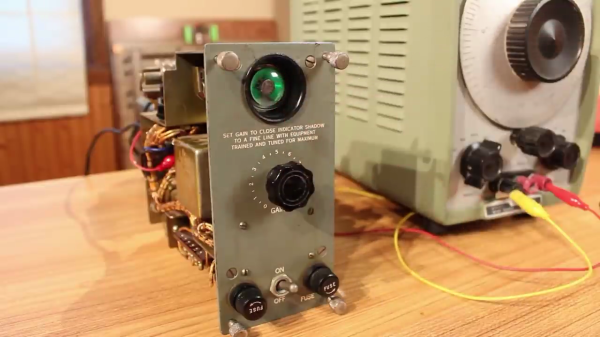
There’s an unknown piece of military electronic gear being investigated over on [Usagi Electric]’s YouTube channel (see video below the break). The few markings and labels on the box aren’t terribly helpful, but along with the construction and parts, seem to identify it as relating to the US Navy from the WWII era. Its central feature is a seeing-eye tube and an adjustment knob. [David] does a bit of reverse engineering on the circuit, and is able to fire it up and get it working, magic eye squinting and all.

But there’s still the unanswered question, what was this thing supposed to do? Besides power, it only has one input signal. There are no outputs, except the “data” presented visually by the magic eye tube. Commenters have suggested it was used with sonar equipment, calibration tool, RTTY tuning aid, light exposure meter, etc. But if you dust off your copy of Navships 900,017 “Radar Systems Fundamentals” from 1944 and turn to page 249, there’s a section entitled Tuning Indicator that describes this circuit, almost.

Continue reading “Mystery WWII Navy Gear With Magic Eye”

Directional Antenna 3-Way

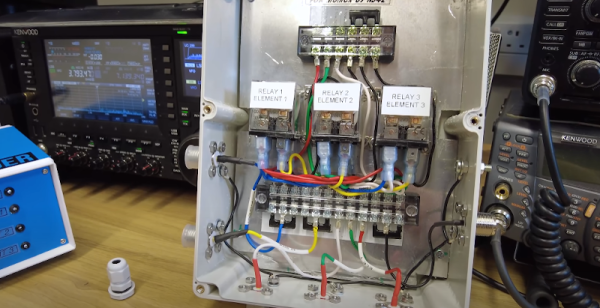
If you read old antenna books, you’ll probably see the idea of phased vertical antennas. These use certain lengths of coax to control the phase of a signal going to three verticals in a triangular configuration. Depending on the phasing, you can cause the array of antennas to be directional in one of three directions. [DX Commander] designed a very modern version of this antenna and shows the theory behind it in a recent video that you can see below.

It seems another ham built the antenna and a control box for it which he’s sent to [DX Commander] although he hasn’t set it up yet to create an 80 meter directional antenna. We’ll be interested in seeing how it works in practice.

Continue reading “Directional Antenna 3-Way”

Apollo Comms Flight Hardware Deep Dive

You no doubt recall the incredible Apollo Guidance Computer (AGC) reverse engineering and restoration project featured on the CuriousMarc YouTube channel a few years ago. Well, [Marc] and the team are at it again, this time restoring the Apollo Unified S-Band tracking and communication system flight hardware. As always, the project is well documented, carefully explained, full of problems, and is proceeding slowly despite the lack of documentation.

Like the guidance computer, the Unified S-Band system was pretty innovative for its day — able to track, provide voice communications, receive television signals, and send commands to and monitor the health of the spacecraft via telemetry. The system operates on three frequencies, an uplink containing ranging code, voice and data. There are two downlinks, one providing ranging, voice, and telemetry, the other used for television and the playback of recorded data. All crammed into two hefty boxes totaling 29 kg.

So far, [Marc] has released part 9 of the series (for reference, the Apollo Guidance Computer took 27 parts plus 8 auxiliary videos). There seems to be even less documentation for this equipment than the AGC, although miraculously the guys keep uncovering more and more as things progress. Also random pieces of essential ground test hardware keep coming out of the woodwork. It’s a fascinating dive into not only the system itself, but the design and construction techniques of the era. Be sure to check out the series (part 1 is below the break) and follow along as they bring this system back to life. [Marc] is posting various documents related to the project on his website. And if you missed the AGC project, here’s the playlist of videos, and the team joined us for a Hackaday Chat back in 2020.

Continue reading “Apollo Comms Flight Hardware Deep Dive”

Affordable HF Loop Antenna Reviewed

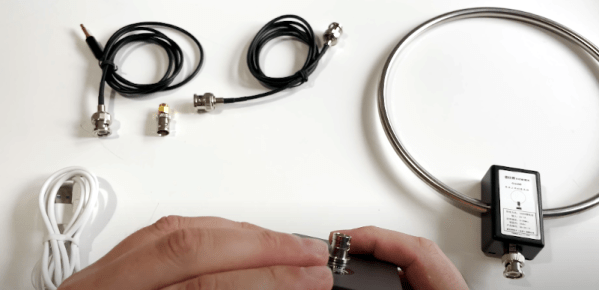
Modern ham radio operators often face restrictions on antennas. This has made small antennas more popular, despite some limitations. [Tech Minds] reviews the GA-450 indoor active HF loop antenna and finds it better than expected. You can see the video review below.

You can’t expect a little antenna to perform as well as giant skyhook. However, for such a small loop covering 3 to 30 MHz, the antenna seems to perform very well. We like that the active part of it has a rechargeable battery. Obviously, you will only want to use this antenna for receiving, but it would be a great pairing for an HF-capable software defined radio (SDR). Even just in the window sill with half gain, it was able to pick up quite a bit of signal on the 40 meter and 20 meter ham bands. According to the video, performance below 7 MHz was lackluster, but it worked nicely at higher frequencies.

The loop is directional and you can rotate the loop on the base to zero in on a particular signal. Of course, if the antenna were up in the air, it might be harder to rotate unless you work out something with a motor. If all you want to do is receive and you have a budget of under $100, this looks like it would be a nice portable option.

You can build your own loop and loop-like antennas, of course. Some of them can be quite portable.

Continue reading “Affordable HF Loop Antenna Reviewed”