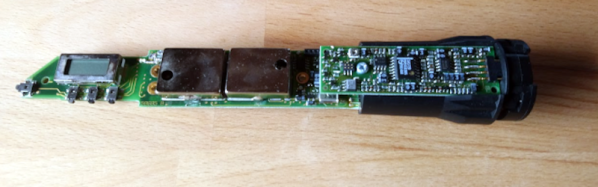
Software defined radio and widespread software-controlled PLL synthesis for RF has been a game changer. Things like the RTL-SDR can be any kind of radio you like on almost any frequency you like. But not every SDR or PLL system opens the configuration doors to you, the end user. That was the problem [vgnotepad] faced when trying to connect a Sennheiser wireless microphone to some receivers. They didn’t use the same frequencies, even though the transmitter was programmable. The solution to that is obvious — hack the transmitter!
The post is only part one of several parts and if you read to the end, you’ll learn a lot about what’s inside the device and how to crack it. Luckily, the device uses a PIC processor, so getting to the software wasn’t a big issue.
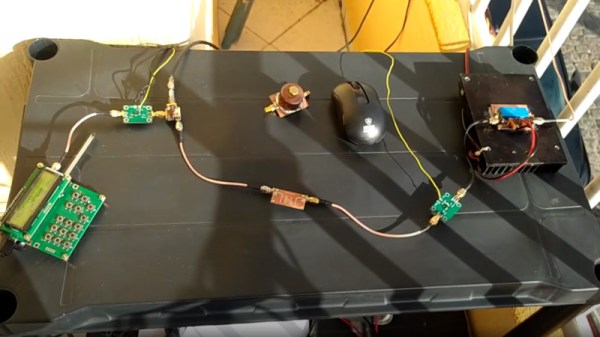
Those readers whose interests don’t lie in the world of amateur radio might have missed one of its firsts, for the last year or two amateurs have had their own geostationary satellite transponder. Called Es’hail-2 / AMSAT Phase 4-A / Qatar-OSCAR 100, it lies in the geostationary orbit at 25.9° East and has a transponder with a 2.4 GHz uplink and a 10.489 GHz downlink. Receiving the downlink is possible with an LNB designed for satellite TV, but for many hams the uplink presents a problem. Along comes [PY1SAN] from Brazil with a practical and surprisingly simple solution using a mixture of odd the shelf modules and a few hand-soldered parts.
An upconverter follows a simple enough principle, the radio signal is created at a lower frequency (in this case by a 435 MHz transmitter) and mixed with a signal from a local oscillator. A filter then picks out the mixer product — the sum of the two — and amplifies it for transmission. [PY1SAN]’s upconverter takes the output from the transmitter and feeds it through an attenuator to a MiniCircuits mixer module which takes its local oscillator via an amplifier from a signal generator module. The mixer output goes through a PCB stripline filter through another amplifier module to a power amplifier brick, and thence via a co-ax feeder to a dish-mounted helical antenna.
The whole thing is a series of modules joined by short SMA cables, and could probably be largely sourced from a single AliExpress order without too much in the way of expenditure. It’s by no means easy to get on air via Es’hail-2, but at least now it need not be impossibly expensive. Even the antenna can be made without breaking the bank.
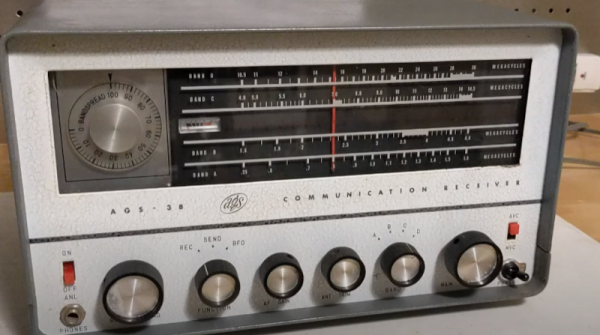
We’ll admit we haven’t heard of the AGS-38, it reminds us of the shortwave receivers of our youth, and it looks like many that were made “white label” by more established (and often Japanese) companies. [Jeff] found a nice example of this Canadian radio and takes it apart for our viewing pleasure. He also found it was very similar to a Layfayette receiver, also made in Japan, confirming our suspicions.
The radio looks very similar to an Eico of the same era — around the 1960s. With seven tubes, radios like this would soon be replaced by transistorized versions.
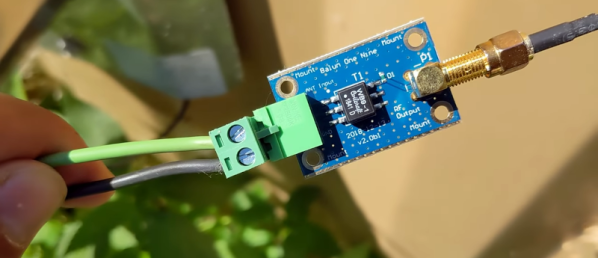
[VK3YE] knows there are at least two things wrong with the cheap antennas you get with most SDR dongles. First, they are too short. You’d like to have enough to pull out a quarter wavelength on the longest frequency you want to operate. The second problem is there’s no real ground. He fixed both of these problems, as you can see in the video below.
The result might be called an ugly duckling rather than a rubber ducky. But it does seem to work. You could probably come up with something nicer to reseal the base, but the tape does work. A nice 3D printed housing would work, too, and might improve the appearance. We also thought about the goop you use on tool handles.
We actually have simply cut these antennas off and reused the cable and connector to hook up a better antenna. You might get more mileage out of that approach. On the other hand, the magnetic base and reasonably small form factor is pretty attractive.
Dipoles are a classic builder’s antenna, after all they are usually little more than two pieces of wire and a feedline. But as [Rob] shows us in the video below, there are a few things to consider.
The first thing is where to get the wire. A damaged extension cord donated the wire. That’s actually an interesting idea because you get multiple wires the same length inside the extension cord. Continue reading “A Cheap Dipole Antenna From An Extension Cord”→
We don’t normally embrace the supernatural here at Hackaday, but when the topic turns to the radio frequency world, Arthur C. Clarke’s maxim about sufficiently advanced technology being akin to magic pretty much works for us. In the RF realm, the rules of electricity, at least the basic ones, don’t seem to apply, or if they do apply, it’s often with a, “Yeah, but…” caveat that’s sometimes hard to get one’s head around.
Perhaps nowhere does the RF world seem more magical than in antenna design. Sure, an antenna can be as simple as a straight piece or two of wire, but even in their simplest embodiments, antennas belie a complexity that can really be daunting to newbie and vet alike. That’s why we were happy to recently host Karen Rucker’s Introduction to Antenna Basics course as part of Hackaday U.
The class was held over a five-week period starting back in May, and we’ve just posted the edited videos for everyone to enjoy. The class is lead by Karen Rucker, an RF engineer specializing in antenna designs for spacecraft who clearly knows her business. I’ve watched the first video of the series and so far and really enjoy Karen’s style and the material she has chosen to highlight; just the bit about antenna polarization and why circular polarization makes sense for space communications was really useful. I’m keen to dig into the rest of the series playlist soon.
The 2021 session of Hackaday U may be wrapped up now, but fear not — there’s plenty of material available to look over and learn from. Head over to the course list on Hackaday.io, pick something that strikes your fancy, and let the learning begin!
With a bit of luck, you’ll live your whole life without needing an implanted medical device. But if you do end up getting the news that your doctor will be installing an active transmitter inside your body, you might as well crack out the software defined radio (SDR) and see if you can’t decode its transmission like [James Wu] recently did.
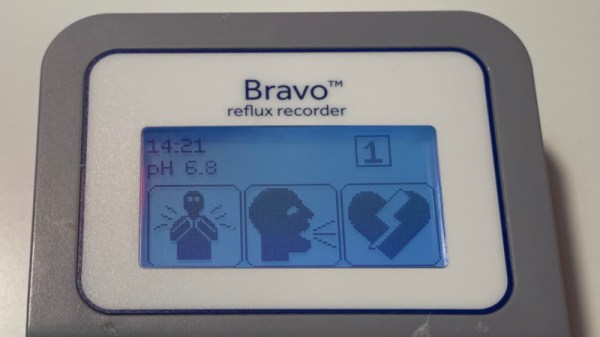
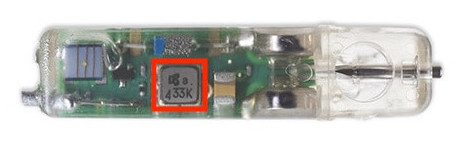
Before the Medtronic Bravo Reflux Capsule was attached to his lower esophagus, [James] got a good look at a demo unit of the pencil-width gadget. Despite the medical technician telling him the device used a “Bluetooth-like” communications protocol to transmit his esophageal pH to a wearable receiver, the big 433 emblazoned on the hardware made him think it was worth taking a closer look at the documentation. Sure enough, its entry in the FCC database not only confirmed the radio transmitted a 433.92 MHz OOK-PWM encoded signal, but it even broke down the contents of each packet. If only it was always that easy, right?
The 433 ended up being a coincidence, but it got him on the right track.
Of course he still had to put this information into practice, so the next step was to craft a configuration file for the popular rtl_433 program which split each packet into its principle parts. This part of the write-up is particularly interesting for those who might be looking to pull data in from their own 433 MHz sensors, medical or otherwise
Unfortunately, there was still one piece of the puzzle missing. [James] knew which field was the pH value from the FCC database, but the 16-bit integer he was receiving didn’t make any sense. After some more research into the hardware, which uncovered another attempt at decoding the transmissions from the early days of the RTL-SDR project, he realized what he was actually seeing was the combination of two 8-bit pH measurements that are sent out simultaneously.
We were pleasantly surprised to see how much public information [James] was able to find about the Medtronic Bravo Reflux Capsule, but in a perfect world, this would be the norm. You deserve to know everything there is to know about a piece of electronics that’s going to be placed inside your body, but so far, the movement towards open hardware medical devices has struggled to gain much traction.