Dissecting China-Sourced Vintage HP 1970s ICs: Genuine Or Not?

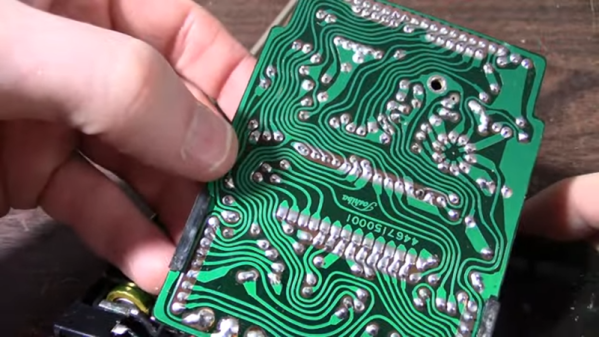
While repairing a real-time clock module for a 1970s HP computer that had been damaged by its leaky internal battery, [CuriousMarc] began to suspect that maybe the replacement clock chips which he had sourced from a seller in China were the reason why the module still wasn’t working after the repairs. This led him down the only obvious path: to decap and inspect both the failed original Ti chip and the replacement chip.

The IC in question is the Texas Instruments AC5948N (along with the AC5954N on other boards), which originally saw use in LED watches in the 1970s. HP used this IC in its RTC module, despite it never having been sold publicly. This makes it even more remarkable that a Chinese seller had the parts in stock. As some comments on the YouTube video mention, back then there wasn’t as much secrecy around designs, and it’s possible someone walked out of the factory with one of the masks for this chip.

Whether true or not, as the video (also included after the break) shows, both the original 1970s chip and the China-sourced one look identical. Are they original stock, or later produced from masks that made their way to Asia? We’ll probably never know for sure, but it does provide an exciting opportunity for folk who try to repair vintage equipment.

Continue reading “Dissecting China-Sourced Vintage HP 1970s ICs: Genuine Or Not?”

Plastic Cleanup Via Retrobrighting

If you work on old radios, electronics is only one of the skills you need. The other is wood or metal working to restore the cabinets and chassis. However, more recent electronics have plastic and old plastic tends to turn yellow. [Odd Experiments] shows how to whiten plastic using a UV light source, aluminum foil, and hydrogen peroxide. Generally, ABS is the plastic at fault, especially those mixed with bromine as a fire retardant. You can see the results in the video below.

Note the peroxide in use was 12% — much stronger than what’s probably in your medicine cabinet. That’s usually only 3% solution, although you can get different strengths including some over 30% if you shop. However, if you search you’ll find that people have used 12%, 6%, and even 3% successfully, although we’d imagine it takes more time with 3%.

Continue reading “Plastic Cleanup Via Retrobrighting”

Z80 Computer Is Both Arduino And Shield

There have been plenty of Z80 computer builds here on Hackaday, but what sets them apart is what you do with them. [Andrew] writes in with his Z80 single-board computer made from scratch, using the Arduino standard headers for its I/O. In turn, since he needed an easy way to program the flash memory which holds the software to run on the Z80, he used an Arduino Mega as a debugger, making the SBC an Arduino shield itself.

Using such a common header pinout for the Z80 computer allows it to be used with a variety of readily-available Arduino shields. This compatibility is achieved with an analog-digital converter and a 3.3 V regulator, mimicking the pins found in an Arduino Uno. The code, available on GitHub, includes an extensive explanation and walkthrough over the process in which the Mega takes over the bus from the Z80 to function as a fully-featured debugger. Programs can be loaded through embedding an assembly listing into the Mega’s sketch, or, once the debugger is up you can also upload a compiled hex file through the serial connection.

This isn’t the first time [Andrew] has been featured here, and his past projects are just as interesting. If you need to translate a Soviet-era calculator’s buttons into English, hack a metallurgical microscope or even investigate what’s that Clacking Clanking Scraping Sound, he’s the one you should call.

An 8085 Retrocomputer From The Heart

The world of 8-bit retrocomputing splits easily into tribes classified by their choice of processor. There are 6809 enthusiasts, 6502 diehards, and Z80 lovers, each sharing a bond to their particular platform that often threads back through time to whatever was the first microcomputer they worked with. Here it’s the Z80 as found in the Sinclair ZX81, but for you it might be the 6502 from an Apple ][. For [Craig Andrews] it’s the 8085, and after many years away from the processor he’s finally been able to return to it and recreate his first ever design using it. The SBC-85 is not wire-wrapped as the original was, instead he’s well on the way to creating an entire ecosystem based around an edge-connector backplane.

The CPU board is an entire computer in its own right as can be seen in the video below the break, and pairs the 8085 with 8k of RAM, a couple of 2732 4k EPROMs, and an 8155 interface chip. This last component is especially versatile, providing an address latch, timer, I/O ports, and even an extra 256 bytes of RAM. Finally there is some glue logic and a MAX232 level shifter for a serial port, with no UART needed since the 8085 has one built-in. The minimal computer capable with this board can thus be slimmed down significantly, something that competing processors of the mid 1970s often struggled with.

Craig’s web site is shaping up to be a fascinating resource for 8085 enthusiasts, and so far the system sports that backplane and a bus monitor card. We don’t see much of the 8085 here at Hackaday, perhaps because it wasn’t the driver for any of the popular 8-bit home computers. But it’s an architecture that many readers will find familiar due to its 8080 heritage, and could certainly be found in many control applications before the widespread adoption of dedicated microcontrollers. It would be interesting to see where Craig takes this next, with more cards, and perhaps making a rival to the RC2014 over in Z80 country.

Continue reading “An 8085 Retrocomputer From The Heart”

Tweet Your BBC Basic Code To The Cloud

From the “things we like, but can’t explain why file” comes the BBC-Micro-bot twitter robot. BBC Basic was a staple in the UK and if you tweet a BBC Basic program to @bbcmicrobot you’ll get a reply with a 30 second video of your program being emulated in all its glory.

As you can see in the above tweet, the code can get a bit terse, but if you look at the bot’s feed you can find some more legible examples. As the author, [@Dominic Pajak] said:

You might want to use fewer and smaller line numbers, fewer spaces and check out the minimum abbreviations for BBC BASIC keywords to achieve this.

Continue reading “Tweet Your BBC Basic Code To The Cloud”

Converting An Atari 2600 Into A Home Computer; Did That Ever Work?

[Tony] posted an interesting video where he looks at the Atari 2600 and the way many companies tried to convert it into a real home computer. This reminded us of the ColecoVision, which started out as a video game but could expand to a pretty reasonable computer.

It might seem silly to convert a relatively anemic Atari video game into a computer, but keep in mind that computers were pretty expensive in those days. Not to mention, the Atari itself was a fair investment back then, too.

Continue reading “Converting An Atari 2600 Into A Home Computer; Did That Ever Work?”

A Tetris To Be Proud Of, With Only A Nano

Tetris may have first arrived in the West on machines such as the PC and Amiga, but its genesis at the hands of [Alexey Pajitnov] was on an Electronika 60, a Soviet clone of an early-1970s DEC PDP-11. Thus those tumbling blocks are hardly demanding in terms of processor power, and a game can be implemented on the humblest of hardware. Relatively modern silicon such as the Atmega328 in [c0pperdragon]’s Arduino Nano Tetris console should then have no problems, but to make that assumption is to miss the quality of the achievement.

In a typical home or desktop computer of the 1980s the processor would have been assisted by plenty of dedicated hardware, but since the Arduino has none of that the feat of creating the game with a 288p video signal having four gray scales and with four-channel music is an extremely impressive one. Beside the Nano there are only a few passive components, there are no CRT controllers or sound chips to be seen.

The entire device is packaged within a clone of a NES controller, with the passives on a piece of stripboard beside the Nano. There is a rudimentary resistor DAC to produce the grey scales, and the audio is not the direct PWM you might expect but a very simple DAC created by charging and discharging a capacitor at the video line frequency. The results can be seen and heard in the video below the break, and though we’re sure we’ve heard something like that tune before, it looks to be a very playable little game.

Continue reading “A Tetris To Be Proud Of, With Only A Nano”