A Forgotten Consumer PC Becomes A Floating Point Powerhouse

[Michael Wessel] found some of his old DOS 3D graphics software and tried to run it on an 8088 PC. The tale of adding an 8087 co-processor to speed up the rendering was anything but straightforward, resulting in a useful little project.

There was a point around the end of the 1980s when the world of PCs had moved on to the 386, but the humble 8086 and 8088 hung around at the consumer end of the market. For Europeans that meant a variety of non-standard machines with brand names such as Amstrad and Schneider, and even surprisingly, later on Sinclair and Commodore too.

Of these the Schneider Euro PC was an all-in-one design reminiscent of an Amiga or Atari ST, packing a serviceable 8088 PC with a single 3.5″ floppy drive. A cheap machine like this was never thought to need an 8087, and lacked the usual socket on the motherboard, so he made a small PCB daughter board for the 8088 socket with space for both chips.

It’s a surprisingly simple circuit, as obviously the two chips were meant to exist together. It certainly had the desired effect on his frame rate, though we’re not sure how many other Euro PC users will need it. It does make us curious though, as to how quickly a modern microcontroller could emulate an 8087 for an even faster render time. Meanwhile if you’re curious about the 8087, of course [Ken Shirriff] has taken a look at it.

Probably The Most Esoteric Commodore 64 Magazine

The world of computer enthusiasts has over time generated many subcultures and fandoms, each of which has in turn spawned its own media. [Intric8] has shared the tale of his falling down a rabbit hole as he traced one of them, a particularly esoteric disk magazine for the Commodore 64. The disks are bright yellow, and come with intricate home-made jackets and labels. Sticking them into a 1541 drive does nothing, because these aren’t standard fare, instead they require GEOS and a particularly upgraded machine. They appear at times in Commodore swap meets, and since they formed a periodical there are several years’ worth to collect that extend into the 2000s, long after the heyday of the 64.

Picking up nuggets of information over time, he traces them to Oregon, and the Astoria Commodore User Group, and to [Lord Ronin], otherwise known as David Mohr. Sadly the magazine ended with his death in 2009, but until then he produced an esoteric selection of stories, adventure games, and other software for surely one of the most exclusive computer clubs in existence. It’s a fascinating look into computer culture from before the Internet, even though by 2009 the Internet had well and truly eclipsed it, when disks like these were treasured for the information they contained. So if you find any of these yellow Penny Farthing disks, make sure that they or at least their contents are preserved.

Surprisingly, this isn’t the only odd format disk magazine we’ve seen.

Adding USB-C (Kinda) To A PowerMac G4

For those who’ve never bitten the Apple, the PowerMac G4 was a blue-tinted desktop Macintosh offered from 1999 to 2004. At the time, the machines were plenty fast — being advertised as the first “personal supercomputer” when they hit the market. But Father Time is particularly harsh on silicon, so they’re properly archaic by modern standards.

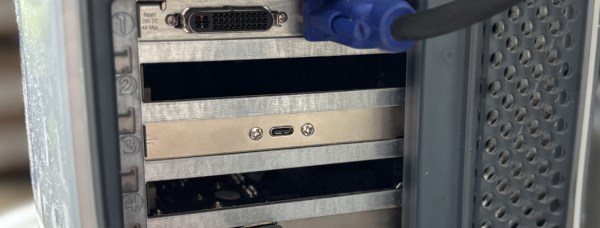
As such, the rear panel of one of these machines is hardly where you’d expect to run into a functional USB-C port. But thanks to the efforts of [Dandu], old has officially met new. Critics will note that it’s not real USB-C, and instead uses USB 2.0 with the more modern connector. That’s true, but considering how many commercial devices we run into that are still using the same trick, we’ll give it a pass.

Continue reading “Adding USB-C (Kinda) To A PowerMac G4”

Satellite Internet On 80s Hardware

Portability has been a goal of a sizable section of the computing world for many decades now. While the obvious products of this are laptops, there are a number of “luggable” PCs that pack more power while ostensibly maintaining their portability. Going back in time past things like the LAN party era of the 90s and 00s takes us to the early era of luggables, with the Commodore SX-64 being one such machine of this era. Its portability is on display in this video where [saveitforparts] is using it to access the Internet over satellite.

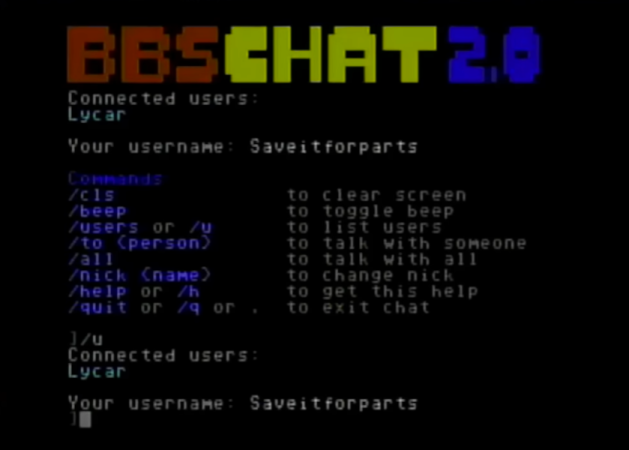
The project uses a Glocom Inmarsat modem and antenna to access the internet through a geostationary satellite, but since this computer is about four decades old now this takes a little bit more effort than a modern computer. A Teensy microcontroller is used to emulate a modem so that the Ethernet connection from the satellite modem can be understood by the Commodore. There was a significant amount of setup and troubleshooting required as well, especially regarding IP addresses and networking but eventually [saveitforparts] got the system up and running well enough to chat on a BBS and browse Wikipedia.

One thing he found that might make a system like this relevant for a modern user is that the text-only mode of the Commodore significantly limited data use. For a normal Internet connection this might be a problem, but on a geostationary satellite network where the data is orders of magnitude more expensive, this can be surprisingly helpful. We might not recommend an SX-64 system specifically, but one inspired by similar computers like this text-only cyberdeck might do the trick with the right networking connections.

Continue reading “Satellite Internet On 80s Hardware”

On The Original Punched Cards

If you mention punch cards to most people, they’ll think of voting. If you mention it to most older computer people, they’ll think of punching programs for big computers on cards. But punched cards are much older than that, and [Nichole Misako Nomura] talks about how the original use was to run looms and knitting machines and — thanks the Internet Archive — you can still find old cards to drive modern machines.

According to the post, a dedicated group of people own old commercial knitting machines, and with some work, they can use archived punch cards with patterns that predate the computerized world. The Jacquard loom was famously the first machine to use cards like this, and it is no secret that they were the inspiration for Hollerith’s use of cards in the census, which would eventually lead to the use of cards for computing.

Continue reading “On The Original Punched Cards”

Basically, It’s BASIC

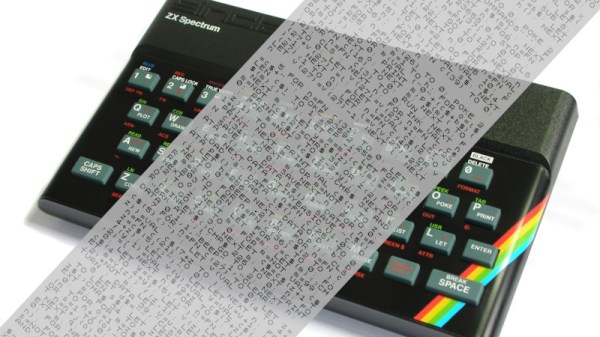
The BASIC language may be considered old-hat here in 2025, and the days when a computer came as a matter of course with a BASIC interpreter are far behind us, but it can still provide many hours of challenge and fun. Even with our love of all things 8-bit, though, we’re still somewhat blown away by [Matthew Begg]’s BASIC interpreter written in 10 lines of BASIC. It’s an entry in the BASIC 10-liner competition, and it’s written to run on a Sinclair ZX Spectrum.

The listing can be viewed as a PNG file on the linked page. It is enough to cause even the most seasoned retrocomputer enthusiasts a headache because, as you might expect, it pushes the limits of the language and the Sinclair interpreter.  It implements Tiny Basic as a subset of the more full-featured BASICs, and he’s the first to admit it’s not fast by any means. He gives a line-by-line explanation, and yes, it’s about as far away from the simple Frogger clones we remember bashing in on our Sinclairs as it’s possible to get.

We love it that there are still boundaries to be pushed, even on machines over four decades old, and especially that this one exceeds what we thought was a pretty good knowledge of Sinclair BASIC. Does this language still have a place in the world? We always look forward to the BASIC 10-liner competition.

Header: background by Bill Bertram, CC BY-SA 2.5.

How The Main Frame Became The Mainframe: An Etymological Dissertation

In his most recent article, [Ken Shirriff] takes a break from putting ASICs under a microscope, and instead does the same in a proverbial manner with the word ‘mainframe’. Although these days the word ‘mainframe’ brings to mind a lumbering behemoth of a system that probably handles things like finances and other business things, but originally the ‘main frame’ was just one of many ‘frames’. Which brings us to the early computer systems.

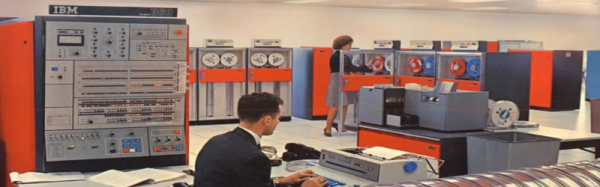
We have all seen the photos of early computer systems, which not only filled rooms, but which also tended to consist of multiple units. This was something which the designers of the IBM 701 computer seem to have come up with, to make it possible to transport and install computer systems without cranes and the breaking out of walls. Within the IBM 701 system’s internal documentation, the unit containing the core logic was referred to as the ‘main frame’, alongside the ‘power frame’, the ‘core frame’, etc.

From this [Ken] then traces how the word ‘main frame’ got reused over the years, eventually making it outside of the IBM world, with a 1978 Radio Electronics magazine defining the ‘mainframe’ as the enclosure for the computer, separating it seemingly from peripherals. This definition seems to have stuck, with BYTE and other magazines using this definition.

By the 1960s the two words ‘main frame’ had already seen itself hyphenated and smushed together into a singular word  before the 1980s redefined it as ‘a large computer’. Naturally marketing at IBM and elsewhere leaned into the word ‘mainframe’ as a token of power and reliability, as well as a way to distinguish it from the dinky little computers that people had at home or on their office desk.

Truly, after three-quarters of a century, the word ‘mainframe’ has become a reflection of computing history itself.