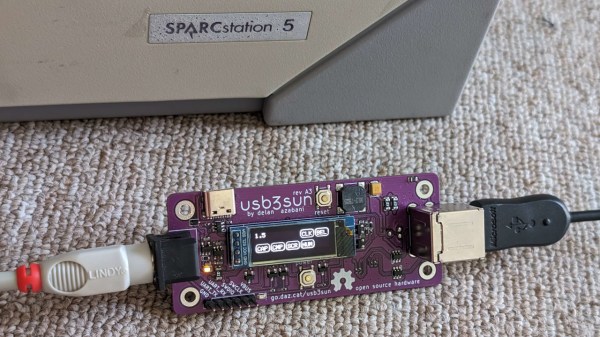
A USB3SUN adapter, connected to a SPARCstation on one end and to a keyboard on another, with the OLED screen showing status icons

An Open SPARCstation USB Keyboard&Mouse Adapter

Got a SPARCstation? You might have had to deal with the proprietary DIN port used for keyboard and mouse input. However, you need not look for outdated hardware anymore – we’ve recently found an adapter project called [usb3sun], which lets you use a regular USB keyboard and mouse instead! Designed by [delan] from [the funny computer museum], the usb3sun adapter is featureful, open-source, and even comes with four blog posts describing its inner workings and development process!

Based on a Pi Pico board, this adapter has a ton of quality of life features – an OLED screen for status display, extra USB port and headers for debugging, a buzzer to emulate bell and click functions, power LEDs, and all the ports you would expect. The OLED screen is needed just because of how many features this adapter’s firmware has, and you’re bound to get more – the [usb3sun] firmware is being actively updated to this day. It’s as if this adapter aims to do all it possibly could help you with – for instance, one of the firmware updates has added idprom reprogramming features, which, as [delan] tells us, lets you boot your workstation with a dead NVRAM battery.

You can order the adapter PCBs yourself, you can breadboard it by following detailed instructions from [delan], or you can get a fully assembled and tested [usb3sun] adapter on Tindie! This adapter will seriously help you in your SPARCstation forays, and, if you don’t happen to own a SPARCstation, you can always emulate SunOS.
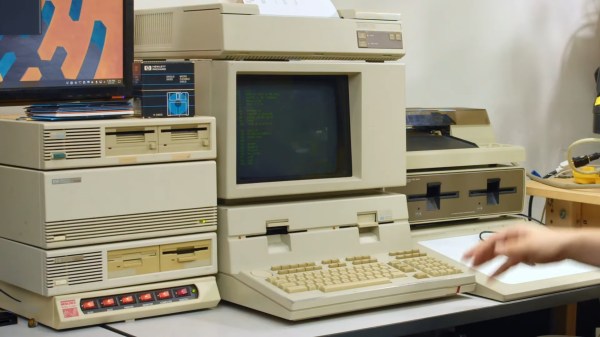
A beige computer with a CRT monitor. A black LCD sits atop a stack of 3 devices next to it and a set of power control switches (the orange light up kind). There appear to be 8 floppy drives available.

Flux Is Your Friend For Archiving Old Floppy Disks

Nothing screams retrocomputing quite like floppy drives. If you want to preserve some of your favorite computing memories like that paper you wrote about the joys of the Information Superhighway, [Shelby] from Tech Tangents has a detailed dive into how to preserve the bits off those old floppies.

Back in the day, the best way to get data off an old drive was to fire up an old computer. Now, with new devices specifically designed for harvesting data off of old floppies like the KryoFlux and the Greaseweazle, you can get the full flux map of the disk. With this, you can build binary image files and actually pull files and duplicate disks from vintage systems.

Some systems, like PCs, Macs, and Commodores are well-understood and are simple to preserve, while others take quite a bit of work to figure out. [Shelby] walks us through some of the more common disk formats as well as some real oddballs like Microsoft Adventure which features inconsistent formatting as a form of early DRM (boo).

Want to do your own preservation? We’ve covered a couple different methods in the past.

Continue reading “Flux Is Your Friend For Archiving Old Floppy Disks”

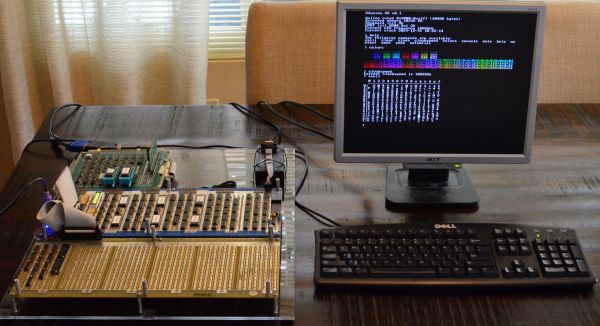
Wire Wrap Odyssey: A 7400-series Homebrew 8-bit Computer

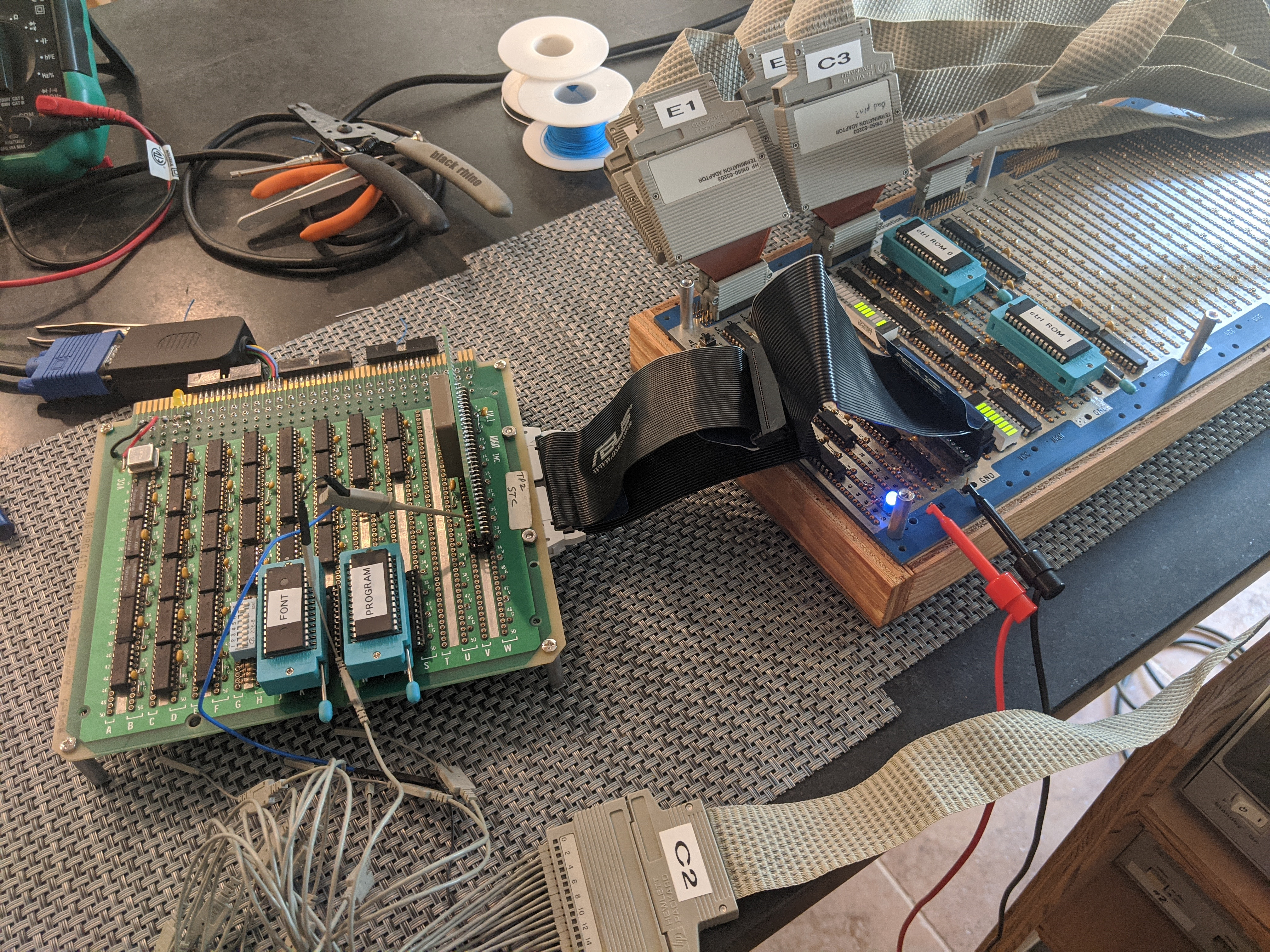
The Wire Wrap Odyssey's first Hello World from the CPU module, here hooked up to a logic analyzer in July of 2020. (Credit: Paul Krizak)
The Wire Wrap Odyssey’s first Hello World from the CPU module, here hooked up to a logic analyzer in July of 2020. (Credit: Paul Krizak)

As part of his computer science curriculum at Texas A&M University in the early 2000s, [Paul Krizak] took a computer architecture course on the basics of their functioning. This and being exposed to dozens of homebuilt computer projects inspired him to begin building his own 8-bit computer in 2010, which eventually grew into the Wire Wrap Odyssey. This name covers both the primary construction method chosen around 2019 in the form of wire-wrapped connections, as well the harrowing journey to reach this point with a functioning computer system despite many choices and setbacks.

The Odyssey CPU is an 8-bit microcoded design with 16-bit address bus, using mostly 74HC-series logic. A VGA graphics card is also part of the design, which can output a 640×480 text display, with character glyphs read from the system ROM (32 kB AT28C256). As for the RAM, this is an extravagant 32 kB dual-port SRAM (Renesas 7007), which also allows both the CPU and video card to use the same SRAM. Currently the system has four peripherals: a PS/2 keyboard controller, an RTC and timer (DS1511Y+), 82C52 UART and 1 MB of extended RAM, but an ATA port and parallel port are in development.

Perhaps the most impressive part about this product is the level of documentation, from the early stages including paper doodles to the current state of the system, including the GitHub repository for the software. [Paul] was also an exhibitor at the Vintage Computing Festival (VCF) SoCal recently with his Wire Wrap Odyssey, where he was able to show off the progress so far. Next year he hopes to visit VCF SoCal again, with the remaining planned peripherals implemented.

Joost Bürgi And Logarithms

Logarithms are a common idea today, even though we don’t use them as often as we used to. After all, one of the major uses of logarithms is to simplify computations, and computers do that just fine (although they might use logs internally). But 400 years ago, doing math was painful. Enter Joost Bürgi. According to [Welch Labs], his book of mathematical tables should have changed math forever. But it didn’t.

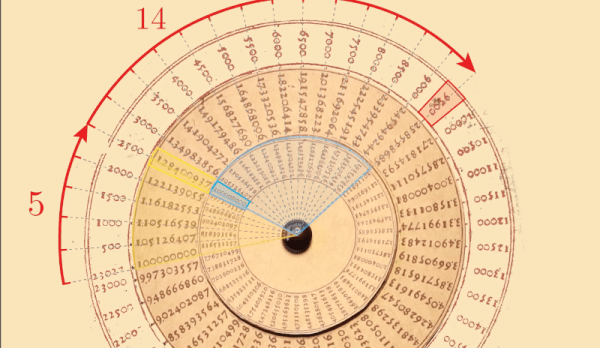
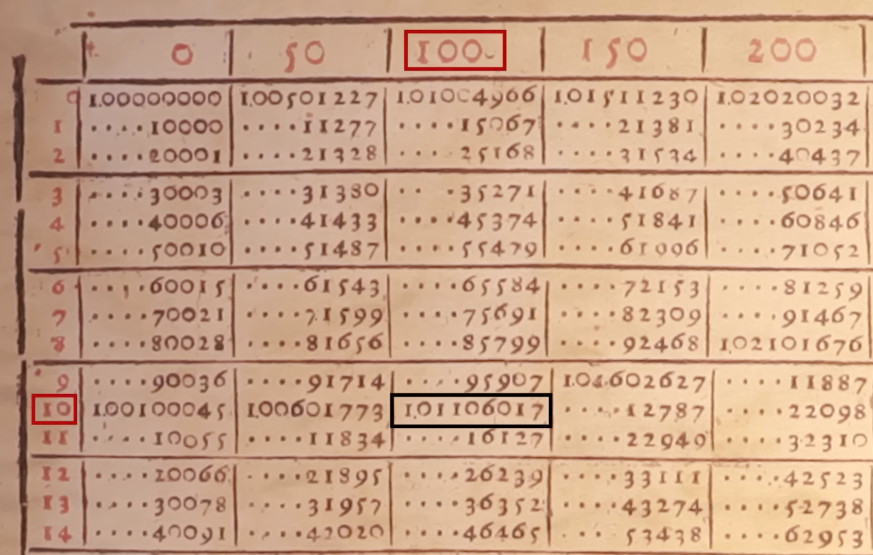
If you know how a slide rule works, you’ll find you already know much of what the video shows. The clockmaker was one of the people who worked out how logs could simplify many difficult equations. He created a table of 23,030 “red and black” numbers to nine digits. Essentially, this was a table of logarithms to a very unusual base: 1.0001.

Why such a strange base? Because it allowed interpolation to a higher accuracy than using a larger base. Red numbers are, of course, the logarithms, and the black numbers are antilogs. The real tables are a bit hard to read because he omitted digits that didn’t change and scaled parts of it by ten (which was changed in the video below to simplify things). It doesn’t help, either, that decimal points hadn’t been invented yet.

What was really impressive, though, was the disk-like construct on the cover of the book. Although it wasn’t mentioned in the text, it is clear this was meant to allow you to build a circular slide rule, which [Welch Labs] does and demonstrates in the video.

Unfortunately, the book was not widely known and Napier gets the credit for inventing and popularizing logarithms. Napier published in 1614 while Joost published in 1620. However, both men likely had their tables in some form much earlier. However, Kepler knew of the Bürgi tables as early as 1610 and was dismayed that they were not published.

While we enjoy all kinds of retrocomputers, the slide rule may be the original. Want to make your own circular version? You don’t need to find a copy of this book.

Continue reading “Joost Bürgi And Logarithms”

A Deep Dive Into A 1980s Radio Shack Computer Trainer

For those of us who remember Radio Shack as more than just an overpriced cell phone store, a lot of the nostalgia for the retailer boils down to the brands on offer. Remember the Realistic line of hi-fi and stereo gear? How about Archer brand tools and parts? Patrolman scanners, Micronta test instruments, and don’t forget those amazing Optimus speakers — all had a place in our development as electronics nerds.

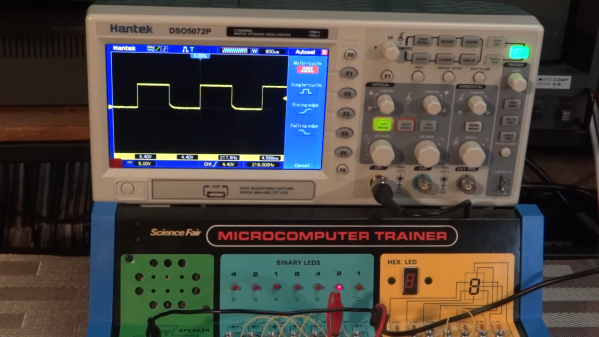
But perhaps the most formative brand under the Radio Shack umbrella was Science Fair, with a line of kits and projects that were STEM before STEM was a thing. One product that came along a little too late for our development was the Science Fair Microcomputer Trainer, and judging by [Michael Wessel]’s deep dive into the kit, we really missed the boat. The trainer was similar to the earlier “100-in-1”-style breadboarding kits, with components laid out on a colorful cardboard surface and spring terminals connected to their leads, making it easy to build circuits using jumper wires. The star of the show in the microcomputer trainer was a Texas Instruments TMS1100, which was a pretty advanced chip with a 4-bit CPU with its own ROM and RAM as well as a bunch of IO lines. The trainer also sported a peppy little 400-kHz crystal oscillator clock, a bunch of LEDs, a seven-segment display, a speaker, and a rudimentary keyboard.

The first video below is a general introduction to the trainer and a look at some basic (not BASIC) programs. [Michael] also pulls out the oscilloscope to make some rough measurements of the speed of the TMS1100, which turns out to be doing only about 400 instructions per second. That’s not much, but in the second video we see that it was enough for him to nerd-snipe his collaborator [Jason] into coding up an 80-nibble Tower of Hanoi solver. It’s a little awkward to use, as the program runs in spurts between which the user needs to check memory locations to see which disc to move to which peg, but it works.

It looks like people are rediscovering the Microcomputer Trainer all of a sudden. It might be a good time to pick one up.

Continue reading “A Deep Dive Into A 1980s Radio Shack Computer Trainer”

The Book8088 Gets A Post-Hype Review

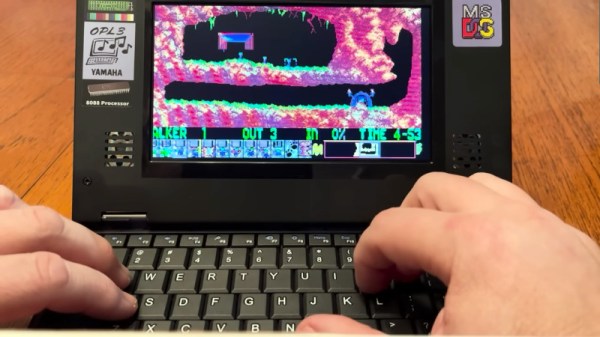
Last year, a couple of rather unusual computers emerged from China: a 386sx-based palmtop and an 8088-based mini-laptop. The average person isn’t exactly clamoring for a DOS machine these days, but they attracted quite a bit of interest among the retrocomputing scene. Now the dust has settled, [The Retro Shack] has taken a Book 8088 and given it an honest review. Do you need portable 1980s computing in your life, and if so it this the machine to give you it?

The first impression of the machine is just how svelte it is, being like a small but chunky netbook. He explores the hardware and finds as expected an NEC V20 instead of the Intel part running the show, and what would have been a hugely expanded DOS PC back in the day with its VGA and sound card, not to mention a solid state hard drive.

We’re overcome with a bit of nostalgia here at the sight of DOS running Lemmings, and on a machine we’d have given anything to own back in the 1980s. His final conclusion is that it’s a very nice little PC but around $160 seems a little much for what is essentially a toy. We have sadly to agree with him though we really want one, though noting that such a machine would have retailed for a huge amount more than that in 1980s dollars and we’d have considered it a huge bargain then.

If you’re still curious, we covered the arrival of these machines last year.

Continue reading “The Book8088 Gets A Post-Hype Review”

Making The Commodore SX-64 Mini

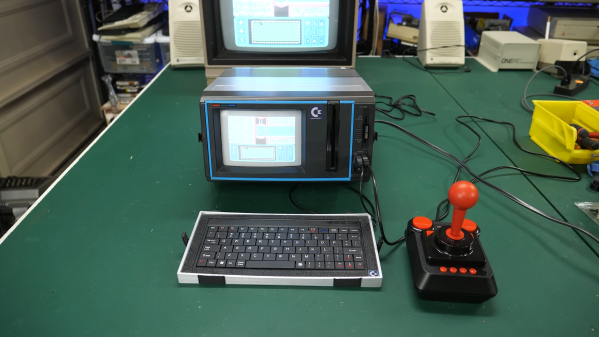
When you find a portable TV from the 1980s, and it reminds you of the portable Commodore 64, there’s only one thing to be done. [Aaron Newcomb] brings us the story of taking an Emerson PC-6 and mating it to the guts of his THEC64 Mini. It’s a bit of a journey, as the process includes modding the TV to include a composite input and trimming some unused PCB off the TV’s mainboard. Then some USB ports and a three-and-a-half inch floppy drive were shoehorned into the chassis, with the rear battery compartment holding the parts from THEC64 Mini.

The build was not entirely without issue. It turns out the degaussing coil connector can plug perfectly into the service port, and Murphy’s law proved itself true again. But no harm was done, and the error was quickly discovered. All that was left was to button the chassis back up and add some paint and 3d-printed trim details. The build looks great! Come back after the break to watch the video from the [Retro Hack Shack] for yourself.

Continue reading “Making The Commodore SX-64 Mini”