Robot Vacuum Makes Cleaning Into A Game

This is not a Roomba hack, but a ground-up vacuum cleaner robot build. It’s the result of a class project from six students at the Royal Institute of Technology in Sweden. There’s a slew of information available in their paper, but fair warning that it’s an 8.6 MB PDF file that we couldn’t get Google to translate. We were able to skim the PDF and cut and paste to translate the interesting bits we found.

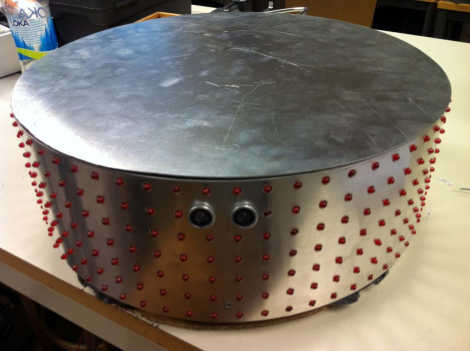
Unlike a Roomba, which just uses a little sweeper to pick up debris, this robot actually includes a vacuum. The image above shows that the cylindrical body is wrapped in an LED matrix, with an ultrasonic sensor on the front for obstacle avoidance. The robot uses a CAN bus to control the various modules inside. We don’t think there’s any autonomous function, but that’s made up for by the remote control. It communicates via a ZigBee module, and includes a d-pad, touch screen, and accelerometer.We’re a little bit hazy on how the games are played, but there are at least two interactive version: one called ball, and another modeled after the classic game of missile command.

You can check out the source code for the project in their repository, or join us after the break for two demo videos.


Continue reading “Robot Vacuum Makes Cleaning Into A Game”

Cypherbot Uses Older UC And Retro-controller

[PJ Allen] has been working on a little robot which he calls Cypherbot. The control circuitry is quite familiar; a Board of Education which features the Basic Stamp 2 microcontroller. This is an older and slower microprocessor, but it works quite well for this application since there’s no need for speed or heavy number crunching. The wheels of the bot are made out of plastic lids (we’re thinking peanut butter jars) with rubber bands for traction that are each driven by a servo motor. The third wheel is tiny and swivels as needed.

The front of the bot has a PING ultrasonic sensor mounted on a servo motor which lets the bot scan back and forth for a wider obstacle avoidance angle. In addition to the autonomous mode there’s an Xbee remote control. [PJ] picked up an Atari keyboard and is using that as the user input. Check out the little guy driving around the house in the video after the break.

Continue reading “Cypherbot Uses Older UC And Retro-controller”

Beefy Rover Looks Like Tons Of Fun

mantis_six_wheeled_remote_control_robot

[Eric] and the crew over at The Tech Junkies, just put the finishing touches on a pretty powerful robot that they call “Mantis”.

The six wheel, chain-driven robot is pretty impressive at first glance. The robot is centered around a Netduino, which controls four 60 amp speed controllers. The speed controllers are tasked with driving four beefy CIM motors, which propel the robot along at a pretty decent tick.

For the project, the team designed their own controller application called IPGamepad, which allows the robot to be controlled by any Android device. The interface is pretty simple as you can see in the video below, making it quite easy to control the bot.

While the Mantis was not a cheap production by any means, it does look like a ton of fun to drive. The crew will be taking this robot along with 2 others out to Maker Faire Detroit, so be sure to swing by and say hello if you’re in the area.

Continue reading “Beefy Rover Looks Like Tons Of Fun”

Modded Wall-E Becomes A Real Robot

[DJ Sures] got his hands on a plastic Wall-E toy and decided to build a robot that includes a camera, voice recognition, and object tracking. The result is adorable so we’re putting this video before the break:

[youtube=http://www.youtube.com/watch?v=OJiMUzJHYFk&w=470]

Continue reading “Modded Wall-E Becomes A Real Robot”

Sandia Labs “Hopper” Robot

Made by Boston Dynamics under contract from Sandia Labs, this “hopper” is quite incredible as you can see in the video after the break. Boston Dynamics is no stranger to great robotics designs, including the well known “Big Dog” four-legged robot. This robot, although possibly less advanced, has a very unique trick up it’s sleve.

This robot’s distinguishing feature is that it can navigate autonomously not only with wheels, but also with a powerful single leg that allows it to jump over obstacles of up to 25 feet. Although envisioned to “deliver a payload” in an urban environment, one could imagine a terrifying  horde of these ‘bots jumping into action armed with bombs or other weapons.

According to Sandia’s website is that this form of locomotion has been “shown to be five times more efficient than hovering” when trying to get around obstacles under 10 meters. Technical challenges that have been overcome include managing the shock of landing and producing a leg powerful enough to jump to this height. Continue reading “Sandia Labs “Hopper” Robot”

Roomba Used To Map Indoor Air Quality

roomba_based_air_quality_tester

The next time you set off for a long day in the coal mines, forget the canary – bring your Roomba along instead!

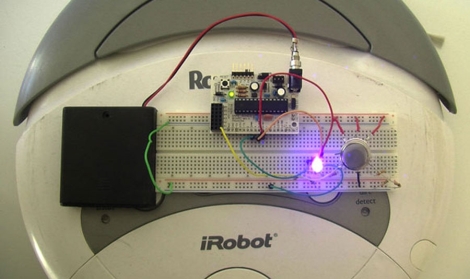
While we are pretty sure that canaries are no longer used in the mining industry, this Roomba hack could make a suitable replacement if they were. A team from the Public Laboratory for Open Technology and Science (PLOTS) recently showed off a Roomba which they modified to test an area’s air quality. Using an Arduino and a volatile organic chemical (VOC) detecting air quality sensor, the Roomba goes about its normal business, lighting an LED any time it encounters overly contaminated air. When captured via a long exposure image, the process creates a “bad air” map of sorts, with the polluted areas highlighted by the glow of the LED.

While the Roomba currently only detects VOCs, the team plans on adding additional sensors in the near future to expand its functionality. The Roomba is merely a proof of concept at the moment, but we imagine that similar technology will be adapted for use in unmanned explorations of chemically hostile environments, if that hasn’t happened already.

[via DVice] [Image via TechnologyReview]

Obstacle Avoiding Hexapod From Reused Parts


[Rob] built this hexapod one day when he had some free time after work. Just like the last hexapod we saw, he based the build on the Pololu design which uses three servo motors for surprisingly reliable movement.

The hardware is very straight forward. A Dorkboard serves as the brain. It’s a PCB that is wider on each side by the width of one female pin-header than a standard AVR 28-pin microcontroller. This gives easy access to all of the pins on the Arduino chip while making it small and light. You can see that a four-pack of batteries hangs below the servo motors to provide power.

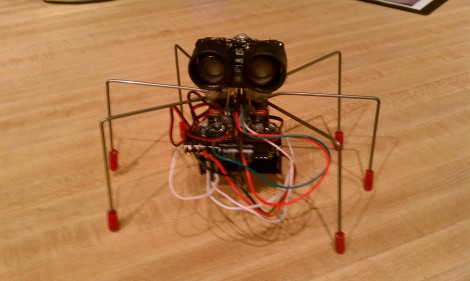
Protruding above the 6-legger is a PING ultrasonic rangefinder. This adds autonomy to the little robot, which you can see running some obstacle avoidance routines in the video after the break. We’ve asked [Rob] if is able to share his code and will update this post if we hear back from him.

Update: Here’s a link to the sketch, and we’ve updated the picture with one that [Rob] sent to us.

Continue reading “Obstacle Avoiding Hexapod From Reused Parts”