Bioloid Hacking With Johnny Lee

bioloid

Though we usually think of Wii projects when we see him, [Johnny Lee] is showing us some Bioloid fun. He’s decided to pick one up to play with, wanting to write his own control programs for it. Unfortunately what he found was that it doesn’t do wireless communication for control. Even after installing a bluetooth module, he found it was only used to trigger different predetermined motions. After some research, he found how to connect the bluetooth module to the main PC link which allows him direct control of the Bioloid via the PC. Unfortunately, the communication speed leaves a lot to be desired, but it’s a good start. We’ll keep our eye on this one.

Fast Little Hexapods

[youtube=http://www.youtube.com/watch?v=GC4vWKenA7Y]

We’ve posted many many times about hexapods. One of the most common comments, aside from how creepy they are, is about their speed. Hexapods are generally pretty slow. These little bots are quite a bit different though. The Sprawl and iSprawl, are anything but slow. Using a hybrid leg mechanism that aims its piston like “toes”, they mimic the motion of cockroaches. The video shows the speed can be pretty quick, especially the iSprawl in the second half. The leg mechanism the Sprawl is air powered, while the iSprawl uses a push/pull cable transmission system. As pointed out at BotJunkie, it’s nice for the “i” in iSprawl to actually mean something. It stands for “independent”.

[via BotJunkie]

Felix’s Machines

[youtube=http://www.youtube.com/watch?v=4CdA-ivDj8o]

Ok, we know you’re going to get mad, there’s virtually no information on the technical side. But the music was so pleasant, and that’s rare.  There’s an interview with Felix, the creator, where he discusses his goals and ideas behind the project. We prefer just to sit and watch though. If you want to make something similar, there were some technical details on a mechanical drum recently.

[Thanks Hash]

Microbot For The Robocup 2008

[youtube=http://www.youtube.com/watch?v=dMJJ2FJqsdI]

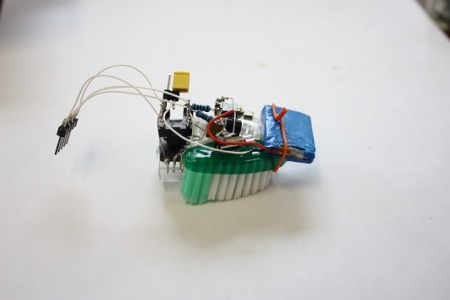
[tioguerra] helped make these tiny bots for the World Robocup 2008 in china. There’s tons of information on the Mixed Reality forum, but you might be specifically interested in the bot section.  There are breakdowns of different aspects, such as charging and IR communication, as well as some great photographs of the unit along with a smaller one. The construction of the robot seems so nicely fit together, someone spent a lot of time getting the design just right.  Since we don’t see a new section for 2009 bots, we are guessing that they’ll use this design again.

Controlling Spykee Via Web Cam Using Your Fingers

spykee

[epokh] sent in this cool project where he wrote some custom code to control the Spykee robot using gestures. He filters out everything but green through his web cam, then wraps his fingers in green tape. He then runs a series of filters to clean it up a little bit. The resulting “blobs” are tracked and converted to motor commands. You can see the setup in action in the video after the break. This guy might look familiar, as we posted a super quick head tracking rig he did with legos recently. Some of you mentioned, in the comments, that the legos were a waste, you’ll find that he thought so too, and ended up fabbing a simple rig to take the place of the legos.

Continue reading “Controlling Spykee Via Web Cam Using Your Fingers”

Naval Academy’s AUV Team Project

auv1

[Daniel] sent us over to the blog for the Naval Academy’s Autonomous underwater vehicle entry for the AUVSI competition. You can follow along as they design, build, and test this years entry. It really looks like it would be fun to be the guy who gets to swim with them, like in the latest post in their blog. Their entry, named “Awkward turtle” can be seen above in orange, pictured with their 5th place winning previous entry.

Tweenbots Rely On Human Help

tweenbots

[Kacie Kinzer] put together an interesting social experiment: Could a robot navigate purely by the help of strangers? She constructed an inexpensive Tweenbot robot that would drive in a straight line. A flag was attached to the top with a plea for help and a destination. Surprisingly, on the first run it was able to traverse through Washington Square Park in just 42 minutes with the help of 29 people. You can see a video of the first run below. This is part of [Kacie]’s thesis work at ITP and she has many other bots planned. While it’s a great demonstration of human kindness, there’s another lesson: If you don’t think your public project looks innocuous enough, draw a smiley face on it.

Continue reading “Tweenbots Rely On Human Help”