Atmospheric High-Voltage Motor Makes Useful Power

While it almost seems like an insane fever dream from an otherwise brilliant inventor, Nikola Tesla’s plan to harvest energy straight out of the atmosphere and essentially give it away is more reality than fiction. It’s usually prohibitively difficult get that energy out of the atmosphere for several obvious reasons, although it is still possible to do as [lasersaber] shows with his most recent atmospheric motor.

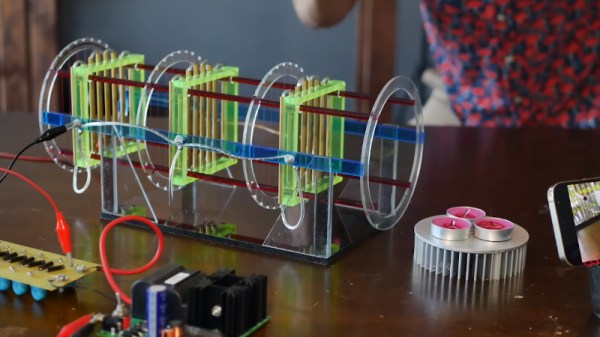
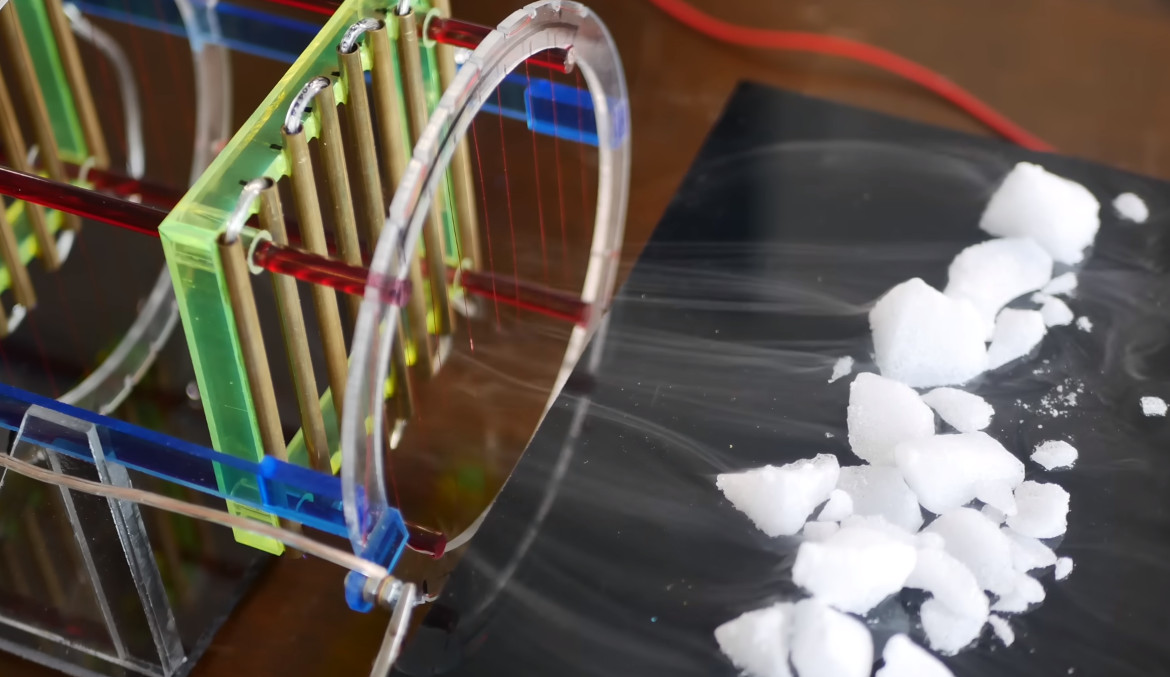
To help solve some of the logistical problems of harvesting electricity from the atmosphere, [lasersaber] is using a Van de Graaff generator as a stand-in for the high voltage gradient that can be found when suspending a long wire in the air. He has been experimenting with high-voltage motors like this for a while now and has refined his designs for corona discharge motors like these to be big enough and have enough torque to drive a drill bit. The motors have a conductive rotor with a series of discharge tubes on the stator, and exposing a metal point on the wiring (where the atmospheric wire would attach) to a sufficiently high voltage will cause rotation. In this case, it’s around 30,000 volts but with an extremely low current.

There are a number of videos documenting his latest build, including this follow-up video where he drills an arbitrarily large number of holes in various materials to demonstrate its effectiveness. Even though he is using a Van de Graaff generator in these builds, he does also show them working with a wire suspended by a drone as well for proof-of-concept. He’s also become somewhat of an expert on high-efficiency and low-power motors and has a number of other interesting builds based on these concepts.

Continue reading “Atmospheric High-Voltage Motor Makes Useful Power”

On the left side, there's a smartphone. On the right side, there's a hairdryer turned on. On the smartphone screen, you can see the working end of the hairdryer shown, as well as a jet of air coming out of that end. In the background, there's an LCD screen showing a noise pattern.

Observe Airflow Using Smartphone And Background-Oriented Schlieren

Multiple people have recently shared this exciting demonstration (nitter) with us – visualizing airflow using a smartphone, called ‘background-oriented schlieren’. On a hot summer day, you might see waves in the air – caused by air changing density as it warms up, and therefore refracting the light differently. Schlieren photography is an general set of techniques for visualizing fluid flow, but of course, it can also be applied to airflow. In this case, using some clever optical recognition tricks, this schlieren method lets you visualize flow of air using only your Android smartphone’s high resolution camera and a known-pattern printed background! Continue reading “Observe Airflow Using Smartphone And Background-Oriented Schlieren”

Insect class-order-family-genus-species chart with drawn examples

Neural Network Identifies Insects, Outperforming Humans

There are about one million known species of insects – more than for any other group of living organisms. If you need to determine which species an insect belongs to, things get complicated quick. In fact, for distinguishing between certain kinds of species, you might need a well-trained expert in that species, and experts’ time is often better spent on something else. This is where CNNs (convolutional neural networks) come in nowadays, and this paper describes a CNN doing just as well if not better than human experts.

Continue reading “Neural Network Identifies Insects, Outperforming Humans”

Big Chemistry: Ultrapure Water

My first job out of grad school was with a biotech company in Cambridge, Massachusetts. It was a small outfit, and everyone had a “lab job” in addition to whatever science they were hired to do — a task to maintain the common areas of the lab. My job was to maintain the water purification systems that made sure everyone had an ample supply of pure, deionized water to work with. The job consisted of mainly changing the filter and ion-exchange cartridges of the final polishing units, which cleaned up the tap water enough for science.

When I changed the filter packs, I was always amazed and revolted by the layers of slime and sediment in them. A glimpse out the window at the banks of the river Charles — love that dirty water — was enough to explain what I was seeing, and it was a lesson in just how much other stuff is mixed in with the water you drink and cook with and bathe in.

While we humans can generally do pretty well with water that rates as only reasonably pure, our industrial processes are quite another thing. Everything from power plants to pharmaceutical manufacturing facilities needs water of much, much higher purity, but nothing requires purer water than the specialized, nanometer-scale operations of a semiconductor fab. But how does ordinary tap water get transformed into a chemical of such purity that contaminants are measured in parts per trillion? And how do fabs produce enough of this ultrapure water to meet their needs? With some big chemistry.

Continue reading “Big Chemistry: Ultrapure Water”

Viewing Atoms With Electrons

When we were in school, they always told us we can’t see atoms. If you have an electron microscope, then they were wrong. [AlphaPhoenix] has access to a scanning tunneling transmission electron microscope and he shows us some atoms in a very thin slice of a crystal.

Of course, you aren’t directly imaging the atoms. You are looking at the shadows of the atoms, but still. If you’ve never worked with a SEM or STEM before, there are plenty of little details that are interesting like the sample holders and the vacuum system.

Continue reading “Viewing Atoms With Electrons”

Does Hot Water Freeze Faster Than Cold? Debate Continues Over The Mpemba Effect

Does hot water freeze faster than cold water? On its face this idea seems like it should be ridiculously simple to test, and even easier to intuit, but this question has in fact had physicists arguing for decades.

Erasto Mpemba’s observations initiated decades of research into the Mpemba effect: whether a liquid (typically water) which is initially hot can freeze faster than the same liquid which begins cold.

There’s a name for the phenomenon of something hot freezing faster than something cold: the Mpemba effect,  named for Erasto Mpemba (pictured above) who as a teenager in Tanzania witnessed something strange in high school in the 1960s. His class was making ice cream, and in a rush to secure the last available ice tray, Mpemba skipped waiting for his boiled milk-and-sugar mixture to cool to room temperature first, like everyone else had done. An hour and a half later, his mixture had frozen into ice cream whereas the other students’ samples remained a thick liquid slurry.

Puzzled by this result, Mpemba asked his physics teacher what was going on. He was told “You were confused. That cannot happen.” Mpemba wasn’t convinced by that answer, and his observations ultimately led to decades of research.

What makes this question so hard to nail down? Among many of the issues complicating exactly how to measure such a thing is that water frankly has some odd properties; it is less dense as a solid, and it is also possible for its solid and liquid phases to exist at the same temperature. Also, water in the process of freezing is not in equilibrium, and how exactly things act as they relax into equilibrium is a process for which — physics-wise — we lack a good theory. Practically speaking, it’s also a challenge how to even accurately and meaningfully measure the temperature of a system that is not in equilibrium.

But there is experimental evidence showing that the Mpemba effect can occur, at least in principle. How this can happen seems to come down to the idea that a hot system (having more energy) is able to occupy and explore more configurations, potentially triggering states that act as a kind of shortcut or bypass to a final equilibrium. In this way, something that starts further away from final equilibrium could overtake something starting from closer.

But does the Mpemba effect actually exist — for example, in water — in a meaningful way? Not everyone is convinced, but if nothing else, it has sure driven a lot of research into nonequilibrium systems.

Why not try your own hand at investigating the Mpemba effect? After all, working to prove someone wrong is a time-honored pastime of humanity, surpassed only in popularity by the tradition of dismissing others’ findings, observations, or results without lifting a finger of your own. Just remember to stick to the scientific method. After all, people have already put time and effort into seriously determining whether magnets clean clothes better than soap, so surely the Mpemba effect is worth some attention.

Record-Setting Jumper Tosses Biomimicry Out The Window

How can a few grams of battery, geared motor, and some nifty materials get a jumping robot over 30 meters into the air? It wasn’t by copying a grasshopper, kangaroo, or an easily scared kitty. How was it done, then?

It’s been observed that of all the things that are possible in nature, out of all the wonderful mechanisms, fluid and aerodynamics, and chemistry, there’s one thing that is so far undiscovered in a living thing: continuous rotation. Yes, that’s right, the simple act of going roundy-round is unique to mechanical devices rather than biological organisms. And when it comes to jumping robots, biomimicry can only go so far.

With this distinct mechanical advantage in mind, [Elliot Hawkes] of the University of California Santa Barbara decided to look beyond biomimicry. As explained in the paper in Nature and demonstrated in the video below the break,  the jumping robot being considered uses rubber bands, carbon fiber bows, and commodity items such as a geared motor and LiPo batteries to essentially wind up the spring mechanism and then, like a trap being sprung, release the pent up energy all at once. The result? The little jumper can go almost 100 feet into the air. Be sure to check it out!

Continue reading “Record-Setting Jumper Tosses Biomimicry Out The Window”