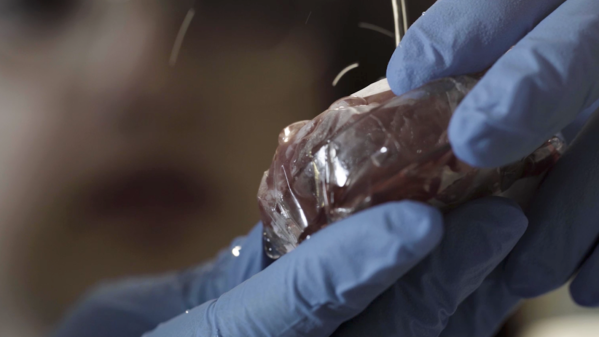
Anti-Bacterial Plastic Wrap Clings To Hope Of Stopping Superbugs’ Spread

Researchers at McMaster University in Ontario have developed a plastic wrap that repels viruses and bacteria, including some of the scariest antibiotic-resistant superbugs known to science. With the help of a scanning electron microscope, the researchers were able to watch superbugs like MRSA and Pseudomonas bounce right off the surface.

The wrap can be applied to things temporarily, much like that stuff you wrestle from the box and stretch over your leftovers. It can also be shrink-wrapped to any compatible surface without losing effectiveness. The ability to cover surfaces with bacteria-shielding armor could have an incredible impact on superbug populations inside hospitals. It could be shrink-wrapped to all kinds of things, from door handles to railings to waiting room chair armrests to the pens that everyone uses to sign off on receiving care.

Continue reading “Anti-Bacterial Plastic Wrap Clings To Hope Of Stopping Superbugs’ Spread”

A DNA-Based Computer Calculates Square Roots Up To 900

While DNA-based computing may not be taking over silicon quite so soon, there is progress in the works. In a paper published by Small, researchers from the University of Rochester demonstrate a molecular computing system capable of calculating square roots of integers up to 900. The computer is built from synthetic biochemical logic gates using hybridization, a process where two strands of DNA join to form double-stranded DNA, and strand displacement reactions.

DNA-based circuits have already been shown to implement complex logic functions, but most existing circuits prior to the recent paper were unable to calculate square root operations. This required 4-bit binary numbers – the new prototype implements a 10-bit square root logic circuit, operating up to the decimal integer 900.

The computer uses 32 strands of DNA for storing and processing information. The process uses three modules, starting off with encoding a number on the DNA. Each combination is attached to a florescent marker, which changes signal during hybridization in the second module. The process for calculating the square root controls the signals, with the results deducted from the final color according to a threshold set in the third module.

We’re beginning to see the end of Moore’s Law approaching, with companies like Intel and AMD struggling to shrink transistors 10 nm wide. Nevertheless, with DNA molecules still about 10 time smaller than the best transistors today and DNA computing systems continuing to gain in sophistication, biochemical circuits could potentially be holding solutions to increasing the speed of computing beyond silicon computing.

Titanium Coating Is Actually Pretty Straightforward

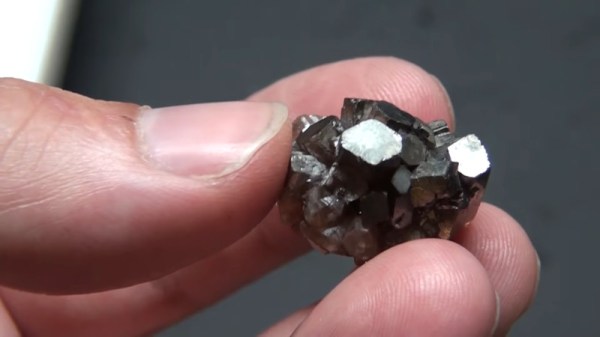
[Justin] enjoys tinkering in his home lab, working on a wide variety of experiments. Recently, he’d found much success in coating objects with thin layers of various metals with the help of a DC sputtering magnetron. However, titanium simply wouldn’t work with this setup. Instead, [Justin] found another way.

As it turns out, coating with titanium is quite achievable for even the garage operative. Simply run current through a titanium wire, heating it above 900 degrees in a vacuum. This will create a shower of titanium atoms that will coat virtually anything else in the chamber. [Justin] was able to achieve this with little more than some parts from Home Depot, a vacuum pump, and a cheap glass jar. He was able to produce a nice titanium oxide finish on a knife blade, giving that classic rainbow look. Coating crystals was less straightforward, but the jet black finish achieved was impressive nonetheless.

[Justin] plans to upgrade his vacuum rig further, and with better process control, we’d expect even better results. The earlier work is also very relevant if you’re interested in creating fine coatings of other materials. Video after the break. Continue reading “Titanium Coating Is Actually Pretty Straightforward”

Spintronic RAM Gets A Little Closer To SRAM

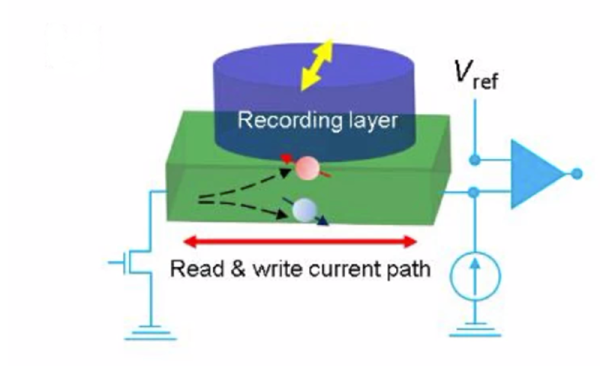
Sometimes it seems as though everything old is new again. The earliest computers used magnetic memory such as magnetic core. As practical as that was compared to making for example each bit of memory be a vacuum tube or relay flip flop, newer technology such as SRAM and DRAM displaced core and similar technologies. However, some of the newest technologies once again use magnetic fields. FRAM or ferroelectric RAM and magnetoresistive or MRAM both use magnetic fields to store data. Now Japanese researchers think they are on track to make MRAM more competitive with traditional RAM chips.

The Tokyo Institute of Technology researchers use new material combinations to make chips that store data based on the spin of electrons — the underlying reason for the way magnets behave. Their recent paper discusses USMR or Unidirectional spin Hall magnetoresistance and using this effect could greatly simplify the construction of MRAM cells.

Continue reading “Spintronic RAM Gets A Little Closer To SRAM”

The Oldest Nuclear Reactor? Nature’s 2 Billion Year Old Experiment

When was the first nuclear reactor created? You probably think it was Enrico Fermi’s CP-1 pile built under the bleachers at the University of Chicago in 1942. However, you’d be off by — oh — about 2 billion years.

The first reactors formed naturally about 2 billion years ago in what is now Gabon in West Africa. This required several things coming together: natural uranium deposits, just the right geology in the area, and a certain time in the life of the uranium. This happened 17 different times, and the average output of these natural reactors is estimated at about 100 kilowatts — a far cry from a modern human-created reactor that can reach hundreds or thousands of megawatts.

The reactors operated for about a million years before they spent their fuel. Nuclear waste? Yep, but it is safely contained underground and has been for 2 billion years.

Continue reading “The Oldest Nuclear Reactor? Nature’s 2 Billion Year Old Experiment”

Tracking Vaccination History With Invisible Tattoos

Nowadays, we still rely on medical records to tell when our last vaccinations were. For social workers in developing countries, it’s an incredibly difficult task especially if there isn’t a good standard in place for tracking vaccinations already.

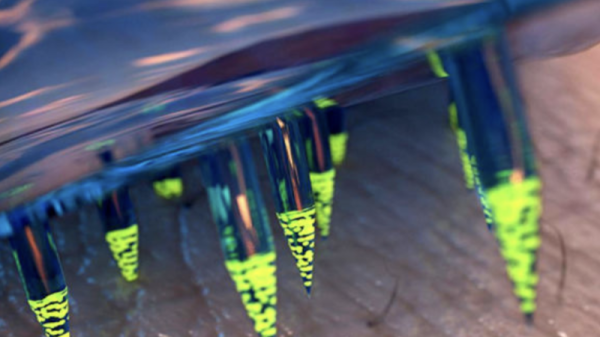
A team at the Massachusetts Institute of Technology may be providing a solution – they’ve developed a safe ink to be embedded into the skin alongside the vaccine, only visible under a special light provided by a smartphone camera app. It’s an inconspicuous way to document the patient’s vaccination history directly into their skin and low-risk enough to massively simplify the process of maintaining medical records for vaccines.

Continue reading “Tracking Vaccination History With Invisible Tattoos”

LC Oscillators, Animated

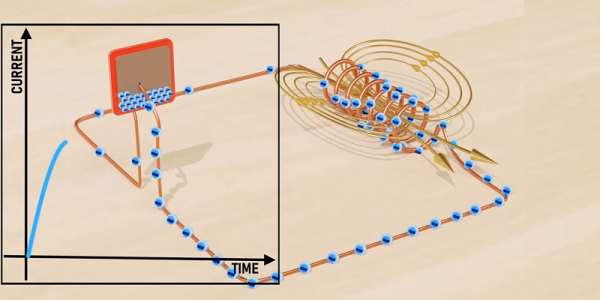
We wish that all the beautiful animations that are available today to understand math and electronics had been around when we were in school. Nonetheless, they are there for today’s students and [Learn Engineering] has another gorgeous one covering LC oscillation. Check it out, below.

If you are thoroughly grounded — no pun intended — in LC circuits, you probably won’t learn anything new. However, the animations are worth watching, just to admire them, if nothing else.

Continue reading “LC Oscillators, Animated”