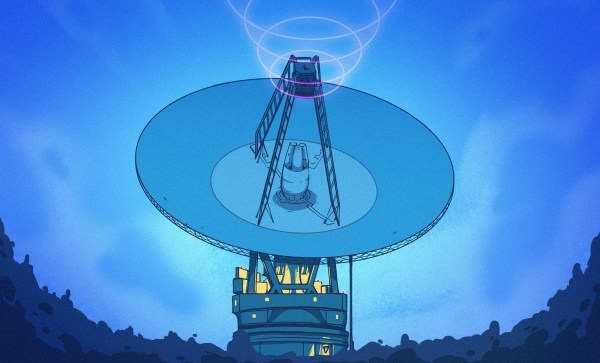
Eulogy To Arecibo: With Demise Of A Unique Scientific Facility, Who Will Carry The Torch?

Few telescopes will get an emotional response from the general public when it is ultimately announced that they will be decommissioned. In the case of the Arecibo Observatory in Arecibo, Puerto Rico, the past months has seen not only astronomers but also countless people across the world wait with bated breath after initial reports of damage to the radio telescope’s gigantic dish.

When the National Science Foundation announced that they would be decommissioning the telescope, there was an understandable outpouring of grief and shock. Not only is Arecibo a landmark in Puerto Rico, it is the telescope from iconic movies such as GoldenEye (1995) and Contact (1997). Its data fed public programs such as the Seti@Home and Einstein@Home projects.

Was Arecibo’s demise truly unavoidable, and what does this mean for the scientific community?

Continue reading “Eulogy To Arecibo: With Demise Of A Unique Scientific Facility, Who Will Carry The Torch?”

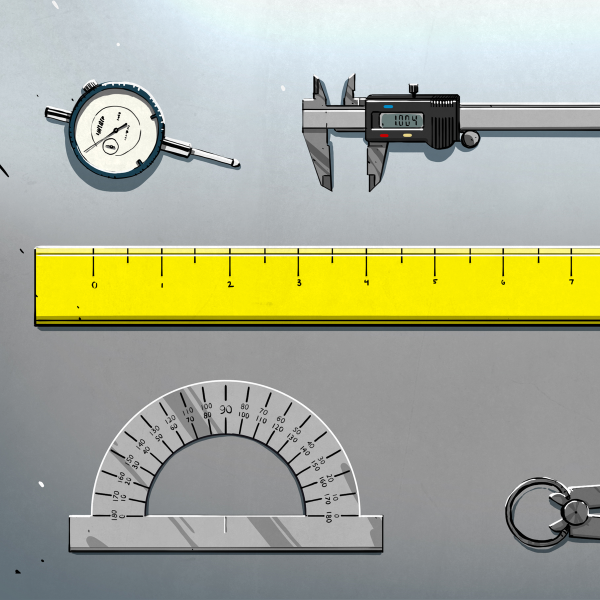
High-Speed Spectrometer Built With Cheap Linear CCD

If you’ve ever dreamed of building a proper spectrometer, it looks like the ESPROS epc901 CCD sensor is absolutely worth your attention. It’s fast, sensitive, easy to interface with, and at just $24 USD, it won’t break the bank. There’s only one problem: implementing it in your project means either working with the bare 2×16 0.5 mm pitch BGA device, or shelling out nearly $1,400 USD for the development kit.

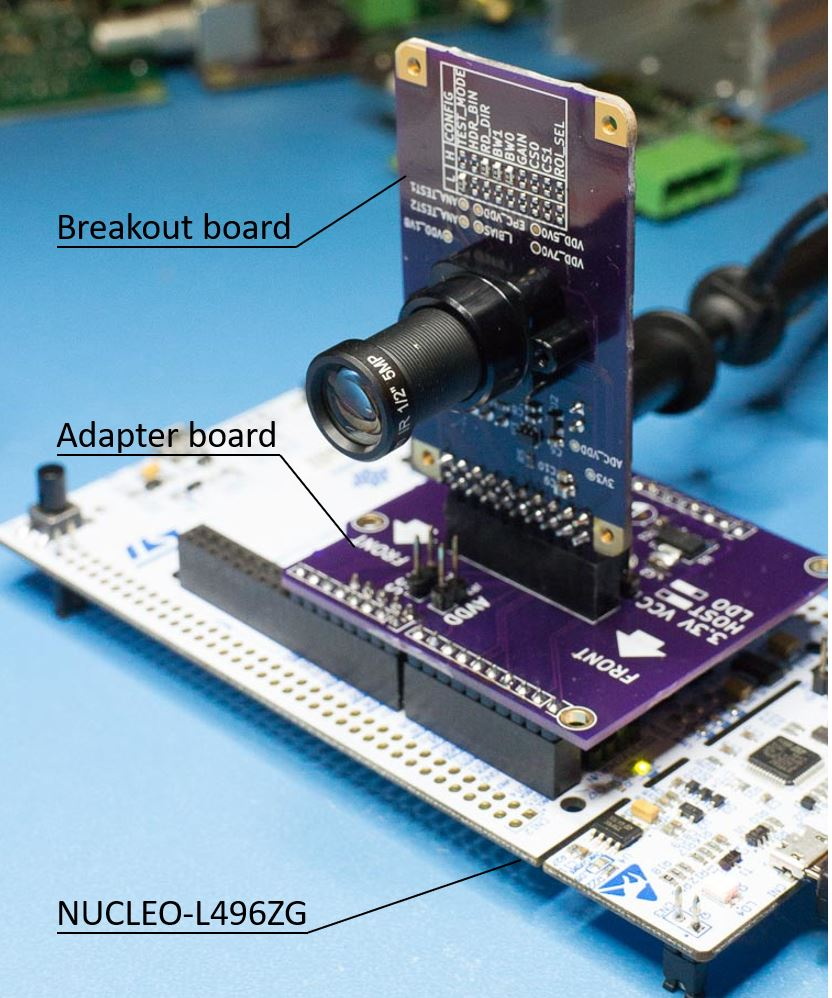
Thankfully, [Adrian Studer] has come up with a compromise. While you’ll still need to reflow the BGA to get it mounted, his open hardware breakout andĀ adapter boards for the ESPROS epc901 make the sensor far easier to work with.

It’s not just a hardware solution either, he also provides firmware code for the STM32L4 based Nucleo development board and some Python scripts that make it easy to pull data from the sensor. The firmware even includes a simple command line interface to control the hardware that you can access over serial.

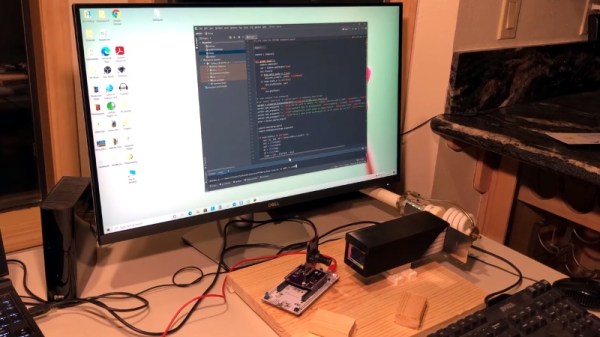
With the sensor successfully wrangled, [Adrian] partnered with [Frank Milburn] to build an affordable spectrometer around it. The design makes use of a 3D printed chamber, a simple commercial diffraction grating, and an array of entrance slits ranging from 0.5 to 0.0254 millimeters in width that were laser-cut into a sheet of stainless steel.

In the videos after the break, you can see the finished spectrometer being used to determine the wavelength of LEDs, as well as a demonstration of how the high-speed camera module is able to study the spectral variations of a CFL bulb over time. [Adrian] tells us that he and [Frank] are open to suggestions as to what they should point their new spectrometer at next, so let them know in the comments if you’ve got any interesting ideas.

We’ve seen an incredible number of spectrometer builds over the years, and some of the more recent ones are really pushing the envelope in terms of what the DIY scientist is capable of doing in the home lab. While they’re still fairly niche, these instruments are slowly but surely finding their way into the hands of more curious hackers.

Continue reading “High-Speed Spectrometer Built With Cheap Linear CCD”

The Battle For Arecibo Has Been Lost

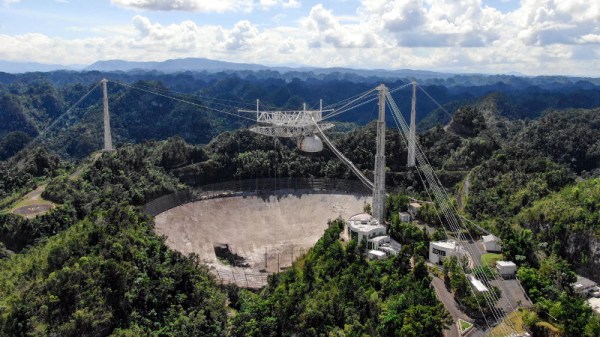
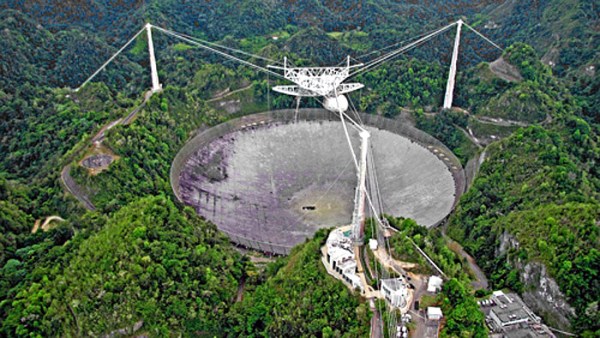
It is with a heavy heart that we must report the National Science Foundation (NSF) has decided to dismantle the Arecibo Observatory. Following the failure of two support cables, engineers have determined the structure is on the verge of collapse and that the necessary repairs would be too expensive and dangerous to conduct. At the same time, allowing the structure to collapse on its own would endanger nearby facilities and surely destroy the valuable research equipment suspended high above the 300 meter dish. Through controlled demolition, the NSF hopes to preserve as much of the facility and its hardware as possible.

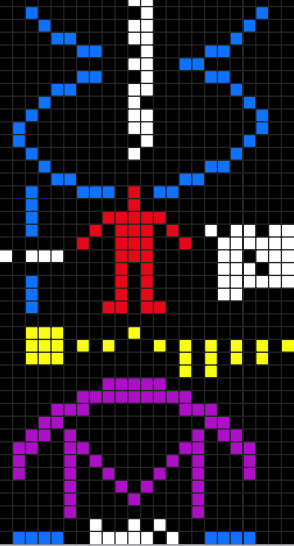
Section of the Arecibo Message

When the first support cable broke free back in August, we worried about what it meant for the future of this unique astronomical observatory. Brought online in 1963 as part of a Cold War project to study how ICBMs behaved in Earth’s upper atmosphere, the massive radio telescope is unique in that it has the ability to transmit as well as receive. This capability has been used to produce radar maps of distant celestial objects and detect potentially hazardous near-Earth asteroids.

In 1974, it was even used to broadcast the goodwill of humankind to any intelligent lifeforms that might be listening. Known as the “Arecibo Message”, the transmission can be decoded to reveal an assortment of pictograms that convey everything from the atomic numbers of common elements to the shape of the human body. The final icon in the series was a simple diagram of Arecibo itself, so that anyone who intercepted the message would have an idea of how such a relatively primitive species had managed to reach out and touch the stars.

There is no replacement for the Arecibo Observatory, nor is there likely to be one in the near future. The Five hundred meter Aperture Spherical Telescope (FAST) in China is larger than Arecibo, but doesn’t have the crucial transmission capability. The Goldstone Deep Space Communications Complex in California can transmit, but as it’s primarily concerned with communicating with distant spacecraft, there’s little free time to engage in scientific observations. Even when it’s available for research, the largest dish in the Goldstone array is only 1/4 the diameter of the reflector at Arecibo.

Just last week we wondered aloud whether a nearly 60 year old radio telescope was still worth saving given the incredible advancements in technology that have been made in the intervening years. Now, unfortunately, we have our answer.

What Is Worth Saving?

When it rain, it pours. One of the primary support cables holding up the Arecibo Observatory dish in Puerto Rico has just snapped, leaving its already uncertain fate. It had been badly damaged by Hurricane Maria in 2017, and after a few years of fundraising, the repairs were just about to begin on fixing up that damage, when the cable broke. Because the remaining cables are now holding increased weight, humans aren’t allowed to work on the dome until the risk of catastrophic failure has been ruled out — they’re doing inspection by drone.

Arecibo Observatory has had quite a run. It started out life as part of a Cold War era ICBM-tracking radar, which explains why it can transmit as well as receive. And it was the largest transmitting dish the world had. It was used in SETI, provided the first clues of gravitational waves, and found the first repeating fast radio bursts. Its radar capabilities mean that it could be used in asteroid detection. There are a number of reasons, not the least of which its historic import, to keep it running.
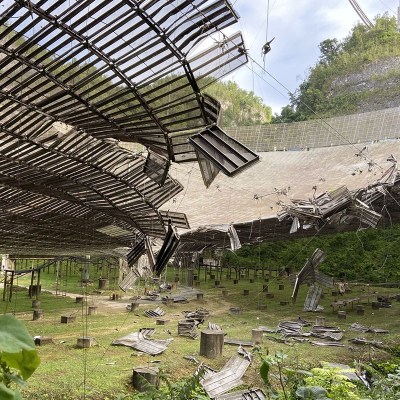
So when we ran this story, many commenters, fearing the worst, wrote in with their condolences. But some wrote in with outrage at the possibility that it might not be repaired. The usual suspects popped up: failure to spend enough on science, or on infrastructure. From the sidelines, however, and probably until further structural studies are done, we have no idea how much a repair of Arecibo will cost. After that, we have to decide if it’s worth it.

Per a 2018 grant, the NSF was splitting the $20 M repair and maintenance bill with a consortium led by the University of Central Florida that will administer the site. With further damage, that might be an underestimate, but we don’t know how much of one yet.

When do you decide to pull the plug on something like this? Although the biggest, Arecibo isn’t the only transmitter out there. The next largest transmitters are part of Deep Space Network, though, and are busy keeping touch with spacecraft all around our solar system. For pure receiving, China’s FAST is bigger and better. And certainly, we’ve learned a lot about radio telescopes since Arecibo was designed.

I’m not saying that we won’t shed a tear if Arecibo doesn’t get repaired, but it’s not the case that the NSF’s budget has been hit dramatically, or that they’re unaware of the comparative value of various big-ticket astronomy projects. Without being in their shoes, and having read through the thousands of competing grant proposals, it’s hard to say that the money spent to prop up a 70 year old telescope wouldn’t be better spent on something else.

Rotating Magnetic Fields, Explained

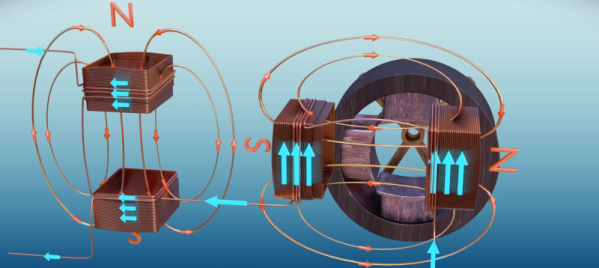
If you made a motor out of a magnet, a wire coil, and some needles, you probably remember that motors and generators depend on a rotating magnetic field. Once you know how it works, the concept is pretty simple, but did you ever wonder who worked it all out to start with? Tesla figures into it, unsurprisingly. But what about Michael Dobrowolsky or Walter Bailey? Not common names to most people. [Learn Engineering] has a slick video covering the history and theory of rotating magnetic field machines, and you can watch it below.

Motors operated on direct current were not very practical at the time and caused a jerky motion. However, Tesla and another inventor named Ferraris realized that AC current could cause a rotating magnetic field without a moving commutator.

Continue reading “Rotating Magnetic Fields, Explained”

Tensions High After Second Failed Cable At Arecibo

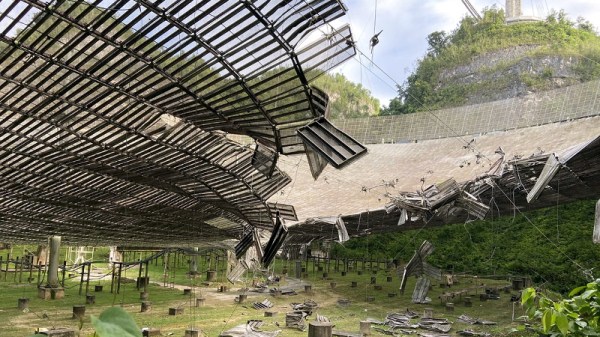
Today we’re sad to report that one of the primary support cables at the Arecibo Observatory has snapped, nudging the troubled radio telescope closer to a potential disaster. The Observatory’s 300 meter reflector dish was already badly in need of repairs after spending 60 years exposed to the elements in Puerto Rico, but dwindling funds have made it difficult for engineers to keep up. Damage from 2017’s Hurricane Maria was still being repaired when a secondary support cable broke free and smashed through the dish back in August, leading to grave concerns over how much more abuse the structure can take before a catastrophic failure is inevitable.

The situation is particularly dire because both of the failed cables were attached to the same tower. Each of the remaining cables is now supporting more weight than ever before, increasing the likelihood of another failure. Unless engineers can support the dish and ease the stress on these cables, the entire structure could be brought down by a domino effect; with each cable snapping in succession as the demands on them become too great.

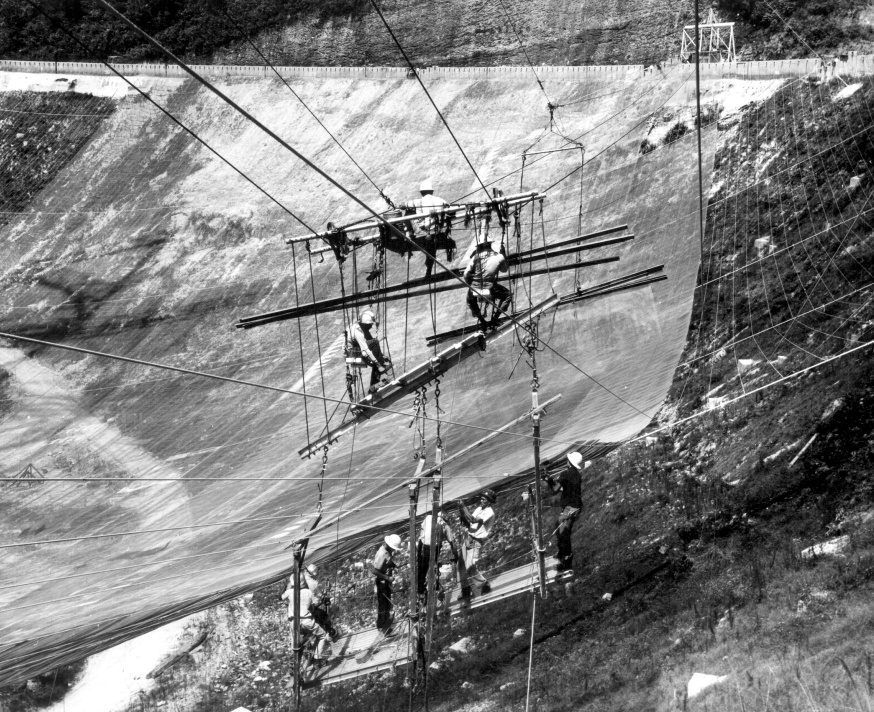
Workers installing the reflector’s mesh panels in 1963.

As a precaution the site has been closed to all non-essential personnel, and to limit the risk to workers, drones are being used to evaluate the dish and cabling as engineers formulate plans to stabilize the structure until replacement cables arrive. Fortunately, they have something of a head start.

Back in September the University of Central Florida, which manages the Arecibo Observatory, contacted several firms to strategize ways they could address the previously failed cable and the damage it caused. Those plans have now been pushed up in response to this latest setback.

Unfortunately, there’s still a question of funding. There were fears that the Observatory would have to be shuttered after Hurricane Maria hit simply because there wasn’t enough money in the budget to perform the relatively minor repairs necessary. The University of Central Florida stepped in and provided the funding necessary to keep the Observatory online in 2018, but they may need to lean on their partner the National Science Foundation to help cover the repair bill they’ve run up since then.

The Arecibo Observatory is a unique installation, and its destruction would be an incredible blow for the scientific community. Researchers were already struggling with the prospect of repairs putting the powerful radio telescope out of commission for a year or more, but now it seems there’s a very real possibility the Observatory may be lost. Here’s hoping that teams on the ground can safely stabilize the iconic instrument so it can continue exploring deep space for years to come.

Illuminating The Inner Workings Of A Venus Flytrap

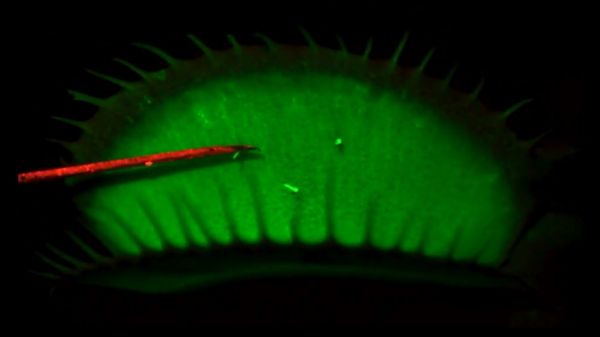
As a carnivorous plant, Venus flytraps have always been a fascinating subject of study. One of their many mysteries is how they differentiate an insect visit from less nutritious stimulants such as a windblown pebble. Now scientists are one step closer to deciphering the underlying mechanism, assisted by a new ability to visualize calcium changes in real time.

Calcium has long been suspected to play an important part in a Venus flytrap’s close/no-close decision process, but scientists couldn’t verify their hypothesis before. Standard chemical tests for calcium would require cutting the plant apart, which would only result in a static snapshot. The software analogy would be killing the process for a memory dump but unable to debug the process at runtime. There were tantalizing hints of a biological calcium-based analog computer at work, but mother nature had no reason to evolve JTAG test points on it.

Lacking in-circuit debug headers, scientists turned to the next best thing: add diagnostic indicator lights. But instead of blinking LEDs, genes were added to produce a protein that glows in the presence of calcium. Once successful, they could work with the engineered plants and get visual feedback. Immediately see calcium levels change and propagate in response to various stimuli over different time periods. Confirming that the trap snaps shut only in response to patterns of stimuli that push calcium levels beyond a threshold.

With these glowing proteins in place, researchers found that calcium explained some of the behavior but was not the whole picture. There’s something else, suspected to be a fast electrical network, that senses prey movement and trigger calcium release. That’ll be something to dig into, but at least we have more experience working with electrical impulses and not just for plants, either.

Continue reading “Illuminating The Inner Workings Of A Venus Flytrap”