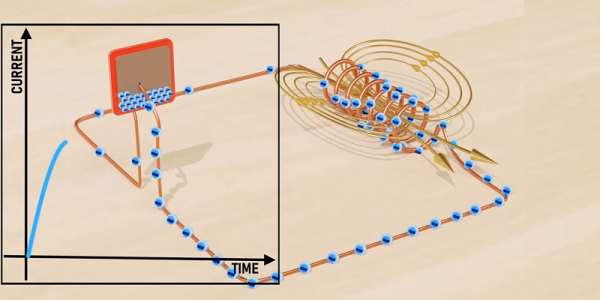
We wish that all the beautiful animations that are available today to understand math and electronics had been around when we were in school. Nonetheless, they are there for today’s students and [Learn Engineering] has another gorgeous one covering LC oscillation. Check it out, below.
If you are thoroughly grounded — no pun intended — in LC circuits, you probably won’t learn anything new. However, the animations are worth watching, just to admire them, if nothing else.
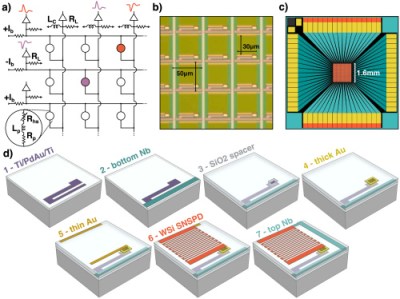
There may soon be breakthroughs in the search for dark matter. A new publication in Optics Expressreveals a camera consisting of superconducting nanowires capable of detecting single photons, a useful feature for detecting light at the furthest ends of the infrared band. The high-performance camera, developed by the National Institute of Standards and Technology (NIST), boasts some of the best performing photon counters in the world in terms of speed, efficiency, and color detection. The detectors also have some of the lowest dark count rates of any photon sensor, resisting false signals from noise.
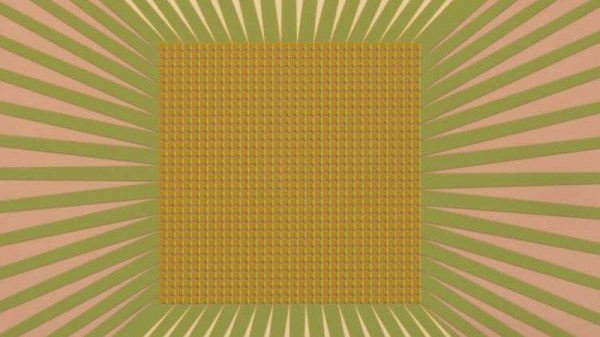
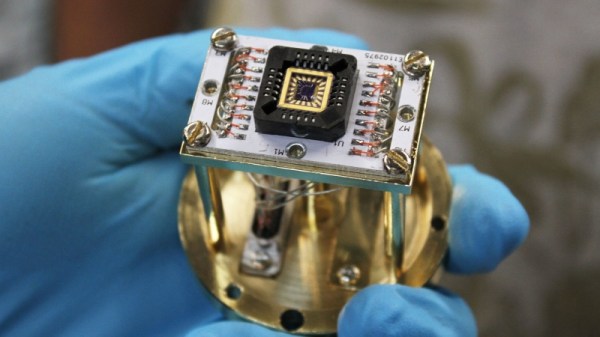
The size of the detectors comes out to 1.6mm on each side, packed with 1024 sensors for high resolution imagery and fabricated from silicon wafers cut into chips. The nanowires are made from tungsten and silicon alloy with leads made from superconducting niobium.
In order to prevent the sensors from overheating, a readout architecture was used based on a previous demonstration on a smaller camera with 64 sensors adding data from rows and columns. The research has been in collaboration with the National Aeronautics and Space Administration (NASA), which seeks to include the camera in the Origins Space Telescope project.
The eventual goal is to use the arrays to analyze chemical compositions of planets outside of our solar system. By observing the absorption spectra of light passing through an exoplanet’s atmosphere, information can be gathered on the elements in the atmosphere. Currently, large-area single-photon counting detector arrays don’t exist for measuring the mid- to far-infrared signatures, the spectrum range for elements that may indicate signs of life. While fabrication success is high, the efficiency of the detectors remains quite low, although there are plans to extend the current project into an even bigger camera with millions of sensors.
In addition to searching for chemical life on other planets, future applications may include recording measurements to confirm the existence of dark matter.
In any normal situation, if you’d read an article that about building your own quantum computer, a fully understandable and natural reaction would be to call it clickbaity poppycock. But an event like the Chaos Communication Congress is anything but a normal situation, and you never know who will show up and what background they will come from. A case in point: security veteran [Yann Allain] who is in fact building his own quantum computer in his garage.
Starting with an introduction to quantum computing itself, and what makes it so powerful also in the context of security, [Yann] continues to tell about his journey of building a quantum computer on his own. His goal was to build a stable computer he could “easily” create by himself in his garage, which will work at room temperature, using trapped ion technology. After a few iterations, he eventually created a prototype with KiCad that he cut into an empty ceramic chip carrier with a hobbyist CNC router, which will survive when placed in a vacuum chamber. While he is still working on a DIY laser system, he feels confident to be on the right track, and his estimate is that his prototype will achieve 10-15 qubits with a single ion trap, aiming to chain several ion traps later on.
As quantum computing is often depicted as cryptography’s doomsday device, it’s of course of concern that someone might just build one in their garage, but in order to improve future cryptographic systems, it also requires to fully understand — also on a practical level — quantum computing itself. Whether you want to replicate one yourself, at a rough cost of “below 15k Euro so far” is of course a different story, but who knows, maybe [Yann] might become the Josef Prusa of quantum computers one day.
In the world of physics research, graphene has been gaining popularity as one of the most remarkable materials in the last 15 years. While it may appear unassuming in common household goods such as pencil leads, the material boasts a higher strength than steel and a higher flexibility than paper. On top of all that, it is also ultra-light and an excellent conductor of electric current and heat.
Recently, physicists from the Massachusetts Institute of Technology discovered that stacking two sheets of graphene and twisting a small angle between them reveals an entire new field of material science – twistronics. In a paper published in Nature, researchers have taken a look into this new material, known as the magic-angle twisted bilayer graphene. By modifying the graphene’s temperature, they were able to cause the material to shift from behaving like an insulator to transforming into a superconductor.
A graphic in the New York Times demonstrates some of the interesting properties that arise from stacking and twisting two sheets. Scientists have long known that graphene is a one-layer-thick honeycombed pattern of carbon atoms, but actually separating a single sheet of graphene has been fairly difficult. A low-tech method pioneered by two physicists at the University of Manchester involves using sticky tape to pull apart graphene layers until a single layer is left.
Small imperfections that arise from slightly misaligned sheets manifests in a pattern that allows electrons to hop between atoms in regions where the lattice line up, but unable to flow in regions that are misaligned. The slower moving electrons are thus more likely to interact with each other, becoming “strongly correlated”.
The technique for measuring the properties of this new twisted graphene is similarly low-tech. After a single layer of graphene is separated by sticky tape, the tape is torn in half to reveal two halves with perfectly aligned lattices. One of the sides is rotated by about 1.3 degrees and pressed onto the other. Sometimes, the layers would snap back into alignment, but other times they would end up at 1.1 degrees and stop rotating.
When the layers were cooled to a fraction of a degree above absolute zero, they were observed to become a superconductor, an incredibly discovery for the physicists involved in the experiment. Further studies showed that different permutations of temperature, magnetic field, and electron density were also able to turn the graphene into a superconductor. On top of this, the graphene was also able to exhibit a form of magnetism arising from the movement of electrons rather than the intrinsic properties of the atoms. With so many possibilities still unexplored, it’s certain that twistronics will reveal some remarkable findings pretty soon.
It’s an unfortunate reality that for many of us, our air isn’t nearly as clean as we’d like. From smog to wildfires, there’s a whole lot of stuff in the air that we’d just as soon like to keep out of our lungs. But in order to combat this enemy, you first need to understand it. That means figuring out just what’s in the air you breathe, and how much of it. That’s where devices like the Dust Box from [The IoT GURU] can come in handy.
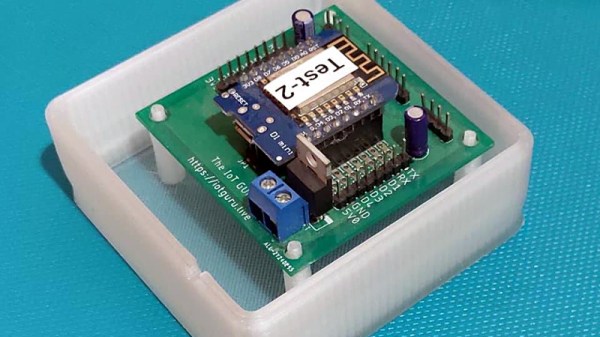
Inside the 3D printed enclosure is a Wemos D1 Mini ESP8266 development board, sitting on a custom breakout PCB. This board gives you some easy expandability to add your own sensors and hardware, though in this particular configuration, the Dust Box is using the BME280 sensor for general environmental monitoring and the SDS011 laser particle sensor to determine what’s in the air. Just plug it into a convenient USB power source, make sure it’s connected to the WiFi, and off it goes.
But where does all that lovely data end up? That’s up to you, but in this case, the [The IoT GURU] is pushing everything out to a web interface that allows the user to view yearly, monthly, and weekly historical data for each of the parameters the Dust Box can check. This is probably a bit more granular than most of us need, but it’s a good example of what’s possible should you need that much information.
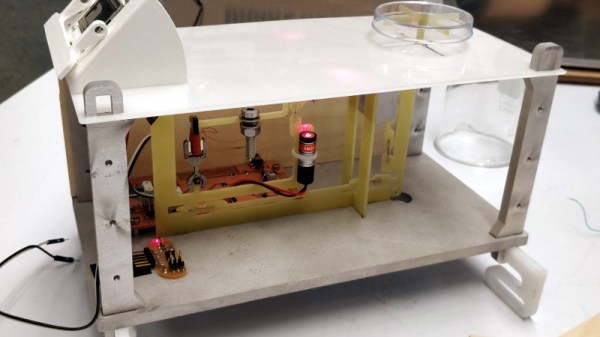
As the open-source movement has brought its influence to more and more fields, we’ve seen an astonishing variety of things once only available at significant expense become accessible to anyone with access to the tools required to create them. One such arena is that of scientific instrumentation, and though we have seen many interesting developments there has been one which has so far evaded us. An analytical balance, a very specialised weighing machine designed to measure the tiniest of masses, remains available only as a new unit costing a fortune, or as a second-hand one with uncertain history and possible contamination. Fortunately, friend of Hackaday [Zach Fredin] is on the case, and as part of one of his MIT courses he chose to create an open-source analytical balance.
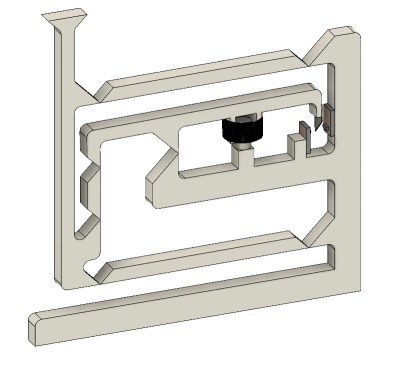
The write-up is interspersed with his course notes as he learns a series of fabrication techniques, but in addition to the milled Delrin finished model he treats us to his prototype and gives us an explanation of how these instruments work. It’s a technique that’s rather different to a traditional weighing machine: instead of measuring deformation of a spring in some way it produces a force from an electromagnet to oppose that exerted by gravity on the mass to be measured, and quantifies how much electrical energy is required to do that. The mechanism incorporates feedback through a vane and an optical sensor, which he admits he’s not yet had time to set up properly.
It’s an interesting project not least because it exposes some of the inner workings of an analytical balance, and we look forward to his completing it. If this whet your appetite for the topic it’s worth also looking at [Ben Krasnow’s] video of a balance made using a moving coil meter for an explanation of the technique.
Over the years, humans have come up with four forces that can be used to describe every single interaction in the physical world. They are gravity, electromagnetism, the weak nuclear force that causes particle decay, and the strong nuclear force that binds quarks into atoms. Together, these have become the standard model of particle physics. But the existence of dark matter makes this model seem incomplete. Surely there must be another force (or forces) that explain both its existence and the reason for its darkness.
Hungarian scientists from the Atomki Nuclear Research Institute led by Professor Attila Krasznahorkay believe they have found evidence of a fifth force of nature. While monitoring an excited helium atom’s decay, they observed it emitting light, which is not unusual. What is unusual is that the particles split at a precise angle of 115 degrees, as though they were knocked off course by an invisible force.
The scientists dubbed this particle X17, because they calculated its mass at 17 megaelectronvolts (MeV). One electron Volt describes the kinetic energy gained by a single electron as it moves from zero volts to a potential of one volt, and so a megaelectronvolt is equal to the energy gained when an electron moves from zero volts to one million volts.
What Are Those First Four, Again?
Let’s start with the easy one, gravity. It gives objects weight, and keeps things more or less glued in place on Earth. Though gravity is a relatively weak force, it dominates on a large scale and holds entire galaxies together. Gravity helps us work and have fun. Without gravity, there would be no water towers, hydroelectric power plants, or roller coasters.
The electromagnetic force is a two-headed beast that dominates at the human scale. Almost everything we are and do is underpinned by this force that surrounds us like an ethereal soup. Electricity and magnetism are considered a dual force because they work on the same principle — that opposite forces attract and like forces repel.
This force holds atoms together and makes electronics possible. It’s also responsible for visible light itself. Each fundamental force has a carrier particle, and for electromagnetism, that particle is the photon. What we think of as visible light is the result of photons carrying electrostatic force between electrons and protons.
The weak and strong nuclear forces aren’t as easy to grasp because they operate at the subatomic level. The weak nuclear force is responsible for beta decay, where a neutron can turn into a proton plus an electron and anti-neutrino, which is one type of radioactive decay. Weak interactions explain how particles can change by changing the quarks inside them.
The strong nuclear force is the strongest force in nature, but it only dominates at the atomic scale. Imagine a nucleus with multiple protons. All those protons are positively charged, so why don’t they repel each other and rip the nucleus apart? The strong nuclear force is about 130x stronger than the electromagnetic force, so when protons are close enough together, it will dominate. The strong nuclear force holds both the nucleus together as well as the nucleons themselves.
The Force of Change
Suspicion of a fifth force has been around for a while. Atomki researchers observed a similar effect in 2015 when they studied the light emitted during the decay of a beryllium-8 isotope. As it decayed, the constituent electrons and positrons consistently repelled each other at another strange angle — exactly 140 degrees. They dubbed it a “protophobic” force, as in a force that’s afraid of protons. Labs around the world made repeated attempts to prove the discovery a fluke or a mistake, but they all produced the same results as Atomki.
Professor Attila Krasznahorkay and his team published their observations in late October, though the paper has yet to be peer-reviewed. Now, the plan at Atomki is to observe other atoms’ decay. If they can find a third atom that exhibits this strange behavior, we may have to take the standard model back to the drawing board to accommodate this development.
So what happens if science concludes that the X17 particle is evidence of a fifth force of nature? We don’t really know for sure. It might offer clues into dark matter, and it might bring us closer to a unified field theory. We’re at the edge of known science here, so feel free to speculate wildly in the comments.




 The write-up is interspersed with his course notes as he learns a series of fabrication techniques, but in addition to the milled Delrin finished model he treats us to