Build A Seismometer Out Of Plumbing Parts

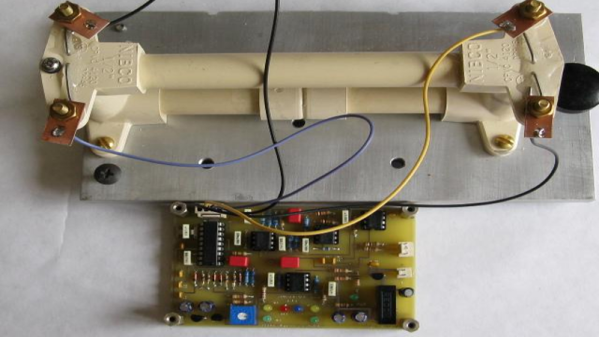
For those outside the rocking and rolling of California’s tectonic plate, earthquakes probably don’t come up on a daily basis as a topic of conversation. Regardless, the instrument to measure them is called a seismometer, and it’s entirely possible to build one yourself. [Bob LeDoux] has shared his article on how to build a Fluid Mass Electrolytic Seismometer, and it’s an impressive piece of work.

This is an instrument which works very differently from the typical needle-and-graph type seen in the movies. Fluid is held in a sealed chamber, with a restricted orifice in the center of a tube. The fluid level is monitored at each side of the orifice. When motion occurs, fluid levels change at either side which allows seismic activity to be measured.

Hooked up to some basic analog electronics, in this form, the device only shows instantaneous activity. However, it would be trivial for the skilled maker to hook this up to a datalogging setup to enable measurements to be plotted and stored. The entire project can be built with simple hand tools and a basic PCB, making it highly accessible.

It’s not the first time we’ve seen a seismometer, either – the Raspberry Shake project is a distributed network of sensors running on the Raspberry Pi.

Green Hacking: Overclocking Photosynthesis

We think of hacking as bending technology to our will. But some systems are biological,  and we’re also starting to see more hacking in that area. This should excite science fiction fans used to with reading about cultures that work with biological tech, so maybe we’ll get there in the real world too.  Hacking farm crops and animals goes back centuries, although we are definitely getting better at it. A case in point: scientists have found a way to make photosynthesis better and this should lead to more productive crops.

We learned in school that plants use carbon dioxide and sunlight to create energy and produce oxygen. But no one explained to us exactly how that happened. It seems a protein called rubisco is what causes this to happen, but unfortunately it isn’t very picky. In addition to converting carbon (from carbon dioxide) into sugar, it also converts oxygen into toxic compounds called ROS (reactive oxygen species) that most plants then have to spend energy eliminating. Scientists estimate that if you could recover the calories lost in this process, you could feed an additional 200 million people worldwide at current production levels.

Continue reading “Green Hacking: Overclocking Photosynthesis”

Excuse Me, I Have To Feed The Computer

It is a staple of science fiction to see a brain in a jar or other container, maybe used as some sort of computer device. You are probably imagining a brain-powered supercomputer with a room full of humans with electrodes in their heads, or maybe some other primate. The reality though is it might be just a small dish full of single-celled amoeba.

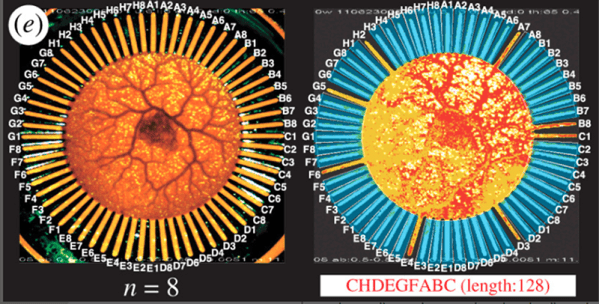
Researchers from China and Japan have successfully made a lowly amoeba solve the traveling salesman problem for 8 cities. We’ll be honest. We don’t totally understand the value to it over traditional methods, but it does prove that you can compute with organic matter. This isn’t just any amoeba, though. It is a particular kind, Physarum polycephalum, that has an unusual property — it can shapeshift, at least to a limited degree. The tiny creature is just like us in that it tries to get things it likes and avoid things it doesn’t like. It likes food, but it doesn’t like light.

Provide food, and the tiny creature will spread out. Shine light on it, and it will retract. That’s the property used to solve the thorny problem, but before we look at how that works it helps to understand the problem it is trying to solve.

Continue reading “Excuse Me, I Have To Feed The Computer”

RFID Doing More Than ID

RFID is a workhorse in industrial, commercial, and consumer markets. Passive tags, like work badges and key fobs, need a base station but not the tags. Sensors are a big market and putting sensors in places that are hard to reach, hostile, or mobile is a costly proposition. That price could drop, and the sensors could be more approachable with help from MIT’s Auto-ID Lab who are experimenting with sensor feedback to RFID devices.

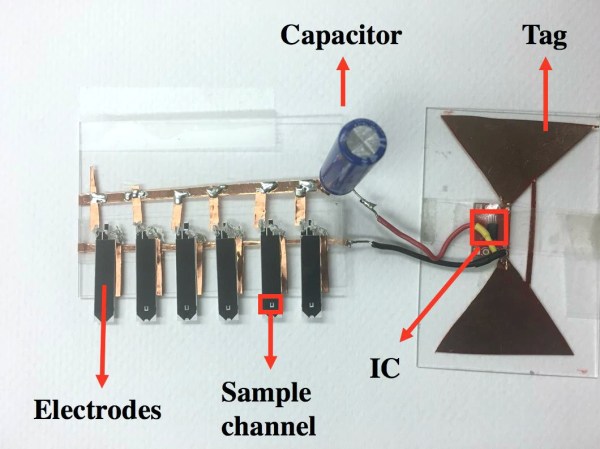
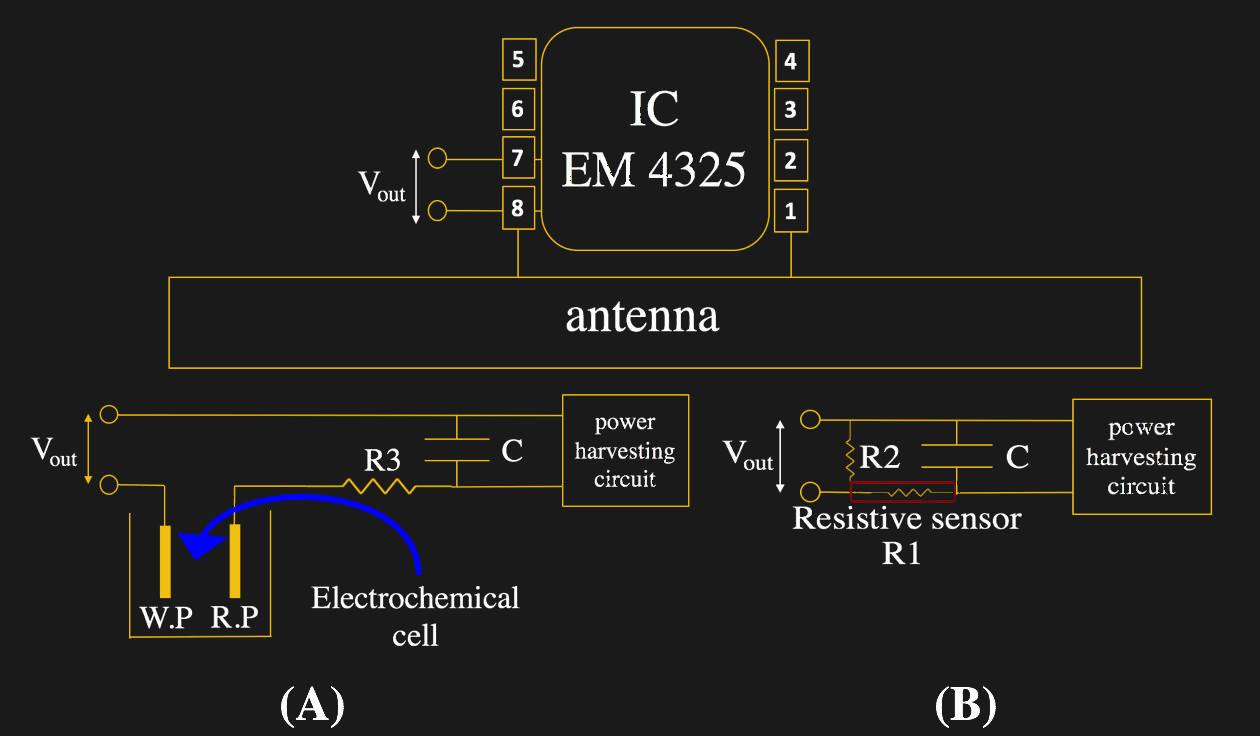
Let’s pretend you want to measure the temperature inside a vat of pressurized acid. You’d rather not drill a hole in it to insert a thermometer, but a temperature sensor sealed in Pyrex that wirelessly transmits the data and never runs out of power is a permanent and cheap solution. The researchers have their sights set on glucose sensing and that news come shortly after Alphabet gave up their RFID quest to measure glucose through contact lenses. Shown the top of this article is a prototype for a Battery Assisted Passive (BAP) RFID sensor that uses commodity glucose testing strips, sending data when the electrochemical reaction occurs. It uses six of these cells in parallel to achieve a high enough peak current to trigger the transmission. But the paper (10.1109/RFID.2018.8376201 behind paywall) mentions a few strategies to improve upon this. However, it does prove the concept that the current spike from the test strips determines the time the tag is active and that can be correlated to the blood glucose detected.

How many of our own projects would instantly upgrade with the addition of a few sensors that were previously unobtainable on a hacker budget? Would beer be brewed more effectively with more monitoring? How many wearables would be feasible with battery-free attachments? The sky is the figurative limit.

Thank you, [QES] for the tip [via TechXplore]

Does Electronic Current Flow Like Water?

If you think about an asylum, there are two kinds of people in it: staff and patients. We aren’t sure which one [Nick Lucid] is in the latest The Science Asylum video that tries to answer the question: does electricity really flow like water?

If you think about it, that isn’t such a strange question. We talk about electrical current — just like current in a stream. Many introductory books on electricity try to relate voltage to water pressure, electric current to water flow, and resistance to changes in pipe volume. Of course, you probably figured out that analogy doesn’t — ahem — hold water to some level of detail, but just how far off is it? We won’t spoil the surprise so you can watch the video to find out, but there were several really interesting tidbits. How fast do electrons drift through a conductor? The speed of light? Actually, no — remember, drift velocity is the average speed of an individual electron, not the speed of the electric current.

Continue reading “Does Electronic Current Flow Like Water?”

Can Magnets Replace The Spring In A Pogo Stick?

Betteridge’s law of headlines states that any headline that ends in a question mark can be answered by the word ‘no’. It’s the case with articles asking if Millennials are responsible for all of the world’s ills, or if some technology is the future. So we come to this fascinating case of native content (amusing, veiled advertising) from a store that sells really, really powerful magnets. The title of the article asks if magnets can replace the spring in a pogo stick. The answer, of course, is no, but it does provide a fascinating look at linear versus exponential growth.

A pogo stick is simply a spring with a set of handles and footholds that is the subject of a great number of hilarious YouTube videos, at least one of which is impressive. The physics of a pogo stick is determined entirely by Hooke’s Law, and is a linear equation, not counting the strength of a spring and the yield point of steel, but this is a pogo stick we’re talking about. Magnets, on the other hand, obey the inverse square law. Is it possible to fit an exponential function to fit a linear function? No. No, it is not.

I refuse to believe this is the first use of the phrase, ‘immensely disappointing pogo stick’

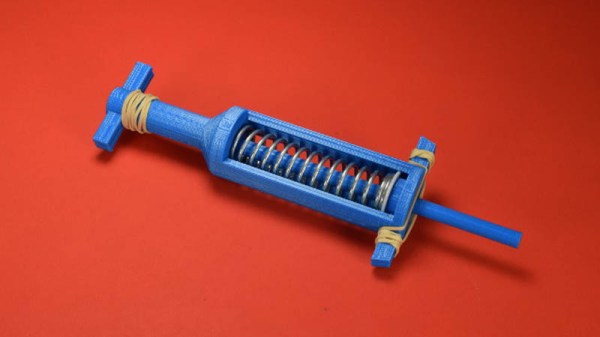
But a lack of understanding of the basic forces of nature never stopped anyone, so the folks at K & J Magnetics made a really neat test. They printed out a 1/8th scale pogo stick, complete with a spring. It worked like any pogo stick would. Then they took out the spring and put a few magnets where the spring should go. How did that work? Well, it bottomed out and was an immensely disappointing pogo stick.

If a problem is worth solving, it’s worth solving wrongly, so more magnets were added. Mounting three magnets onto a pogo stick gave the same exponential force, but still not enough. Four, five, and six magnets were added to the model pogo stick, and while six magnets gave this model pogo enough force to be ‘bouncy’, there simply wasn’t enough space for the pogo stick to compress.

The takeaway from this experiment is extremely obvious in retrospect, but probably too subtle for a lot of people. There’s a difference between a linear relationship and and exponential relationship. There’s also a video, you can check that out below.

Continue reading “Can Magnets Replace The Spring In A Pogo Stick?”

OpenLH: Automating Biology For Everyone

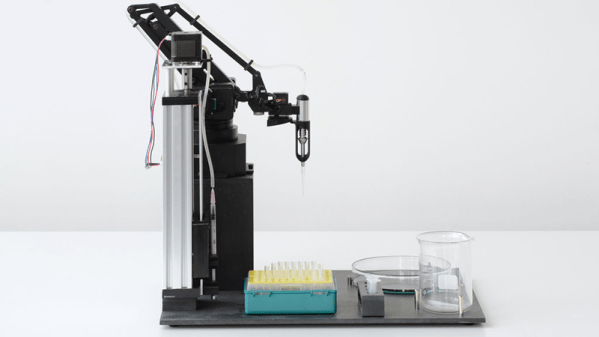
When we took a biology lab, you had to use a mouth pipette to transfer liquids around. That always seemed odd to use your mouth to pick up something that could be dangerous. It’s also not very efficient. A modern lab will use a liquid handling robot, but these aren’t exactly cheap. Sometimes these are called pipettors and even a used one on eBay will set you back an average of $1,000 — and many of them much more than that. Now there’s an open source alternative, OpenLH, that can be built for under $1,000 that leverages an open source robot arm. You can find a video about the system below.

The robot arm, a uArm Swift Pro, is the bulk of the cost.  The Pro can also operate as a 3D printer or a laser engraver with a little work. In fact, we wondered if you could use the arm to make a 3D printer and then print the parts you need to convert it to a liquid handler. Seems like it should work.

Continue reading “OpenLH: Automating Biology For Everyone”