Compact Slayer Exciter For Your High Voltage Needs

Tesla coils are incredible pieces of hardware, but they can be tricky to build. Between the spark gap, capacitors, and finely tuned coils, it’s not exactly a beginners project. Luckily, there’s hope for anyone looking for a less complex way to shoot some sparks: the Slayer Exciter. This device can be thought of as the little cousin to the Tesla coil, and can be used for many of the same high voltage experiments while being far easier to assemble.

Now [Jay Bowles] is obviously no stranger to building his own Tesla coils, but since so many of his fans wanted to see his take on this less complex option, he recently built his own Slayer Exciter. After putting on a few of his own unique touches, the end result looks very promising. It might not be able to throw sparks as far as some of the other creations featured on his YouTube channel, but it’s still impressive for something so simple.

[Jay] uses two transistors in parallel for reliability
When we say simple, we mean it. Building a bare-bones Slayer Exciter takes only takes five components: the two coils, a transistor, a diode, and a resistor. For this build, power is provided by a trio of rechargeable 9 V batteries in the base of the unit which can be easily swapped out as needed.

In the video, [Jay] does a great job explaining and illustrating how this basic circuit creates exceptionally high frequency energy. In fact, the frequency is so high that the human ear can’t hear it; unfortunate news for fans of the Tesla coil’s characteristic buzz.

Generally speaking Slayer Exciters would have the same sort of vertical coils that you’d see used on a traditional Tesla coil, but in this case, [Jay] has swapped that out for a pancake coil held in the upper level of the device. This makes for a very compact unit that would be perfect for your desk, if it wasn’t for the fact that the arcs produced by this gadget are hot enough to instantly vaporize human skin. Just something to keep in mind.

We’ve seen Slayer builds in the past, but none as well designed as this one. Incidentally, if you’re wondering about the array of neon indicator lights that [Jay] uses to visualize the electrical field, we covered that project as well.

Continue reading “Compact Slayer Exciter For Your High Voltage Needs”

Where Do You Get Your Neutrons? Neutron Sources For Nuclear Fusion, Science, Medicine, And Industry

All of us probably know what neutrons are, or have at least heard of them back in physics class. Yet these little bundles of quarks are much more than just filler inside an atom’s nucleus. In addition to being an essential part of making matter as stable as it (usually) is, free neutrons can be used in a variety of manners.

From breaking atoms apart (nuclear fission), to changing the composition of atoms by adding neutrons (transmutation), to the use of neutrons in detecting water and inspecting materials, neutrons are an essential tool in the sciences, as well as in medicine and industrial applications. This has meant a lot of development toward the goal of better neutron sources. While nuclear fission is an efficient way to get lots of neutrons, for most applications a more compact and less complicated approach is used, some of which use nuclear fusion instead.

In this article we’ll be taking a look at the many applications of neutron sources, and these neutron sources themselves.

Continue reading “Where Do You Get Your Neutrons? Neutron Sources For Nuclear Fusion, Science, Medicine, And Industry”

Drones Can Undertake Excavations Without Human Intervention

Researchers from Denmark’s Aarhus University have developed a method for autonomous drone scanning and measurement of terrains, allowing drones to independently navigate themselves over excavation grounds. The only human input is a starting location and the desired cliff face for scanning.

For researchers studying quarries, capturing data about gravel, walls, and other natural and man-made formations is important for understanding the properties of the terrain. Controlling the drones can be expensive though, since there’s considerable skill involved in manually flying the drone and keeping its camera steady and perpendicular to the wall it is capturing.

The process designed is a Gaussian model that predicts the wind encountered near the wall, estimating the strength based on the inputs it receives as it moves. It uses both nonlinear model predictive control (NMPC) and a PID controller in its feedback control system, which calculate the values to send to the drone’s motor controller. A long short-term memory (LSTM) model is used for calculating the predictions. It’s been successfully tested in a chalk quarry in Denmark and will continue to be tested as its algorithms are improved.

Getting a drone to hover and move between GPS waypoints is easy enough, but once they need to maneuver around obstacles it starts getting tricky. Research like this will be invaluable for developing systems that help drones navigate in areas where their human operators can’t reach.

[Thanks to Qes for the tip!]

The Legacy Of One Of Science’s Brightest Stars: Freeman Dyson

Of the many well-known names in science, few have been as reluctant to stick to one particular field as Freeman John Dyson. Born in the UK in 1923, he showed a great interest in mathematics and related fields even as a child. By the time he was 15 he had won a scholarship at Trinity College, in Cambridge, where he studied mathematics. Though the war forced him to work at the Air Force’s Operational Research Section (ORS), afterwards he would return to Trinity to get his BA in mathematics.

His subsequent career saw him teaching at universities in the UK and US, before eventually ending up at Cornell University, where he joined the Institute for Advanced Study at the invitation of its head, J. Robert Oppenheimer. Here he would meet up with such people as Richard Feynman with whom he would work on quantum electrodynamics.

Beyond mathematics and physics, Dyson would also express great interest in space exploration — with Dyson spheres being well-known — and genetics, both in the context of the first formation of life and in genetic manipulation to improve plants to deal with issues today. He also worked on the famous Project Orion, which used nuclear bombs for propulsion.

In this article we’ll take a look at these and other parts of Mr. Dyson’s legacy, as well as the influence of his works today.

Continue reading “The Legacy Of One Of Science’s Brightest Stars: Freeman Dyson”

Visualizing Energy Fields With A Neon Bulb Array

Everyone knows that one of the coolest things to do with a Tesla coil is to light up neon or fluorescent tubes at a distance. It’s an easy and very visual way to conceptualize how much energy is being pumped out, making it a favorite trick at science museums all over the world. But what would it look like if you took that same concept and increased the resolution? Replace that single large tube with an array of smaller ones. That’s exactly what [Jay Bowles] did in his latest video, and the results are impressive to say the least.

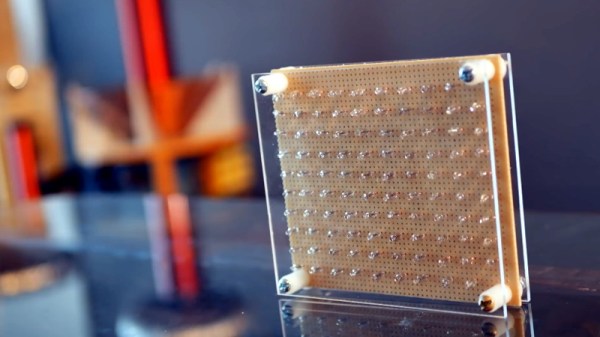
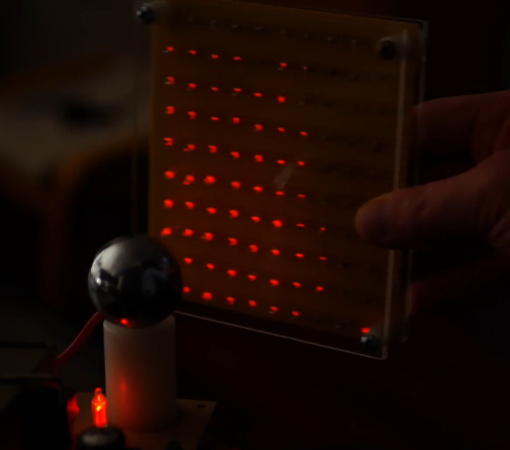
From a hardware standpoint, it doesn’t get much simpler. [Jay] knew from experience that if you bring a small neon indicator close to a Tesla coil, it will start to glow when approximately 80 volts is going through it. The higher the voltage, the brighter the glow. So he took 100 of these little neon bulbs and arranged them in a 10×10 grid on a piece of perfboard. There’s nothing fancy around the backside either, just all the legs wired up in parallel.

When [Jay] brings the device close to his various high-voltage toys, the neon bulbs still glow like they did before. But the trick is, they don’t all glow at the same brightness or time. As the panel is moved around, the user can actually see the shape and relative strength of the field by looking at the “picture” created by the neon bulbs.

The device isn’t just a cool visual either, it has legitimate applications. In the video, [Jay] explains how it allowed him to observe an anomalous energy field that collapsed when he touched the base of his recently completed Tesla coil; an indication that there was a grounding issue. He’s also observed some dead spots while using what he’s come to call his “High-Voltage Lite-Bright” and is interested in hearing possible explanations for what he’s seeing.

We’ve been fans of [Jay] and the impressively produced videos he makes about his high-voltage projects for years now, and we’re always excited when he’s got something new. Most hardware hackers start getting sweaty palms once the meter starts indicating more than about 24 VDC, so we’ve got a lot of respect for anyone who can build this kind of hardware and effectively communicate how it works to others.

Continue reading “Visualizing Energy Fields With A Neon Bulb Array”

Be Wary Of Radioactive Bracelets And Similar

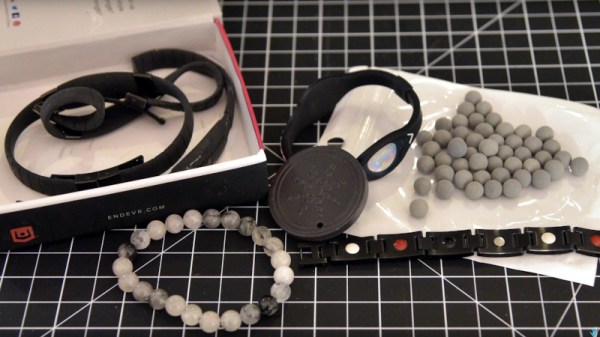
Before you start cutting up that ‘negative ion’ health bracelet or personal massager, be aware that these are highly likely to contain thorium oxide or similar radioactive powder, as this research video by [Justin Atkin] (also embedded after the break) over at The Thought Emporium YouTube channel shows. Even ignoring the irony that thorium oxide is primarily an alpha (He+) emitter and thus not a ‘negative ion’ source (which would be beta decay, with e), thorium oxide isn’t something you want on your skin, or inside your lungs.

These bracelets and similar items appear to embed grains of thorium oxide into the usual silicon-polymer-based bracelet material, without any measures to prevent grains from falling out over time. More dangerous are the items such as the massage wand, which is essentially a metal tube that is filled with thorium oxide powder. This is not the kind of item you want to open on your kitchen table and have it spill everywhere.

Considering that these items are readily available for sale on Amazon, EBay and elsewhere, giving items like these a quick check with the ol’ Geiger counter before ripping them open or cutting them up for a project seems like a healthy idea. Nobody wants to cause a radiological incident in their workshop, after all.

Continue reading “Be Wary Of Radioactive Bracelets And Similar”

Gear Up Your Gear Knowledge With Gears

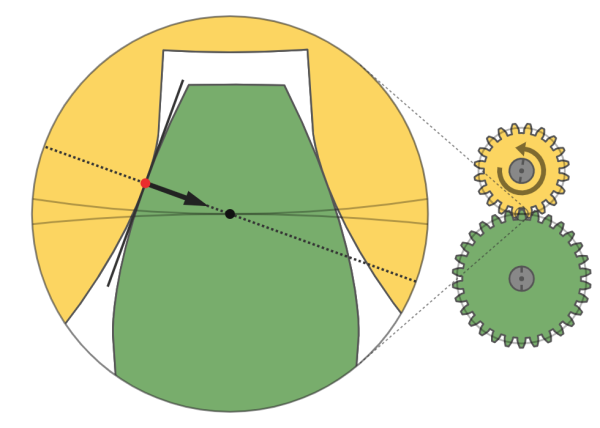
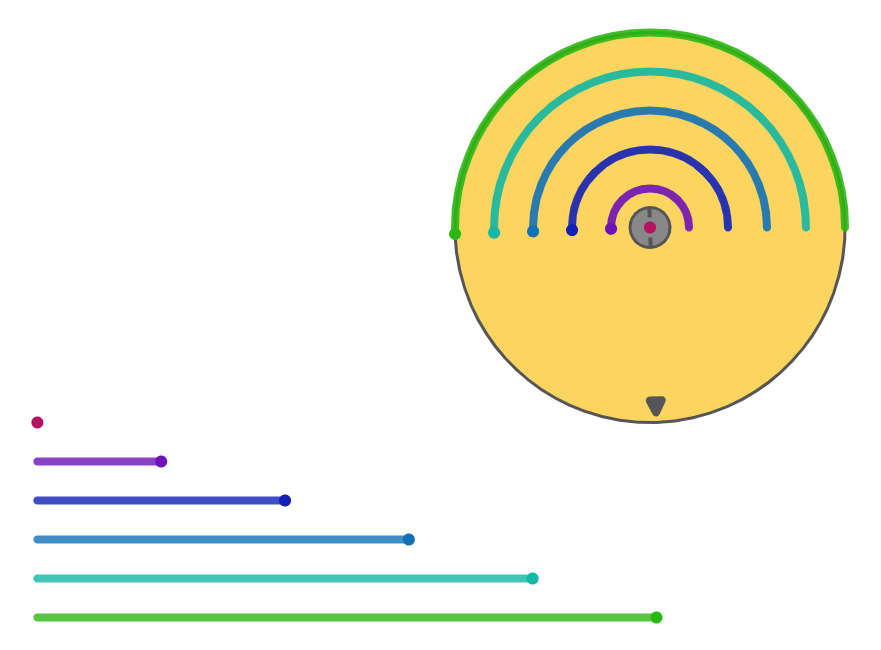
Gears are fairly straightforward way to couple rotational motion, and the physics topics required to understand them are encountered in an entry level physics classroom, not a university degree. But to really dig down to the root of how gears transfer motion may be somewhat more complex than it seems. [Bartosz Ciechanowski] put together an astonishingly good interactive teaching tool on gears, covering the fundamentals of motion up through multi-stage gear trains.

Illustrating the distance traveled at different points on the disc

The post starts at the beginning – not “how to calculate a gear ratio” – but how does rotational motion work at all. The illustrations help give the reader an intuitive sense for how the rate of rotation is measured and what that measurement actually represents in the real world. From there [Bartosz] builds up to describing how two discs touching edge to edge transfer motion and the relationship of their size on that process. After explaining torque he has the fundamentals in place to describe why gears have teeth, and why they work at all.

Well written explanatory copy aside, the real joy in this post is the interactivity. Each concept is illustrated, and each illustration is interactive. Images are accompanied by a slider which lets you adjust what’s shown, either changing the speed of a rotating gear or advancing the motion of two teeth interlocking. We found that being able to move through time this way really helped form an intuitive understanding of the concepts being discussed. This feels like the dream of interactive multimedia textbooks come to life.