3D Printing Batteries

We’ve all gotten pretty adept at 3D printing keychains and enclosures. Some people can even 3D print circuit boards to an extent. But the real goal is a Star Trek-style replicator that just pushes out finished products. Printing different components would be a key technology and unless you want to supply external power, one of those components better be a battery or other power source like a solar cell. A recent paper entitled Additive Manufacturing of Batteries explores this technology. The paper is behind a paywall, but you can probably find a copy if you are persistent.

Some of the techniques are pretty exotic. For example, holographic lithography can produce high-performance lithium-ion batteries. However, some of the processes didn’t sound much different than some of the more common printing techniques employed by desktop printers, although with more exotic materials. For example, some batteries can be made with inkjet printing and even fused deposition printing. Continue reading “3D Printing Batteries” →
Liquid Methane Rocket Is Set To Soar

Solid rockets are a fun way to get started in rocketry. Brewing up a batch of rocket candy is something achievable even in the home lab, and anyone can give it a go with the right materials. Building a flight-capable liquid-fuelled rocket engine is another thing entirely, but the Purdue Space Program is up to the task.

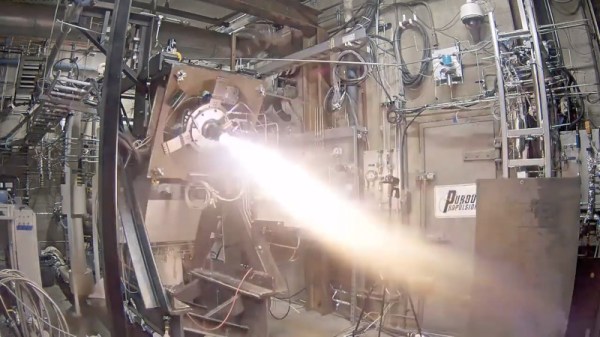
The result of their hard work is Boomie Zoomie, a rocket which stands 15ft tall and weighs 130lbs. With peak thrust of 800 lbs, it’s got plenty of grunt to help get things off the ground. It’s fuelled by liquid methane, a first for a university-built rocket. The craft is constructed out of 6″ aluminium pipe sections, which were a best-case trade-off between weight, cost, and machinability. Special care was taken during the design process to make things modular, to both allow for future design revisions and ease of field prep. This allows different parts of the team to work independently, streamlining the process of preparing the rocket for launch.

Aiming to compete in the FAR MARS liquid rocket competition, the rocket has undergone two successful hotfires. The team estimates that the first launch should happen in the next few months. Preparations are continuing on the launch trailer and ancilliary support equipment to get things up and running. The aim is to reach a lofty altitude of 45,000 feet.

For those interested in a career in rocketry, Purdue may just be the place to be, with over 300 members in its space program. We’ve seen other top-notch collegiate rocket programs, too – such as this Boston University effort that aims to reach space. Video after the break.

Continue reading “Liquid Methane Rocket Is Set To Soar” →

Investigating Retroreflectors With One Heck Of A Microscope

Retroreflectors are interesting materials, so known for their nature of reflecting light back to its source. Examples include street signs, bicycle reflectors, and cat’s eyes, which so hauntingly pierce the night. They’re also used in the Tilt Five tabletop AR system, for holographic gaming. [Adam McCombs] got his hands on a Tilt Five gameboard, and threw it under the microscope to see how it works.

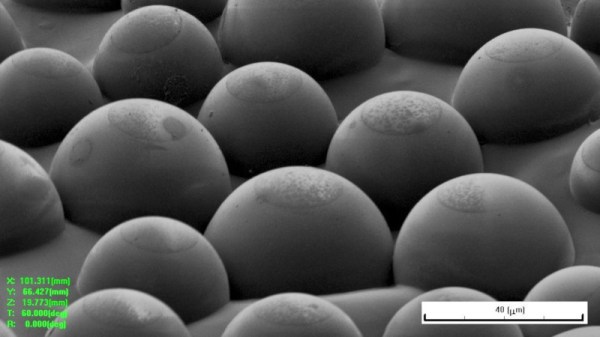
Using the ion beam, a trench was dug around the side of one of the spheres, revealing the interface between the adhesive and the sphere itself.

[Adam] isn’t mucking around, fielding a focused ion beam microscope for the investigation. This scans a beam of galium metal ions across a sample for imaging. With the added kinetic energy of an ion beam versus a more typical electron beam, the sample under the microscope can be ablated as well as imaged. This allows [Adam] to very finally chip away at the surface of the retroreflector to see how it’s made.

The analysis reveals that the retroreflecting spheres are glass, coated in metal. They’re stuck to a surface with an adhesive, which coats the bottom of the spheres, and acts as an etch mask. The metal coating is then removed from the sphere’s surface sticking out above the adhesive layer. This allows light to enter through the transparent part of the sphere, and then bounce off the metal coating back to the source, creating a sheet covered in retroreflectors.

[Adam] does a great job of describing both the microscopy and production techniques involved, before relating it to the fundamentals of the Tilt Five AR technology. It’s not the first time we’ve heard from [Adam] on the topic, and we’re sure it won’t be the last!

How Smart Are AI Chips, Really?

The best part about the term “Artificial Intelligence” is that nobody can really tell you what it exactly means. The main reason for this stems from the term “intelligence”, with definitions ranging from the ability to practice logical reasoning to the ability to perform cognitive tasks or dream up symphonies. When it comes to human intelligence, properties such as self-awareness, complex cognitive feats, and the ability to plan and motivate oneself are generally considered to be defining features. But frankly, what is and isn’t “intelligence” is open to debate.

What isn’t open to debate is that AI is a marketing goldmine. The vagueness has allowed for marketing departments around the world to go all AI-happy, declaring that their product is AI-enabled and insisting that their speech assistant responds ‘intelligently’ to one’s queries. One might begin to believe that we’re on the cusp of a fantastic future inhabited by androids and strong AIs attending to our every whim.

In this article we’ll be looking at the reality behind these claims and ponder humanity’s progress towards becoming a Type I civilization. But this is Hackaday, so we’re also going to dig into the guts of some AI chips, including the Kendryte K210 and see how the hardware of today fits into our Glorious Future. Continue reading “How Smart Are AI Chips, Really?” →

The Blessings And Destruction Wrought By Lead Over Millennia

Everyone one of us is likely aware of what lead — as in the metal — is. Having a somewhat dull, metallic gray appearance, it occupies atomic number 82 in the periodic table and is among the most dense materials known to humankind. Lead’s low melting point and malleability even when at room temperature has made it a popular metal since humans first began to melt it out of ore in the Near East at around 7,000 BC in the Neolithic period.

Although lead’s toxicity to humans has been known since at least the 2nd century BC and was acknowledged as a public health hazard in the late 19th century, the use of lead skyrocketed in the first half of the 20th century. Lead saw use as a gasoline additive beginning in the 1920s, and the US didn’t abolish lead-based paint until 1978, nearly 70 years after France, Belgium and Austria banned it.

With the rise of consumer electronics, the use of lead-based solder became ever more a part of daily life during the second part of the 20th century, until an increase in regulations aimed at reducing lead in the environment. This came along with the World Health Organization’s fairly recent acknowledgment that there is truly no safe limit for lead in the human body.

In this article I’ll examine the question of why we are still using lead, and if we truly must, then how we can use this metal in the safest way possible.

Continue reading “The Blessings And Destruction Wrought By Lead Over Millennia” →

A Miniature Radio Telescope In Every Backyard

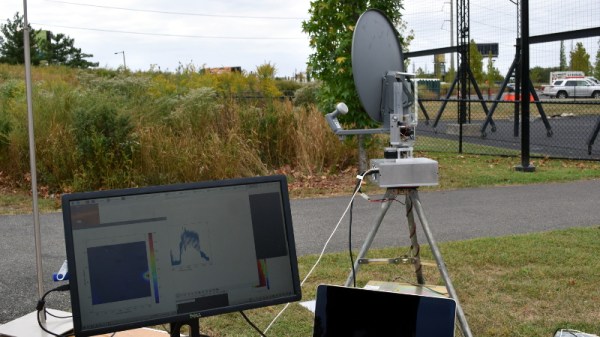
You probably wouldn’t expect to see somebody making astronomical observations during a cloudy day in the center of a dense urban area, but that’s exactly what was happening at the recent 2019 Philadelphia Mini Maker Faire. Professor James Aguirre of the University of Pennsylvania was there demonstrating the particularly compact Mini Radio Telescope (MRT) project built around an old DirecTV satellite dish and a smattering of low-cost components, giving visitors a view of the sky in a way most had never seen before.

Thanks to the project’s extensive online documentation, anyone with a spare satellite dish and a couple hundred dollars in support hardware can build their very own personal radio telescope that’s capable of observing objects in the sky no matter what the time of day or weather conditions are. Even if you’re not interested in peering into deep space from the comfort of your own home, the MRT offers a framework for building an automatic pan-and-tilt directional antenna platform that could be used for picking up signals from orbiting satellites.

With the slow collapse of satellite television in the United States these dishes are often free for the taking, and a fairly common sight on the sidewalk come garbage day. Perhaps there’s even one (or three) sitting on your own roof as you read this, waiting for a new lease on life in the Netflix Era.

Whether it’s to satisfy your own curiosity or because you want to follow in Professor Aguirre’s footsteps and use it as a tool for STEM outreach, projects like MRT make it easier than ever to build a functional DIY radio telescope.

Continue reading “A Miniature Radio Telescope In Every Backyard” →

The Long History Of Fast Reactors And The Promise Of A Closed Fuel Cycle

The discovery of nuclear fission in the 1930s brought with it first the threat of nuclear annihilation by nuclear weapons in the 1940s, followed by the promise of clean, plentiful power in the 1950s courtesy of nuclear power plants. These would replace other types of thermal plants with one that would produce no exhaust gases, no fly ash and require only occasional refueling using uranium and other fissile fuels that can be found practically everywhere.

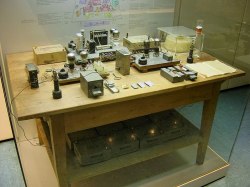
The equipment with which nuclear fission was experimentally proven in 1938.

As nuclear reactors popped up ever faster during the 1950s and 1960s, the worry about running out of uranium fuel became ever more present, which led to increased R&D in so-called fast reactors, which in the fast-breeder reactor (FBR) configuration can use uranium fuel significantly more efficiently by using fast neutrons to change (‘breed’) 238U into 239Pu, which can then be mixed with uranium fuel to create (MOX) fuel for slow-neutron reactors, allowing not 1% but up to 60% of the energy in uranium to be used in a once-through cycle.

The boom in uranium supplies discovered during the 1970s mostly put a stop to these R&D efforts, with some nations like France still going through its Rapsodie, Phénix and SuperPhénix designs until recently finally canceling the Generation IV ASTRID demonstrator design after years of trying to get the project off the ground.

This is not the end of fast reactors, however. In this article we’ll look at how these marvels of engineering work and the various fast reactor types in use and under development by nations like Russia, China and India.

Continue reading “The Long History Of Fast Reactors And The Promise Of A Closed Fuel Cycle” →