Simple Hydrogen Generator Makes Bubbles And Looks Cool

Hydrogen! It’s a highly flammable gas that seems way too cool to be easy to come by. And yet, it’s actually trivial to make it out of water if you know how. [Maciej Nowak] has shown us how to do just that with his latest build.

The project in question is a simple hydrogen generator that relies on the electrolysis of water. Long story short, run a current through water and you can split H2O molecules up and make H2 and O2 molecules instead. From water, you get both hydrogen to burn and the oxygen to burn it in! Even better, when you do burn the hydrogen, it combines with the oxygen to make water again! It’s all too perfect.

This particular generator uses a series of acrylic tanks. Each is fitted with electrodes assembled from threaded rods to pass current through water. The tops of the tanks have barbed fittings which allow the gas produced to be plumbed off to another storage vessel for later use. The video shows us the construction of the generator, but we also get to see it in action—both in terms of generating gas from the water, and that gas later being used in some fun combustion experiments.

Pedants will point out this isn’t really just a hydrogen generator, because it’s generating oxygen too. Either way, it’s still cool. We’ve featured a few similar builds before as well.

(Pedantic editor’s note: Because this build doesn’t separate the H2 from the O2, what you get is a stoichiometric mix, or HHO, or “Oxyhydrogen“. By virtue of being in exactly the right ratio to combust, this stuff is significantly more explosive than pure H2. Be careful!)

Continue reading “Simple Hydrogen Generator Makes Bubbles And Looks Cool”

Most Extreme Hypergravity Facility Starts Up In China With 1,900 Times Earth’s Gravity

The schematic diagram of the experimental centrifuge. (Credit: Jianyong Liu et al., 2024)

Recently China’s new CHIEF hypergravity facility came online to begin research projects after beginning construction in 2018. Standing for Centrifugal Hypergravity and Interdisciplinary Experiment Facility the name covers basically what it is about: using centrifuges immense acceleration can be generated. With gravity defined as an acceleration on Earth of 1 g, hypergravity is thus a force of gravity >1 g. This is distinct from simple pressure as in e.g. a hydraulic press, as gravitational acceleration directly affects the object and defines characteristics such as its effective mass. This is highly relevant for many disciplines, including space flight, deep ocean exploration, materials science and aeronautics.

While humans can take a g-force (g0) of about 9 g0 (88 m/s2) sustained in the case of trained fighter pilots, the acceleration generated by CHIEF’s two centrifuges is significantly above that, able to reach hundreds of g. For details of these centrifuges, this preprint article by [Jianyong Liu] et al. from April 2024 shows the construction of these centrifuges and the engineering that goes into their operation, especially the aerodynamic characteristics. Both air pressure (30 – 101 kPa) and arm velocity (200 – 1000 g) are considered, with the risks being overpressure and resonance, which if not designed for can obliterate such a centrifuge.

The acceleration of CHIEF is said to max out at 1,900 gravity tons (gt, weight of one ton due to gravity), which is significantly more than the 1,200 gt of the US Army Corps of Engineers’ hypergravity facility.

Crowdsourcing Ionosphere Data With Phones

How do you collect a lot of data about the ionosphere? Well, you could use sounding rockets or specialized gear. Or maybe you can just conscript a huge number of cell phones. That was the approach taken by Google researchers in a recent paper in Nature.

The idea is that GPS and similar navigation satellites measure transit time of the satellite signal, but the ionosphere alters the propagation of those signals. In fact, this effect is one of the major sources of error in GPS navigation. Most receivers have an 8-parameter model of the ionosphere that reduces that error by about 50%.

However, by measuring the difference in time between signals of different frequencies, the phone can estimate the total electron current (TEC) of the ionosphere between the receiver and the satellite. This requires a dual-frequency receiver, of course.

Continue reading “Crowdsourcing Ionosphere Data With Phones”

The Laser Shadow Knows

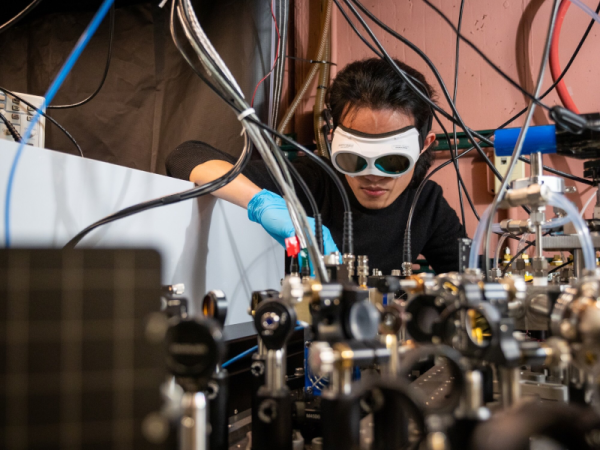
Normally, you think of things casting a shadow as being opaque. However, new research shows that under certain conditions, a laser beam can cast a shadow. This may sound like nothing more than a novelty, but it may have applications in using one laser beam to control another. If you want more details, you can read the actual paper online.

Typically, light passes through light without having an effect. But using a ruby crystal and specific laser wavelengths. In particular, a green laser has a non-linear response in the crystal that causes a shadow in  a blue laser passing through the same crystal.

Continue reading “The Laser Shadow Knows”

The Diablo Canyon NPP in California. This thermal plant uses once-through cooling. (Credit: Doc Searls)

US DOE Sets New Nuclear Energy Targets

To tackle the growing electrification of devices, we’ll need to deploy more generation to the grid. The US Department of Energy (DOE) has unveiled a new target to triple nuclear generating capacity by 2050.

Using a combination of existing Generation III+ reactor designs, upcoming small modular and micro reactors, and “legislation like the ADVANCE Act that streamlines regulatory processes,” DOE plans to add 35 gigawatt (GW) of generating capacity by 2035 and an additional 15 GW installed per year by 2040 to hit a total capacity of 200 GW of clean, green atom power by 2050.

According to the DOE, 100 GW of nuclear power was deployed in the 1970s and 1980s, so this isn’t an entirely unprecedented scale up of nuclear, although it won’t happen overnight. One of the advantages of renewables over nuclear is the lower cost and better public perception — but a combination of technologies will create a more robust grid than an “all of your eggs in one basket” approach. Vehicle to grid storage, geothermal, solar, wind, and yes, nuclear will all have their place at the clean energy table.

If you want to know more about siting nuclear on old coal plants, we covered DOE’s report on the matter as well as some efforts to build a fusion reactor on a decommissioned coal site as well.

Microfluidic Motors Could Work Really Well For Tiny Scale Tasks

The vast majority of motors that we care about all stick to a theme. They rely on the electromagnetic dance between electrons and magnets to create motion. They come in all shapes and sizes and types, but fundamentally, they all rely on electromagnetic principles at heart.

And yet! This is not the only way to create a motor. Electrostatic motors exist, for example, only they’re not very good because electrostatic forces are so weak by comparison. Only, a game-changing motor technology might have found a way to leverage them for more performance. It achieves this by working with fluid physics on a very small scale.

Continue reading “Microfluidic Motors Could Work Really Well For Tiny Scale Tasks”

The Life Cycle Of Nuclear Fission Fuel: From Stars To Burn-Up

Outdone only by nuclear fusion, the process of nuclear fission releases enormous amounts of energy. The ‘spicy rocks’ that are at the core of both natural and artificial fission reactors are generally composed of uranium-235 (U-235) along with other isotopes that may or may not play a role in the fission process. A very long time ago when the Earth was still very young, the ratio of fissile U-235 to fertile U-238 was sufficiently high that nuclear fission would spontaneously commence, as happened at what is now the Oklo region of Gabon.

Although natural decay of U-235 means that this is unlikely to happen again, we humans have learned to take uranium ore and start a controlled fission process in reactors, beginning in the 1940s. This can be done using natural uranium ore, or with enriched (i.e. higher U-235 levels) uranium. In a standard light-water reactor (LWR) a few percent of U-235 is used up this way, after which fission products, mostly minor actinides, begin to inhibit the fission process, and fresh fuel is inserted.

This spent fuel can then have these contaminants removed to create fresh fuel through reprocessing, but this is only one of the ways we have to extract most of the energy from uranium, thorium, and other actinides like plutonium. Although actinides like uranium and thorium are among the most abundant elements in the Earth’s crust and oceans, there are good reasons to not simply dig up fresh ore to refuel reactors with.

Continue reading “The Life Cycle Of Nuclear Fission Fuel: From Stars To Burn-Up”