ForceGen: Using A Diffusion Model To Help Design Novel Proteins

Although proteins are composed out of only a small number of distinct amino acids, this deceptive simplicity quickly vanishes when considering the many possible sequences across a protein, not to mention the many ways in which a single 1D protein sequence can fold into a 3D protein shape with a specific functionality. Although natural evolution has done much of the legwork here already, figuring out new sequences and their functionality is a daunting task where increasingly deep learning algorithms are being applied. As [Bo Ni] and colleagues report in a research article in Science Advances, the hardest challenge is designing a protein sequence based on the desired functionality. They then demonstrate a way to use a generative model to speed up this process.

They set out to design proteins with specific mechanical properties, for which they used the known unfolding characteristics of various protein sequences to train a diffusion model. This approach is thus more akin to the technology behind image generation algorithms like DALL-E than LLMs. Using the trained diffusion model it was then possible to generate likely sequences of which the properties could then be simulated, with favorable results.

As a large data set aid, such a diffusion model could conceivably be very useful in fields even beyond protein synthesis, automating tedious tasks and conceivably speeding up discoveries.

Low-Cost Saliva-based Biosensor For Cancer Detection

More and more biomarkers that can help in the early diagnosis of diseases like cancer are being discovered every year, but often the effective application relies on having diagnostic methods that are both affordable and as least invasive as possible. This is definitely true in the case of breast cancers, where the standard diagnostic method after seeing something ‘odd’ on a scan is to perform a biopsy so that a tissue sample can be tested in a laboratory. What [Hsiao-Hsuan Wan] and colleagues demonstrate in a recently published research article in the Journal of Vacuum Science & Technology B is a way to use saliva on disposable test strips to detect the presence of cancer-related biomarkers. Best of all, the system could be very affordable.

The two biomarkers tested in this experiment are HER2 (in 10 – 30% of breast cancer cases) and CA 15-3, both of which are indicative of a variety of cancers, including breast cancers. According to the researchers, the levels of these biomarkers in saliva can be correlated to those in blood serum. Where other biosensors may include the read-out circuitry – making those disposable and expensive – here the disposable part is the test strips which are plated with electrodes.

Continue reading “Low-Cost Saliva-based Biosensor For Cancer Detection”

Canned Air Is Unexpectedly Supersonic

How fast is the gas coming out from those little duster tubes of canned air? Perhaps faster than one might think! It’s supersonic (video, embedded below) as [Cylo’s Garage] shows by imaging clear shock diamonds in the flow from those thin little tubes.

Shock diamonds are a clear indicator of supersonic flow.

Shock diamonds, normally seen in things like afterburning jet turbine or rocket engine exhaust streams, are the product of standing wave patterns that indicate supersonic speeds. These are more easily visible in jet plumes, but [Cylo’s Garage] managed to get some great images of the same phenomenon in more everyday things such as the flow of duster gas.

Imaging this is made possible thanks to what looks like a simple but effective Schlieren imaging setup, which is a method of visualizing normally imperceptible changes in a fluid’s refractive index. Since the refractive index of a gas can change in response to density, pressure, or temperature, it’s a perfect way to see what’s going on when there’s otherwise nothing for one’s eyeballs to latch onto.

Intrigued by this kind of imaging? It requires a careful setup, but nothing particularly complicated or hard to get a hold of. Here’s one such setup, here’s a Schlieren videography project, and here’s a particularly intriguing approach that leverages modern electronics like a smartphone.

Thanks to [Quinor] for the tip!

Continue reading “Canned Air Is Unexpectedly Supersonic”

Metal 3D Printing Gets Really Fast (and Really Ugly)

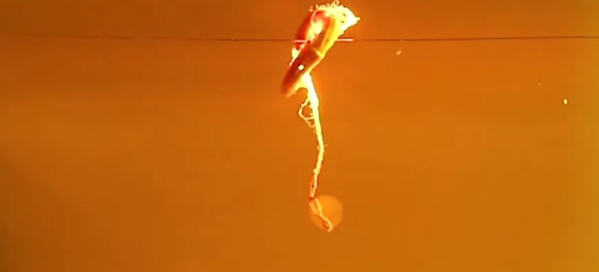
The secret to cranking out a furniture-sized metal frame in minutes is Liquid Metal Printing (LMP), demonstrated by researchers at the Massachusetts Institute of Technology. They’ve demonstrated printing aluminum frames for tables and chairs, which are perfectly solid and able to withstand post-processing like drilling and milling.

The system heats aluminum in a graphite crucible, and the molten metal is gravity-fed through a ceramic nozzle and deposited into a bed of tiny 100-micron glass beads. The beads act as both print bed and support structure, allowing the metal to cool quickly without really affecting the surface. Molten aluminum is a harsh material to work with, so both the ceramic nozzle material and the glass beads to fill the print bed were selected after a lot of testing.

This printing method is fast and scalable, but sacrifices resolution. Ideally, the team would love to make a system capable of melting down recycled aluminum to print parts with. That would really be something new and interesting when it comes to manufacturing.

The look of the printed metal honestly reminds us a little of CandyFab from [Windell Oskay] and [Lenore Edman] at Evil Mad Scientist, which was a 3D printer before hobbyist 3D printers or kits were really a thing. CandyFab worked differently — it used hot air to melt sugar together one layer at a time — but the end result has a similar sort of look to it. Might not be pretty, but hey, looks aren’t everything.

(Update: see it in action in this video, which is also embedded just below. Thanks [CityZen] for sharing in the comments!)

Continue reading “Metal 3D Printing Gets Really Fast (and Really Ugly)”

Shuji Nakamura: The Man Who Gave Us The Blue LED Despite All Odds

With the invention of the first LED featuring a red color, it seemed only a matter of time before LEDs would appear with other colors. Indeed, soon green and other colors joined the LED revolution, but not blue. Although some dim prototypes existed, none of them were practical enough to be considered for commercialization. The subject of a recent [Veritasium] video, the core of the problem was that finding a material with the right bandgap and other desirable properties remained elusive. It was in this situation that at the tail end of the 1980s a young engineer at Nichia in Japan found himself pursuing a solution to this conundrum.

Although Nichia was struggling at the time due to the competition in the semiconductor market, its president was not afraid to take a gamble on a promise, which is why this young engineer – [Shuji Nakamura] – got permission to try his wits at the problem. This included a year long study trip to Florida to learn the ins and outs of a new technology called metalorganic chemical vapor deposition (MOCVD, also metalorganic vapor-phase epitaxy). Once back in Japan, he got access to a new MOCVD machine at Nichia, which he quickly got around to heavily modifying into the now well-known two-flow reactor version which improves the yield.

Continue reading “Shuji Nakamura: The Man Who Gave Us The Blue LED Despite All Odds”

How Different Are SpaceX Thermal Tiles From The Space Shuttle’s?

When SpaceX first showed off the thermal tiles on its Starship spacecraft that should keep it safe when re-entering the Earth’s atmosphere towards the loving embrace of the chopsticks on the launch tower, some similarity to the thermal tiles on NASA’s now retired Space Shuttle Orbiter was hard to miss.

Electron microscope image of the fibrous part of a Starship thermal tile, showing very large fibers. (Credit: Breaking Taps, YouTube)

Yet how similar are they really? That’s what the [Breaking Taps] channel on YouTube sought to find out, using an eBay-purchased chunk of Shuttle thermal tile along with bits of Starship tiles that washed ashore following the explosive end to the vehicle’s first integrated test last year.

To answer the basic question: the SpaceX engineers responsible for the Starship thermal tiles seem to have done their homework. An analysis of not only the structure of the fibrous material, but also the black IR-blocking coating, shows that the Starship tiles are highly reminiscent of the EATB (introduced in 1996) tiles with TUFI (toughened unipiece fibrous insulation) coatings with added molybdenum disilicide, which were used during the last years of the Shuttle program.

TUFI is less fragile than the older RCG (reaction cured glass) coating, but also heavier, which is why few TUFI tiles were used on the Shuttles due to weight concerns. An oddity with the Starship tiles is that they incorporate many very large fibers, which could be by design, or indicative of something else.

Continue reading “How Different Are SpaceX Thermal Tiles From The Space Shuttle’s?”

An image of a cave drawing of horned cow. There is another one coming up behind it as well. There are four dots as described by the researchers on the main cow's back.

Writing – So Easy A Caveperson Could Do It

We modern humans tend to take writing for granted, and often forget that like any other technology, somebody had to invent it. Researchers from Cambridge believe they’ve determined the purpose of one of the earliest writing beta-tests.

Examining a database of images taken in caves throughout Europe and dated to the Upper Paleolithic, the researchers found “three of the most frequently occurring signs—the line <|>, the dot <•>, and the <Y>—functioned as units of communication.”

It appears the <|> and <.> symbols when “in close association with images of animals” denote time relating to lunar months of the year, starting with spring as the new year. The <Y> symbol appears to carry the meaning <To Give Birth> allowing early people a way to tell others information about the prey of a region, which would be pretty handy when hunting and gathering are your only options for food.

We’ve covered other ancient technologies like storytelling and abrasives. If you’re curious what the climate was like for our ancestors, perhaps paleoclimatology will tickle your fancy.