Determining The Size Of The New US Lithium Deposit Amidst Exploding Demand

With demand for lithium in the world market projected to increase by 2040 to as much as eight times the demand in 2022, finding new deposits of this metal has become a priority. Currently most of the world’s lithium comes from Australia, Chile, China and Argentina, with potential new mining sites under investigation. One of these sites is the McDermitt caldera in the US, a likely remnant of the Yellowstone hotspot and resulting volcanic activity. According to a recent study (Chemistry World article) by Thomas R. Benson and colleagues in Science Advances, this site may not only contain between 20 to 40 million tons of lithium in the form of the mineral clay illite, but was also formed using a rather unique process.

This particular group of mineral clays can contain a number of other chemicals, which in this particular case is lithium due to the unique way in which the about 40 meter thick layer of sediment was formed. Although lithium is a very common metal, its high reactivity means that it is never found in its elementary form, but instead bound to other elements. Lithium is thinly distributed within the Earth’s crust and oceans. Incidentally, the Earth’s oceans contain by far the largest amount of lithium, at approximately 230 billion tons.

So how much lithium could be extracted from this new area, and how does this compare to the increasing demand?

Continue reading “Determining The Size Of The New US Lithium Deposit Amidst Exploding Demand”

Zinc-Air, The Next Contender In Vehicle Batteries?

If you’ve got an interest in technology, it’s inevitable that your feed will feature a constant supply of stories with titles in the vein of “New battery breakthrough offers unlimited life and capacity!”. If we had a pound, dollar, or Euro for each one, we’d be millionaires by now. But while the real science behind the breathless headlines will undoubtedly have provided incremental battery improvements, we’re still waiting for the unlimited battery.

It’s not to say that they don’t conceal some interesting stories though, and there’s an announcement from Australia proving this point admirably. Scientists at ECU in Perth have created a new cathode compound for rechargeable zinc-air batteries, which it is hoped will make them much safer and cheaper competitors for lithium-ion cells.

Most of us think of zinc-air batteries as the tiny cells you’d put in a camera or a hearing aid, but these conceal a chemistry with significant potential that is held back by the difficulty of creating a reliable cathode. In these batteries the cathode is a porous support in which a reaction between zinc powder wet paste and oxygen in the air occurs, turning zinc into zinc oxide and releasing electrons which can be harvested as electricity. They have a very high power density, but previous cathode materials have quickly degraded performance when presented with significant load.

The new cathode support is a nano-composite material containing cobalt, nickel, and iron, and is claimed to offer much better performance without the degradation. Whether or not it can be mass-produced remains to be seen, but as a possible alternative to lithium-ion in portable and transport applications it’s of great interest.

Tape Is Very, Very Quiet

If someone stops by and asks you to help them make some noisy thing less noisy, you probably wouldn’t reach for a roll of tape. But [The Action Lab] shows some 3M tape made for exactly that purpose. For the right kind of noise, it can dampen noise caused by a surface vibrating. You can see how (and why) it works in the video below.

The tape works using a technique known as “constrained layer damping.” Obviously, the tape only works in certain applications. The video explains that it bonds a stiff surface to the vibrating surface using an elastic-like layer. The tape reduces vibrations from things like cymbals and a cookie tin. The noise reduction is both in amplitude and in the duration of the sound, making things noticeably quieter.

You sometimes see a similar material in cars to reduce vibration noise, but we aren’t sure if it uses the same technique. We’ve also seen different kinds of tape used to lower drums’ volume. Reduces the neighbor’s complaints about your practice jam sessions.

This tape reduces noise but can also reduce fatigue wear on metal and composite structures. The downside is it seems extraordinarily expensive. It also doesn’t help that most places want you to buy an entire case, which drives the price even higher. Depending on the size, you can expect to pay about $200 for each 36-yard roll of this tape. But it seems like the principle involved is simple enough that you could make your own, sort of like the video does with the aluminum plate.

Usually, when we talk about noise reduction around here, we mean the electronic kind. Or, sometimes, fungal.

Continue reading “Tape Is Very, Very Quiet”

Triso Fuel And The Rolls Royce Of Nuclear Reactors

Bangor University scientists think that the way to go big with nuclear power is to, in fact, go small. Their tiny nuclear fuel pellets called triso fuel are said to be the size of poppy seeds and are meant to power a reactor by Rolls Royce the size of a “small car.” We aren’t sure if that’s a small Rolls Royce or a small normal car.

The Welsh university thinks the reactor has applications for lunar bases, here on Earth, and even on rockets because the reactor is so small. We can’t tell if the fuel from Bangor is unique or if it is just the application and the matching reactor that is making the news. Triso fuel — short for tri-structural isotropic particle fuel — was developed in the 1960s, and there are multiple projects worldwide gearing up to use this sort of fuel.

Continue reading “Triso Fuel And The Rolls Royce Of Nuclear Reactors”

Road Salt? Bah! New Roadway Material Promises A Better Solution To Snow And Ice

If you’ve ever lived somewhere it gets properly cold, you’ll know that winter’s icy grasp brings the inevitable challenge of keeping roadways safe. While road salt and gritting have long been the go-to solutions, their detrimental environmental impact and the potential for infrastructure degradation are well-documented.

However, a game-changing new development might just offer a brighter, greener solution. Just imagine it—roads that stay ice free without requiring regular attention. 

Continue reading “Road Salt? Bah! New Roadway Material Promises A Better Solution To Snow And Ice”

Electro-Optical Control Of Lasers With A Licorice Twist

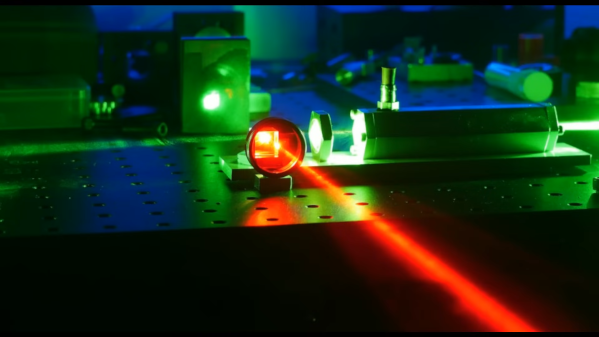
You’ve got to hand it to [Les Wright]; he really knows how to dig into optical arcana and present topics in an interesting way. Case in point: an electro-optical control cell that’s powered by ouzo.

OK, the bit about the Greek aperitif may be stretching things a bit, but the Kerr Cell that [Les] builds in the video below does depend on anethole, the essential component of aniseed extract, which lends its aromatic flavor to everything from licorice to Galliano and ouzo. As [Les] explains, the Kerr effect uses a high-voltage field to rapidly switch light passing through a medium on and off. The most common medium in Kerr cells is nitrobenzene, a “distressingly powerful organic solvent” with such fun side effects as toxicity, flammability, and carcinogenicity.

Luckily, [Les] found a suitable substitute in the form of anethole — a purified sample, not just an ouzo nip. The solution went into a plain glass cuvette equipped with a pair of aluminum electrodes, which got connected to one of the high-voltage supplies we’ve seen him build before for his nitrogen laser. A pair of polarizing filters go on either end of the cuvette, and are adjusted to blank out the light passing through it. Applying 45 kilovolts across the cell instantly turns the light back on. Watch it in action in the video below.

There’s a lot of room left for experimentation on this one, including purification of the anethole for potentially better results. We’d also be curious if plain ouzo would show some degree of Kerr effect. For science, of course.

Continue reading “Electro-Optical Control Of Lasers With A Licorice Twist”

$1 Graphene Sensor Identifies Safe Water

If you live in a place where you can buy Arduinos and Raspberry Pis locally, you probably don’t spend much time worrying about your water supply. But in some parts of the world, it is nothing to take for granted, bad water accounts for as many as 500,000 deaths worldwide every year. Scientists have reported a graphene sensor they say costs a buck and can detect dangerous bacteria and heavy metals in drinking water.

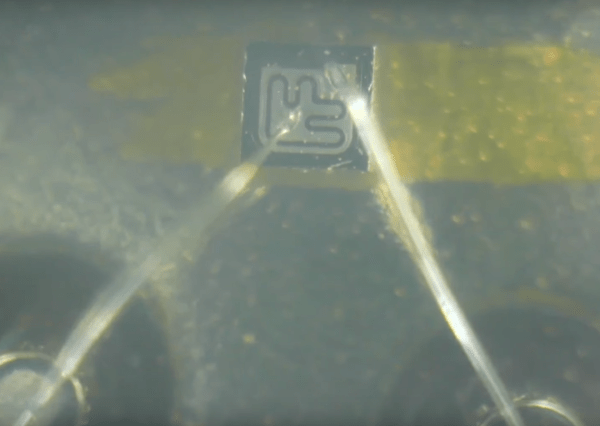
The sensor uses a GFET — a graphene-based field effect transistor to detect lead, mercury, and E. coli bacteria. Interestingly, the FETs transfer characteristic changes based on what is is exposed to. We were, frankly, a bit surprised that this is repeatable enough to give you useful data. But apparently, it is especially when you use a neural network to interpret the results.

What’s more, there is the possibility the device could find other contaminants like pesticides. While the materials in the sensor might have cost a dollar, it sounds like you’d need a big equipment budget to reproduce these. There are silicon wafers, spin coating, oxygen plasma, and lithography. Not something you’ll whip up in the garage this weekend.

Still, it is interesting to see a FET used this way and a cheap way to monitor water quality would be welcome. Using machine learning with water sensors isn’t a new idea. Of course, the sensor is one part of the equation. Monitoring is the other.