Quantum Computing On A Commodore 64 In 200 Lines Of BASIC

The term ‘quantum computer’ gets usually tossed around in the context of hyper-advanced, state-of-the-art computing devices. But much as how a 19th century mechanical computer, a discrete computer created from individual transistors, and a human being are all computers, the important quantifier is how fast and accurate the system is at the task. This is demonstrated succinctly by [Davide ‘dakk’ Gessa] with 200 lines of BASIC code on a Commodore 64 (GitHub), implementing a range of quantum gates.

Much like a transistor in classical computing, the qubit forms the core of quantum computing, and we have known for a long time that a qubit can be simulated, even on something as mundane as an 8-bit MPU. Ergo [Davide]’s simulations of various quantum gates on a C64, ranging from Pauli-X, Pauli-Y, Pauli-Z, Hadamard, CNOT and SWAP, all using a two-qubit system running on a system that first saw the light of day in the early 1980s.

Naturally, the practical use of simulating a two-qubit system on a general-purpose MPU running at a blistering ~1 MHz is quite limited, but as a teaching tool it’s incredibly accessible and a fun way to introduce people to the world of quantum computing.

Cooling Paint You Can Actually Make

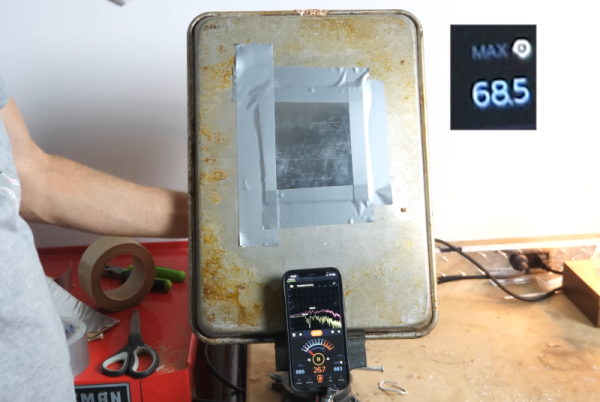
[NightHawkInLight] has been working on radiative sky paint. (Video, embedded below.) That’s a coating that radiates heat in the infrared spectrum at a wavelength that isn’t readily absorbed or reflected by the atmosphere. The result is a passive system that keeps materials a few degrees cooler in direct sunlight than an untreated piece in the shade. That sounds a bit like magic, but apparently the math checks out.

Continue reading “Cooling Paint You Can Actually Make”

Pill Bugs And Chitons Get Jobs As Tiny Grippers

A research paper titled Biological Organisms as End Effectors explores the oddball approach of giving small animals jobs as grippers at the end of a robotic arm. Researchers show that pill bugs and chitons — small creatures with exoskeletons and reflexive movements — have behaviors making them useful as grippers, with no harm done to the creatures in the process. The prototypes are really just proofs of concept, but it’s a novel idea that does work in at least a simple way.

Pill bugs reflexively close, and in the process can grasp and hold lightweight objects. The release is simply a matter of time; researchers say that after about 115 seconds a held object is released naturally when the pill bug’s shell opens. While better control over release would be good, the tests show basic functionality is present.

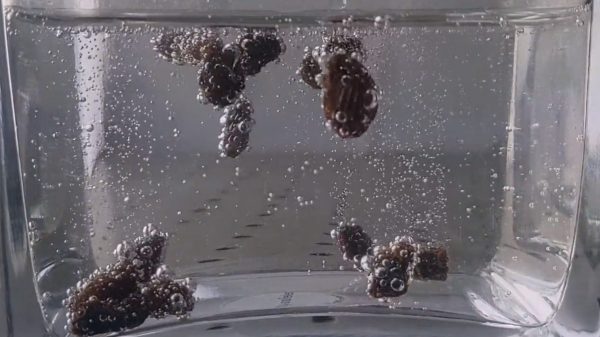
The chiton — a small mollusk — can grip underwater.

Another test involves the chiton, a small mollusk that attaches to things with suction and can act as an underwater end effector in a similar way. Interestingly, a chiton is able to secure itself to wood and cork; materials that typical suction cups do not work on.

A chiton also demonstrates the ability to manipulate a gripped object’s orientation. Chitons seek dark areas, so by shining light researchers could control in which direction the creature attempts to “walk”, which manipulates the held object. A chiton’s grip is strong, but release was less predictable than with pill bugs. It seems chitons release an object more or less when they feel like it.

This concept may remind readers somewhat grimly of grippers made from dead spiders, but researchers emphasize that we have an imperative to not mistreat these living creatures, but to treat them carefully as we temporarily employ them in much the same manner as dog sleds or horses have been used for transportation, or carrier pigeons for messages. Short videos of both pill bug and chiton grippers are embedded below, just under the page break.

Continue reading “Pill Bugs And Chitons Get Jobs As Tiny Grippers”

Demo Relativity For A C-Note

If you are a science fiction fan, you probably hate the theory of relativity. After all, how can the Enterprise get to a new star system every week if you can’t go faster than the speed of light? [Nick Lucid] wants to set you straight: it is real, and you can prove it to yourself for under $100.

The idea uses muons created in our atmosphere by cosmic rays colliding with gasses in the atmosphere. So how do you detect muons yourself? [Nick] shows you how to do it with a fish tank, dry ice, and rubbing alcohol. If that sounds like a cloud chamber, you aren’t wrong.

A cloud chamber is undeniably cool, but how does it prove relativity? You’ll see several kinds of particles interacting with your cloud chamber, but you can tell which ones are muons by the size and motion of the streaks. The muons don’t last very long. So you’d expect very few muons to make it to the surface of the Earth. But they not only reach the surface but go deep under it, as well.

So how do you explain it? Relatively. The muon experiences its average 2.2 microseconds lifetime in what appears to us to be over 150 microseconds, even if it is moving relatively slowly for a muon. Some muons are faster or live longer, so we see a lot of them hit the Earth every minute of every day. This is due to time dilation and also explains length contraction because the muon moves at a certain speed, yet it appears to go further to us than to the muon.

Coincidentally, we recently discussed this same effect relative to using muons for underground navigation. If you want an easier way to count muons with a computer, you can build a detector for about the same price as the cloud chamber.

Continue reading “Demo Relativity For A C-Note”

Earth’s Final Frontier: Exploring The Alien Depths Of The Earth’s Oceans

Despite how hostile to life some parts of the Earth’s continents are, humanity has enthusiastically endeavored over the course of millennia to establish at least a toehold on each of them. Yet humanity has barely ventured beyond the surface of the oceans which cover around three-quarters of the planet, with human activity in these bodies of water dropping off quickly along with the fading of light from the surface.

Effectively, this means for all intents and purposes we have to this day not explored the vast majority of the Earth’s surface, due to over 70% of it being covered by water. As an ocean planet, much of Earth’s surface is covered by watery depths of multiple kilometers, with each 10 meters of water increasing the pressure by one atmosphere (1.013 bar), so that at a depth of one kilometer we’re talking about an intense 101 atmospheres.

Over the past decades, the 1985 discovery of Titanic’s wreck approximately 3.8 kilometer below the surface of the Atlantic, the two year long search for AF447’s black boxes, and the fruitless search for the wreckage of MH370 despite washed-up remnants have served as stark reminders of just how alien and how hostile the depths of the Earth’s oceans are. Yet with both tourism and mining efforts booming, will we one day conquer the full surface of Earth?

Continue reading “Earth’s Final Frontier: Exploring The Alien Depths Of The Earth’s Oceans”

Ecological System Dynamics For Computing

Some of you may remember that the ship’s computer on Star Trek: Voyager contained bioneural gel packs. Researchers have taken us one step closer to a biocomputing future with a study on the potential of ecological systems for computing.

Neural networks are a big deal in the world of machine learning, and it turns out that ecological dynamics exhibit many of the same properties. Reservoir Computing (RC) is a special type of Recurrent Neural Network (RNN) that feeds inputs into a fixed-dynamics reservoir black box with training only occurring on the outputs, drastically reducing the computational requirements of the system. With some research now embodying these reservoirs into physical objects like robot arms, the researchers wanted to see if biological systems could be used as computing resources.

Using both simulated and real bacterial populations (Tetrahymena thermophila) to respond to temperature stimuli, the researchers showed that ecological system dynamics has the “necessary conditions for computing (e.g. synchronized dynamics in response to the same input sequences) and can make near-future predictions of empirical time series.” Performance is currently lower than other forms of RC, but the researchers believe this will open up an exciting new area of research.

If you’re interested in some other experiments in biocomputing, checkout these RNA-based logic gates, this DNA-based calculator, or this fourteen-legged state machine.

Will The Lilium Jet Work? A Deep-Dive Into The Physics Behind EVTOL Aircraft

The Lilium Jet is a proposed eVTOL (electric Vertical Take Off and Landing) aircraft that the German company Lilium GmbH has claimed it will bring to the market ‘soon’, which would made it the first eVTOL aircraft in the world to enter into commercial service. As anyone who has any experience with VTOL knows, it’s a tricky subject to engineer, let alone when you want to do it fully electric. In a deep-dive video on the Lilium Jet and eVTOL in general, [John Lou] goes through the physics behind VTOL take-off, landing and flight, as well as range and general performance.

It is clear that Lilium’s presented aircraft concept has many issues, some of which are due to new and unproven technologies, while others seem to be founded in over-promising and likely under-delivering. With Lilium having signed a number of contracts to deliver the first Pioneer Edition Lilium Jets and commercial service promised by 2025, it’s hard to ignore that the first full prototype of the 7-seater Lilium Jet is supposed to fly this year.

Although as [John] points out in the video, eVTOL is not an impossible concept, it is important to remain realistic about what is physically possible, and not seek to push the boundaries. When the UK introduced its first mass-produced VTOL jet in the form of the Harrier, it too faced an uncomfortable time as bugs got ironed out. As these eVTOL aircraft would be carrying real human passengers, it’s a good place to realize that although you can pick a fight with physics, you will never come out on the winning side.

Hopefully Lilium realizes this too, and these sleek, battery-powered aircraft will truly take to the skies in a few years.

Continue reading “Will The Lilium Jet Work? A Deep-Dive Into The Physics Behind EVTOL Aircraft”