Largest Ever Hydrogen Fuel Cell Plane Takes Flight

In the automotive world, batteries are quickly becoming the energy source of the future. For heavier-duty tasks, though, they simply don’t cut the mustard. Their energy density, being a small fraction of that of liquid fuels, just can’t get the job done. In areas like these, hydrogen holds some promise as a cleaner fuel of the future.

Universal Hydrogen hopes that hydrogen will do for aviation what batteries can’t. The company has been developing flight-ready fuel cells for this exact purpose, and has begun test flights towards that very goal.

Continue reading “Largest Ever Hydrogen Fuel Cell Plane Takes Flight”

Self-Healing Concrete: What Ancient Roman Concrete Can Teach Us

Concrete is an incredibly useful and versatile building material on which not only today’s societies, but also the ancient Roman Empire was built. To this day Roman concrete structures can be found in mundane locations such as harbors, but also the Pantheon in Rome, which to this day forms the largest unreinforced concrete dome in existence at 43.3 meters diameter, and is in excellent condition despite being being nearly 1,900 years old.

Even as the Roman Empire fell and receded into what became the Byzantine – also known as the Eastern Roman – Empire and the world around these last remnants of Roman architecture changed and changed again, all of these concrete structures remained despite knowledge of how to construct structures like them being lost to the ages. Perhaps the most astounding thing is that even today our concrete isn’t nearly as durable, despite modern inventions such as reinforcing with rebar.

Reverse-engineering ancient Roman concrete has for decades now been the source of intense study and debate, with a recent paper by Linda M. Seymour and colleagues adding an important clue to the puzzle. Could so-called ‘hot mixing’, with pockets of reactive lime clasts inside the cured concrete provide self-healing properties?

Continue reading “Self-Healing Concrete: What Ancient Roman Concrete Can Teach Us”

Blender And OpenEMS Teamed Up Make Stunning Simulations

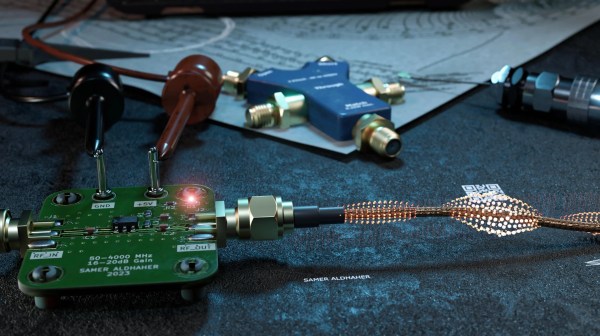
There’s tons of theory out there to explain the behavior of electronic circuits and electromagnetic waves. When it comes to visualization though, most of us have had to make do with our lecturer’s very finest blackboard scribbles, or some diagrams in a textbook. [Sam A] has been working on some glorious animated simulations, however, which show us various phenomena in a far more intuitive way.

The animations were created in Blender, the popular 3D animation software. As for the underlying simulation going on behind the scenes, this was created using the openEMS platform. [Sam] has used openEMS to run electromagnetic simulations of simple circuits via KiCAD. From there, it was a matter of finding a way to export the simulation results in a way that could be imported into Blender. This was achieved with Paraview software acting as a conduit, paired with a custom Python script.

The result is that [Sam] can produce visually pleasing electromagnetic simulations that are easy to understand. One needn’t imagine a RF signal’s behaviour in a theoretical coax cable with no termination, when one can simply see what happens in [Sam]’s animation. 

Simulation is a powerful tool which is often key to engineering workflows, as we’ve seen before.

Continue reading “Blender And OpenEMS Teamed Up Make Stunning Simulations”

Creating A 3D Visualization Of Freely Moving Organisms Using Camera Array And Software Algorithm

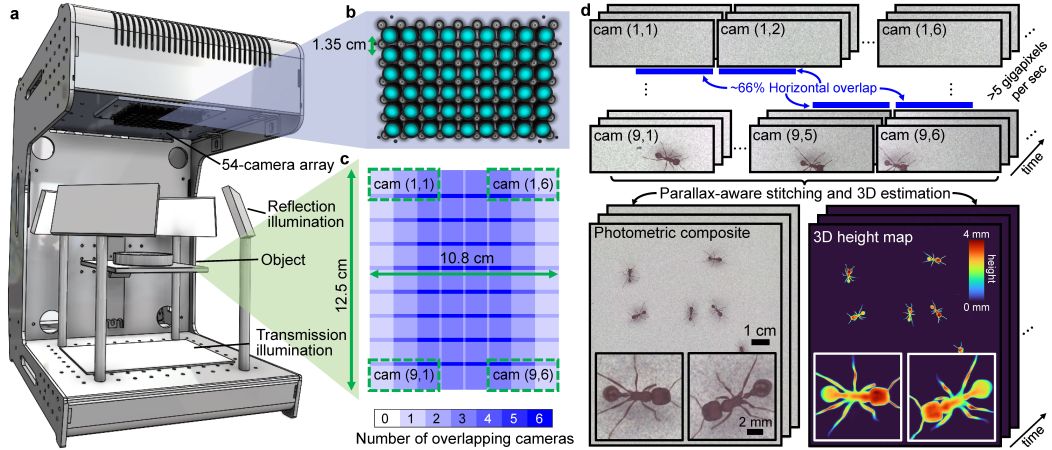
Observing a colony, swarm or similar grouping of creatures like ants or zebrafish over longer periods of time can be tricky. Simply recording their behavior with a camera misses a lot of information about the position of their body parts, while taking precise measurements using a laser-based system or LiDAR suffers from a reduction in parameters such as the resolution or the update speed. The ideal monitoring system would be able to record at high data rates and resolutions, while presenting the recorded data all three dimensions. This is where the work by Kevin C. Zhou and colleagues seeks to tick all the boxes, with a recent paper (preprint, open access) in Nature Photonics describing their 3D-RAPID system.

This system features a 9×6 camera grid, making for a total of 54 cameras which image the underlying surface. With 66% overlap between cameras across the horizontal dimension, there enough duplicate data between image stream that is subsequently used in the processing step to extract and reconstruct the 3D features, also helped by the pixel pitch of between 9.6 to 38.4 µm. The software is made available via the author’s GitHub.

Three configurations for the imaging are possible, ranging from no downsampling (1x) for 13,000×11,250 resolution at 15 FPS, to 2x downsampling (6,500×5,625@60FPS) and finally 4x (3,250×2,810@230FPS). Depending on whether the goal is to image finer features or rapid movement, this gives a range of options before the data is fed into the computational 3D reconstruction and stitching algorithm. This uses the overlap between the distinct frames to reconstruct the 3D image, which in this paper is used together with a convolutional neural network (CNN) to automatically determine for example how often the zebrafish are near the surface, as well as the behavior of fruit flies and harvester ants.

As noted in an interview with the authors, possible applications could be found in developmental biology as well as pharmaceutics.


Huygens’ Telescopes Weren’t Very Good, Now We Think We Know Why

[Christiaan Huygens] was a pretty decent mathematician and scientist by the standards of the 17th century. However, the telescopes he built were considered to be relatively poor in quality for the period. Now, as reported by Science News, we may know why. The well-known Huygens may have needed corrective glasses all along.

Much of Huygens’ astronomical work concerned Saturn.

Huygens is known for, among other things, his contribution to astronomy. He discovered Titan, the largest moon of Saturn, and also studied the planet’s rings. He achieved this despite telescopes that were described at the time as fuzzy or blurrier than they otherwise should have been.

Huygens built two-lens telescopes, and would keep a table of which lenses to combine for different magnification levels. However, his calculations don’t align well with today’s understanding of optics. As it turns out, Huygens may have been nearsighted, which would account for why his telescopes were blurry. To his vision, they may indeed have been sharp, due to the nature of his own eyes. Supporting this are contemporary accounts that suggest Huygens father was nearsighted, with the condition perhaps running in the family. According to calculations by astronomer Alexander Pietrow, Huygens may have had 20/70 vision, in which he could only read at 20 feet what a person with “normal” vision could read from 70 feet away.

It’s a theory that answers a mildly-interesting mystery from many hundreds of years ago. These days, our troubles with telescopes are altogether more complex. If only a simple pair of glasses could solve NASA’s problems!

Caterpillar-Like Soft Robot With Distributed Programmable Thermal Actuation

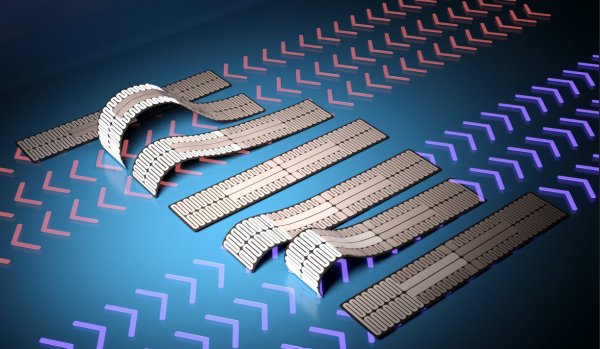
Researchers at North Carolina State University have created a soft robot that moves in a distinctly caterpillar-like manner. As detailed in the research paper in Science Advances by [Shuang Wu] and colleagues, the robot they developed consists of a layer of liquid crystalline elastomers (LCE) and polydimethylsiloxane (PDMS) with embedded silver nanowire that acts as a heater.

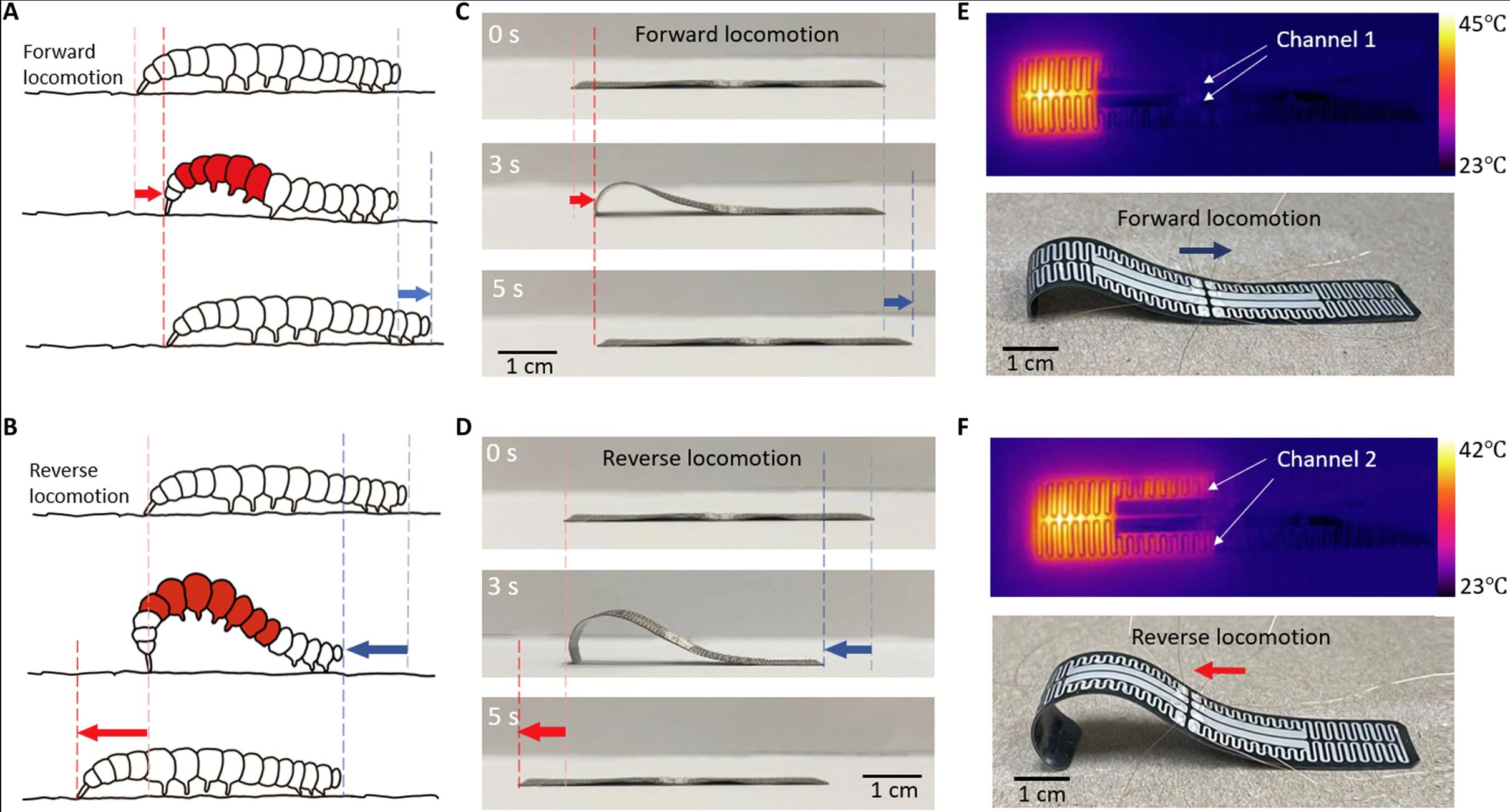
The LCE is hereby designed as a thermal bimorph actuator, using a distinct thermal expansion coefficient between the LCE and PDMS sides to create a highly controllable deformation and thus motion. Since the nanowire is divided into sections that can be individually heated, the exact deformation can be quite tightly controlled, enabling the crawling motion.

(A) Schematics of the forward locomotion of a caterpillar. (B) Schematics of the reverse locomotion of a caterpillar. (C) Snapshots of the crawling robot in one cycle of actuation for reverse locomotion. (D) Snapshots of the crawling robot in one cycle of actuation for forward locomotion. (E) infrared image of the crawling robot with 0.05-A current injected in channel 1 and the tilted view of the crawling robot. (F) Infrared image of the crawling robot with 30-mA current injected in channel 2 and the corresponding tilted view of the crawling robot. (Credit: Shuang Wu, et al. (2023))

As can be seen in the video below, the motion is fairly rapid and quite efficient, as well as decidedly caterpillar-like. Although the current prototype uses external control wires that supply the current, it might be possible to integrate a power supply and control circuitry in a stand-alone robot. Since the heater works on low voltage (5 V) and relatively little power is required, this would seem to make stand-alone operation eminently possible.

Continue reading “Caterpillar-Like Soft Robot With Distributed Programmable Thermal Actuation”

Combining Acoustic Bioprinting With Raman Spectroscopy For High-Throughput Identification Of Bacteria

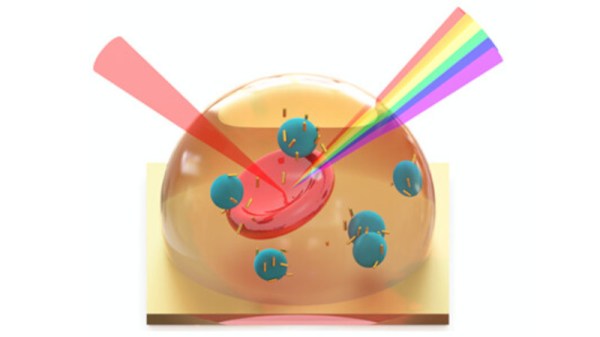
Rapidly analyzing samples for the presence of bacteria and similar organic structures is generally quite a time-intensive process, with often the requirement of a cell culture being developed. Proposed by Fareeha Safir and colleagues in Nano Letters is a method to use an acoustic droplet printer combined with Raman spectroscopy. Advantages of this method are a high throughput, which could make analysis of samples at sewage installations, hospitals and laboratories significantly faster.

Raman spectroscopy works on the principle of Raman scattering, which is the inelastic scattering of photons by matter, causing a distinct pattern in the thus scattered light. By starting with a pure light source (that is, a laser), the relatively weak Raman scattering can be captured and the laser light filtered out. The thus captured signal can be analyzed and matched with known pathogens. Continue reading “Combining Acoustic Bioprinting With Raman Spectroscopy For High-Throughput Identification Of Bacteria”