Toyota’s Cartridge Helps Make Hydrogen Portable

Hydrogen has long been touted as the solution to cleaning up road transport. When used in fuel cells, the only emissions from its use are water, and it eliminates the slow recharging problem of battery-electric vehicles. It’s also been put forth as a replacement for everything from natural gas supplies to laptop batteries.

Toyota has been pushing hard for hydrogen technology, and has worked to develop vehicles and infrastructure to this end. The company’s latest efforts involve a toteable hydrogen cartridge – letting you take hydrogen power on the go!

Continue reading “Toyota’s Cartridge Helps Make Hydrogen Portable”

An illuminated MCH2022 sign composed of large LED letters

Mutually Crafted Happiness: How MCH2022 Happened

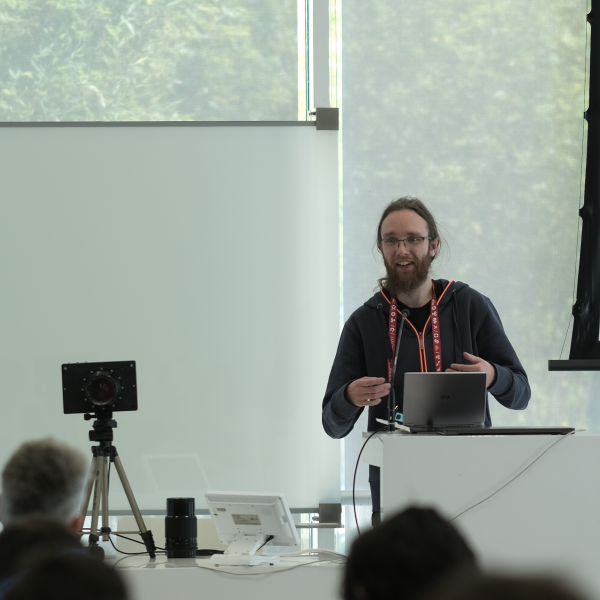
Just a few days ago, MCH2022, a six day long hacker camp in Netherlands, has concluded – bringing about three thousand hackers together to hang out. It was my first trip to a large hacker camp like this, as I’ve only been to smaller ones, and this story is coming from someone who’s only now encountering the complexity and intricacy of one. This is the story of how it’s run on the inside.

MCH2022 is the successor of a hacker camp series in the Netherlands – you might’ve heard of the the previous one, SHA, organized in 2017. The “MCH” part officially stands for May Contain Hackers – and those, it absolutely did contain. An event for hackers of all kinds to rest, meet each other, and hang out – long overdue, and in fact, delayed for a year due to the everpresent pandemic. This wasn’t a conference-like event where you’d expect a schedule, catering and entertainment – a lot of what made MCH cool was each hacker’s unique input.

Just like many other camps similar to this, it was a volunteer-organized event – there’s no company standing behind it, save for a few sponsors with no influence on decisionmaking; it’s an event by hackers, for hackers. The Netherlands has a healthy culture of hackerspaces, with plenty of cooperation between them, and forming a self-organized network of volunteers, that cooperation works magic. Continue reading “Mutually Crafted Happiness: How MCH2022 Happened”

Ask Hackaday: What Was Your First Electronics Win?

Back in high school, I joined the stage crew — because of course I did. As student theater groups go, it was pretty active, and with two shows to produce each year, there was always a lot of work to do. I gravitated to the lighting crew, which was a natural fit for me. Besides the electrical part of the job, there was also a lot of monkeying around on scaffolding and rickety ladders to hang the lights, which was great fun for the young and immortal. Plus there was the lighting console to run during performances, a job I eventually took over for my last two years.

Unfortunately, the lighting system was a bit pathetic. The console was mounted in the stage right wings, rather than out in the front of the house where a sensible person would put it. And despite being only about ten years old, the dimmers were already starting to fail. The board had about 20 channels, but you could always count on one of the channels failing, sometimes during a show, requiring some heroics to repatch the lights into one of the dimmers we always left as a spare, just for the purpose.

Continue reading “Ask Hackaday: What Was Your First Electronics Win?”

Dead Spider Becomes Robot Gripper: It’s Necrobotics!

Robot arms and grippers do important work every hour of every day. They’re used in production lines around the world, toiling virtually ceaselessly outside of their designated maintenance windows.

They’re typically built out of steel, and powered by brawny hydraulic systems. However, some scientists have gone for a smaller scale approach that may horrify the squeamish. They’ve figured out how to turn a dead spider into a useful robotic gripper.

The name of this new Frankensteinian field? Why, it’s necrobotics, of course!

Continue reading “Dead Spider Becomes Robot Gripper: It’s Necrobotics!”

Hackaday Links Column Banner

Hackaday Links: July 31, 2022

Don’t look up! As of the time of this writing, there’s a decent chance that a Chinese Long March 5B booster has already completed its uncontrolled return to Earth, hopefully safely. The reentry prediction was continually tweaked over the last week or so, until the consensus closed in on 30 Jul 2022 at 17:08 UTC, give or take an hour either way. That two-hour window makes for a LOT of uncertainty about where the 25-ton piece of space debris will end up. Given the last prediction by The Aerospace Corporation, the likely surface paths cover a lot of open ocean, with only parts of Mexico and South America potentially in the crosshairs, along with parts of Indonesia. It’s expected that most of the material in the massive booster will burn up in the atmosphere, but with the size of the thing, even 20% making it to the ground could be catastrophic, as it nearly was in 2020.

[Update: US Space Command confirms that the booster splashed down in the Indian Ocean region at 16:45 UTC. No word yet on how much debris survived, or if any populated areas were impacted.]

Good news, everyone — thanks to 3D printing, we now know the maximum height of a dive into water that the average human can perform without injury. And it’s surprisingly small — 8 meters for head first, 12 meters if you break the water with your hands first, and 15 meters feet first. Bear in mind this is for the average person; the record for surviving a foot-first dive is almost 60 meters, but that was by a trained diver. Researchers from Cornell came up with these numbers by printing models of human divers in various poses, fitting them with accelerometers, and comparing the readings they got with known figures for deceleration injuries. There was no mention of the maximum survivable belly flop, but based on first-hand anecdotal experience, we’d say it’s not much more than a meter.

Humans have done a lot of spacefaring in the last sixty years or so, but almost all of it has been either in low Earth orbit or as flybys of our neighbors in the Sol system. Sure we’ve landed plenty of probes, but mostly on the Moon, Mars, and a few lucky asteroids. And Venus, which is sometimes easy to forget. We were reminded of that fact by this cool video of the 1982 Soviet landing of Venera 14, one of only a few attempts to land on our so-called sister planet. The video shows the few photographs Venera 14 managed to take before being destroyed by the heat and pressure on Venus, but the real treat is the sound recording the probe managed to make. Venera 14 captured the sounds of its own operations on the Venusian surface, including what sounds like a pneumatic drill being used to sample the regolith. It also captured, as the narrator put it, “the gentle blow of the Venusian wind” — as gentle as ultra-dense carbon dioxide hot enough to melt lead can be, anyway.

Continue reading “Hackaday Links: July 31, 2022”

Demonstrate Danger, Safely

Dan Maloney and I were talking about the chess robot arm that broke a child’s finger during the podcast, and it turns out that we both have extreme respect for robot arms in particular. Dan had a story of a broken encoder wheel that lead to out-of-control behavior that almost hit him, and I won’t even get within striking distance of the things unless I know they’re powered off after seeing what programming errors in a perfectly functioning machine can do to two-by-fours.

This made me think of all the dangerous things I’ve done, but moreover about all the intensely simple precautions you can to render them non-risky, and I think that’s extremely important to talk about. Tops of my list are the aforementioned industrial robot arm and high powered lasers.

Staying safe with an industrial robot arm is as easy as staying out of reach when it’s powered. Our procedure was to draw a line on the floor that traced the arm’s maximum radius, and you stay always outside that line when the light is on. It’s not foolproof, because you could hand the ’bot a golf club or something, but it’s a good minimum precaution. And when you need to get within the line, which you do, you power the thing down. There’s a good reason that many industrial robots live in cages with interlocks on the doors.

Laser safety is similar. You need to know where the beam is going, make sure it’s adequately terminated, and never take one in the eye. This can be as simple as putting the device in a box: laser stays in box, nobody goes blind. If you need to see inside, a webcam is marvelous. But sometimes you need to focus or align the laser, and then you put on the laser safety glasses and think really hard about where the beam is going. And then you close the box again when you’re done.

None of these safety measures are particularly challenging to implement, or conceptually hard: draw a line on the floor, put it in a box. There were a recent series of videos on making Lichtenberg figures safely, and as a general rule with high voltage projects, a great precaution is a two-button deadman’s switch box. This at least ensures that both of your hands are nowhere near the high voltage when it goes on, at the cost of two switches.

If all of the safety precautions are simple once you’ve heard them, they were nothing I would have come up with myself. I learned them all from other hackers. Same goes with the table saw in my workshop, or driving a car even. But since the more hackery endeavors are less common, the “common-sense” safety precautions in oddball fields are simply less commonly known. It’s our jobs as the folks who do know the secrets of safety to share them with others. When you do something dangerous, show off your safety hacks!

Why Fedora Decided To Give CC0 Licensed Code The Boot

The term “open source” can be tricky. For many people, it’s taken to mean that a particular piece of software is free and that they can do whatever they wish with it. But the reality is far more complex, and the actual rights you’re afforded as the user depend entirely on which license the developers chose to release their code under. Open source code can cost money, open source code can place limits on how you use it, and in some cases, open source code can even get you into trouble down the line.

Which is precisely what the Fedora Project is looking to avoid with their recent decision to reject all code licensed under the Creative Common’s “Public Domain Dedication” CC0 license. It will still be allowed for content such as artwork, and there may even be exceptions made for existing packages on a case-by-case basis, but CC0 will soon be stricken from the list of accepted code licenses for all new submissions.

Fedora turning their nose up at a software license wouldn’t normally be newsworthy. In fact, there’s a fairly long list of licenses that the project deems unacceptable for inclusion. The surprising part here is that CC0 was once an accepted license, and is just now being reclassified due to an evolving mindset within the larger free and open source (FOSS) community.

So what’s the problem with CC0 that’s convinced Fedora to distance themselves from it, and does this mean you shouldn’t be using the license for your own projects?

Continue reading “Why Fedora Decided To Give CC0 Licensed Code The Boot”