The tech news channels were recently abuzz with stories about strange signals coming back from Voyager 1. While the usual suspects jumped to the usual conclusions — aliens!! — in the absence of a firm explanation for the anomaly, some of us looked at this event as an opportunity to marvel at the fact that the two Voyager spacecraft, now in excess of 40 years old, are still in constant contact with those of us back on Earth, and this despite having covered around 20 billion kilometers in one of the most hostile environments imaginable.
Like many NASA programs, Voyager has far exceeded its original design goals, and is still reporting back useful science data to this day. But how is that even possible? What 1970s-era radio technology made it onto the twin space probes that allowed it to not only fulfill their primary mission of exploring the outer planets, but also let them go into an extended mission to interstellar space, and still remain in two-way contact? As it turns out, there’s nothing magical about Voyager’s radio — just solid engineering seasoned with a healthy dash of redundancy, and a fair bit of good luck over the years.
When it comes to robots, especially ones that need to achieve some degree of autonomy, the more constrained the environment they work in, the easier it is for them to deal with the world. An industrial arm tethered next to a production line, for example, only has to worry about positioning its tool within its work envelope. The problems mount up for something like an autonomous car, though, which needs to deal with the world in two — or perhaps two and a half — dimensions.
But what about adding a third dimension? That’s the realm that aerial robots have to live and work in, and it’s where the problems get really interesting. Not only are there hardly any constraints to movement, but you’ve also got to deal with the problems of aerodynamic forces, navigation in space, and control systems that need to respond to the slightest of perturbations without overcompensating.
The atmosphere is a tough place to make a living, and dealing with the problems of aerial robotics has kept Nick Rehm occupied for many years as a hobbyist, and more recently as an aerospace engineer at Johns Hopkins Applied Physics Laboratory. Nick has spent his time away from the office solving the problems of autonomous flight, including detection and avoidance of mid-air collisions, development of vertical take-off and landing (VTOL) and fixed-wing aircraft, and even ground-effect aircraft. He’ll drop by the Hack Chat to discuss the problems of aerial robots and the challenges of unconventional aviation, and help us figure out how to deal with the third dimension.
The big news this week comes from the world of medicine, where a woman has received a 3D-printed ear transplant. The 20-year-old woman suffered from microtia, a rare congenital deformity that left her without a pinna, the external structure of the ear. Using scans of the normal ear, doctors were able to make a 3D model of what the missing pinna should look like. Raw material for the print was taken from the vestigial ear of the patient in the form of cartilage cells, or chondrocytes. The ear was printed using a bioprinter, which is a bit like an inkjet printer. The newly printed ear was placed into a protective structure and transplanted. The operation was done in March, and the results are pretty dramatic. With a little squinting, it does look a bit like there are some printing artifacts in the ear, but we’d imagine that’s more from the protective cage that was over the ear as it healed.
When NASA astronauts aboard the International Space Station have to clamber around on the outside of the orbiting facility for maintenance or repairs, they don a spacesuit known as the Extravehicular Mobility Unit (EMU). Essentially a small self-contained spacecraft in its own right, the bulky garment was introduced in 1981 to allow Space Shuttle crews to exit the Orbiter and work in the craft’s cavernous cargo bay. While the suits did get a minor upgrade in the late 90s, they remain largely the product of 1970s technology.
Not only are the existing EMUs outdated, but they were only designed to be use in space — not on the surface. With NASA’s eyes on the Moon, and eventually Mars, it was no secret that the agency would need to outfit their astronauts with upgraded and modernized suits before moving beyond the ISS. As such, development of what would eventually be the Exploration Extravehicular Mobility Unit (xEMU) dates back to at least 2005 when it was part of the ultimately canceled Constellation program.
NASA’s own xEMU suit won’t be ready by 2025.
Unfortunately, after more than a decade of development and reportedly $420 million in development costs, the xEMU still isn’t ready. With a crewed landing on the Moon still tentatively scheduled for 2025, NASA has decided to let their commercial partners take a swing at the problem, and has recently awarded contracts to two companies for a spacesuit that can both work on the Moon and replace the aging EMU for orbital use on the ISS.
As part of the Exploration Extravehicular Activity Services (xEVAS) contract, both companies will be given the data collected during the development of the xEMU, though they are expected to create new designs rather than a copy of what NASA’s already been working on. Inspired by the success of the Commercial Crew program that gave birth to SpaceX’s Crew Dragon, the contract also stipulates that the companies will retain complete ownership and control over the spacesuits developed during the program. In fact, NASA is even encouraging the companies to seek out additional commercial customers for the finished suits in hopes a competitive market will help drive down costs.
There’s no denying that NASA’s partnerships with commercial providers has paid off for cargo and crew, so it stands to reason that they’d go back to the well for their next-generation spacesuit needs. There’s also plenty of incentive for the companies to deliver a viable product, as the contact has a potential maximum value of $3.5 billion. But with 2025 quickly approaching, and the contact requiring a orbital shakedown test before the suits are sent to the Moon, the big question is whether or not there’s still enough time for either company to make it across the finish line.
Join Hackaday Editor-in-Chief Elliot Williams and Staff Writer Dan Maloney for a tour of the week’s best and brightest hacks. We begin with a call for point-of-sale diversity, because who wants to carry cash? We move on to discussing glass as a building material, which isn’t really easy, but at least it can be sintered with a DIY-grade laser. Want to make a call on a pay phone in New York City? Too late — the last one is gone, and we offer a qualified “good riddance.” We look at socially engineering birds to get them away from what they should be really afraid of, discuss Apple’s potential malicious compliance with right-to-repair, and get the skinny on an absolute unit of a CNC machine. Watching TV? That’s so 2000s, but streaming doesn’t feel quite right either. Then again, anything you watch on a mechanical color TV is pretty cool by definition.
Military officials and civilian security researchers have been warning us for years: cyberattacks are becoming a very real part of modern warfare. Far from being limited to military targets, cyberattacks can take out everything from vital public infrastructure to commercial and industrial operations, too.
In the early hours of February 24, as the Russian invasion force began raining missiles on Ukrainian cities, another attack was in progress in the digital realm. Suddenly, satellite terminals across Europe were going offline, with many suffering permanent damage from the attack.
Details remain hazy, but researchers and military analysts have pieced together a picture of what happened that night. The Great Euro Sat Hack prove to be the latest example of how vulnerable our digital infrastructure can be in wartime.
I hope last week’s introduction to bulk material handling got you all thinking up amazing hacks, and we’ll soon be reporting on DIY Cap’n Crunch Robots galore. This week we’ll look at how to measure particle sizes, separate particles, and even grind them up when you need to.
Measuring Material Properties
Last week we talked about cohesive strength. Bulk material behaves somewhere between a solid and a liquid — if you’ve done your homework, it flows down the funnel just fine. But if you haven’t, it sticks together and holds up the rest of the material. Cohesive strength is the measure of how much weight the material at the bottom of the funnel can hold up.
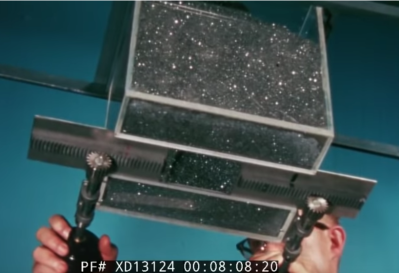
You can get a rough measurement by packing material in a box with a square hole at the bottom. One side of the hole should have a retractable slide. Slowly withdraw the slide, making the hole rectangular. Material will bridge over, and then at some point a larger chunk will fall out. This is about the size of the minimum opening that will not arch, and a practical measure of the material’s cohesive strength.
Many materials cohere better when wet. Dry a sample in a microwave to determine the percent moisture by weighing it before and after.
Cohesive strength is closely allied to shear strength. If you want to measure shear strength, cut two 1 cm wide rings of 5 cm diameter PVC pipe, stack them, pack with material, put a disk atop the material and load it, then drag the top ring off the bottom with a spring scale. The force per unit area is the shear strength at that pressure. If it starts packing you’ll see it in the curve.
Packing factor is another useful measurement. Gently shake material to fill a rigid container and weigh it. Now empty the container and refill, packing the material as hard as you can with a length of 1” dowel. Reweigh, and the ratio of the two weights tells you how well the material packs.
Real bulk material is almost always made up of particles of varying sizes, shapes, and compositions. Dirt is particles of different kinds of mineral and organic matter varying from outright rocks to sub micron clay particles. If you’re having problems, getting a graph of material size distribution can be helpful.
For particles above about 75 μM, you can measure the sizes with sieves. If you want to be fancy, they sell nice sets of metal sieves with wire mesh in the bottom. Screen assortments are cheaper. Below 75 μM, you have to use a hydrometer. This is messy and takes a while, but does work.
The idea is to mix the material with soapy water and then use a hydrometer from the auto parts store to measure the density. The particles fall out by Stokes law, big ones first. Stokes law is just that the drag force on a sphere is proportional to the square of the radius. Mass will go up as cube of the radius, so large particles fall faster than small ones. As they fall out, the density of the fluid decreases. This page describes how to do it, and this page has a handy calculator for interpreting the results.
Grinding
You can also change the size of particles in your mix. If particles are too large, they can be crushed or ground. You can separate by size and only grind some of the sizes or discard some of the material. There’s a whole science to grinding. The finer you grind, the harder it gets to grind. Cosmetics and pharmaceutical companies are full of grinding experts.
In general, there are three ways to make something smaller – crush it, cut it, or hit it.
Crushing is straightforward. Use rollers or jaws, a rolling pin or a rock crusher. Don’t overlook the vise. A jaw crusher only crushes particles larger than the jaw space, useful to make a certain size. Rock crushers have a complex motion (video) that should nonetheless be easily imitated by a hacker project. Amateur/hobby gold prospectors have an accessible community.
Crushing action in rollers only works until the particle is small enough that the surface of the roller deforms instead of the particle. Stones have been used to crush grain into flour for most of history.
Cutting is best for soft things, like gummy worms, and tough things (video.). Make sure the cut material has an easy path out. Think of an old fashioned kitchen meat grinder. .
If you want small particles, you need an impact grinder. A coffee mill or blender works by striking the particle with a fast moving impactor. This can be a blade – useful if the material first needs to be cut up, as in a coffee mill – or blunt. Many industrial mills use two pivoting weights on a shaft, and this unit just uses chains (video).
Another impact mill is the ball mill. Rotate a drum on it’s side with steel balls and the material. The balls travel up the side, then fall back down, striking the material.
All these work by fracturing the material. What if you’re trying to powder something that doesn’t fracture, say rubber O rings? For that, there’s cryogenic grinding.
Many rubbery materials are really glasses — materials that are a gloppy liquid at a higher temperature, often brittle at a cool temperature, and soft in-between. The glass you’re probably thinking of is a brittle, breakable material at room temperature, but at high temperature is a liquid. The transition point is the ‘glass transition temperature’.
So what about our O rings? If they’re natural rubber their transition point is about -70° C. Below that temperature they’re brittle and can be ground up. Unfortunately, grinding is going to put heat back in. So consider grinding slowly – some labs grind biological materials like skin samples with a special mortar and pestle cooled beforehand with liquid nitrogen. Just be sure everything in contact with the material has been cooled, and use a thick walled container with lots of thermal mass.
Separating Wheat From Chaff
Sometimes you have a mix and need to separate it. Your roommate dumped all the gummy bears and all those weird ginger candies into a bowl or whatever. Last week we introduced particle segregation as a bad thing. But when you want to un-mix a mixture, it can be a good thing. Any of the techniques from last week can be an aid.
Sieves and screens work to separate by size. They clog unless the material keeps moving over them. One simple way to do this is to flow the material over sieves on a slanted board, finest sieve first. Another is to mechanically shake the screen. Paper filters are just fine screens, and do clog.
A trommel is a slowly turning cylinder with walls of different sized screens along it’s length. Material is fed into the fine screen end and slowly moves towards the other.
Stokes law provides another way to separate materials as we saw above. Make an upward air draft in a vertical pipe. Deliver the material into the pipe part way up. Materials with more drag than weight will go up, larger materials will go down. You can use the air speed to control the size of particle. An industrial machine called an air classifier does this with higher velocity air blowing material into the rim of a spinning set of blades.
It could be the air (or another gas) you want to remove. There are a couple ways to do it. The first is the cyclone familiar to wood shops. The second is even simpler – inject the air/material mix into the top of a tall, slender container with a tube that extends about halfway into the container. Let the air out from an outlet pipe in the roof. The air flow expands, slows down, and the material falls out.
You can just blow the material sideways – the age old system of threshing wheat works this way. Wheat comes from the plant with a husk, you beat it with a flail to loosen the husk, giving you wheat grains and chaff mixed. Put the mix on a blanket and have four peasants toss it repeatedly. The chaff blows away in the wind.
Inertial Separation
A very sensitive separation technique is inertial separation. Here’s a mix of gummy colas and jelly beans. We separated them by tilting and gently shaking the sheet. A material moves on a sheet by staying in place until the acceleration is more than some critical value. Then it rolls or slides.
If your material is dirt or such, run a magnet through it. There’s iron ore and bits of human generated iron in a lot of soil. It can get into motors and such. If you need it out run the material past magnets. An eddy current separator uses AC magnetic effects to do the same with nonferrous metals.
You can also segregate materials by dissolving them. A mixture of table salt and white sand would seem impossible, but if you stir it into water, then decant and boil off the water, the salt and sand can be recovered separately. But we think we’re veering into chemistry now, and we should stop.
Next time we’ll finish up by looking at controlling movement: building gates and contraptions that move your bulk material without clogging up.