Perovskites Understood

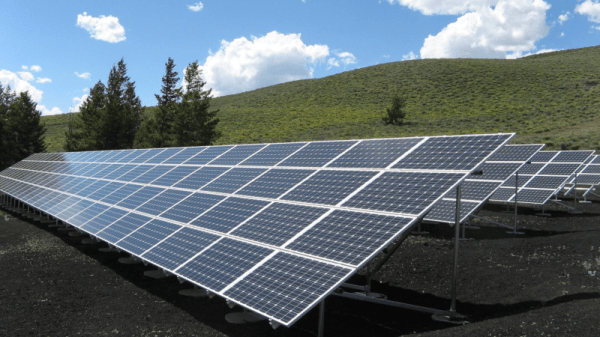
The usual solar cell is made of silicon. The better cells use the crystalline form of the element, but there are other methods to obtain electric energy from the sun using silicon. Forming silicon crystals, though, can be expensive so there is always interest in different solar technologies. Perovskite is one of the leading candidates for supplanting silicon. Since they use lead salts, they are cheap and simple to construct. The efficiency is good, too, even when the material is not particularly well ordered. The problem is every model science has on what should make a good solar cell predicted that orderly compounds would perform better, even though this is not true for perovskite. Now scientists at Cambridge think they know why these cells perform even in the face of structural defects.

Perovskites take their name from a natural mineral that has the same atomic structure. In 2009, methylammonium lead halide perovskites were found to act as solar cells. Conversion rates can be as high as 25.5% according to sources and — apparently — the cells could be as much as 31% efficient, in theory. Solar cells top out — again, in theory — at 32.3% although in the real world you are lucky to get into the high twenties.

Continue reading “Perovskites Understood”

Solar Cells, Half Off

A company named Leap Photovoltaic claims they have a technology to create solar panels without silicon wafers which would cut production costs in half. According to [FastCompany] the cells are still silicon-based, but do not require creating wafers as a separate step or — as is more common — acquiring them as a raw material.

The process is likened to 3D printing as silicon powder is deposited on a substrate. The design claims to use only a tenth of the silicon in a conventional cell and requires fewer resources to produce, too.

Continue reading “Solar Cells, Half Off”

Solar Power Goes Back To 1910 Tech

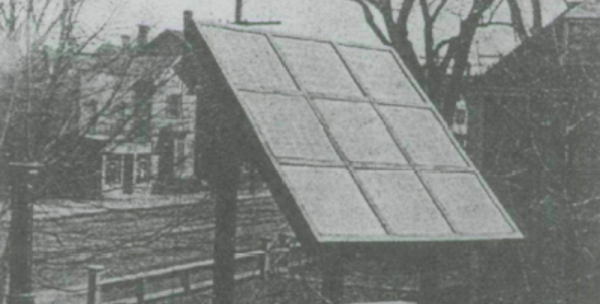
If you want to read about a low-tech approach to solar cells invented — and forgotten — 40 years before Bell Labs announced the first practical silicon solar cell, we can’t promise the website, Low Tech Magazine, will be available. Apparently the webserver it is on is solar-powered, and a disclaimer mentions that it sometimes goes offline.

The article by [Kris De Decker] tells of George Cove and includes a picture from 1910 of the inventor standing next to what looks suspiciously like a solar panel (the picture above is from a 1909 issue of Technical World Magazine). His first demonstration of the technology was in 1905 and there is a picture of another device from 1909 that produced 45 watts of power using 1.5 square meters with a conversion efficiency of 2.75%. That same year, a new prototype had 4.5 square meters and used its 240-watt output to charge 5 lead-acid batteries. The efficiency was about 5%.

Continue reading “Solar Power Goes Back To 1910 Tech”

Quint explaining his water turbine

Power Your Home With A Water Battery

I’ve stated it before on Hackaday but one of the most interesting engineering challenges posed to me this year was “how could you store enough energy to power a decent portion of a home for several hours without using batteries, all while staying within the size of a typical suburban plot?” [Quint Builds] attempts something up that alley by using solar power to pump water up onto his roof and later releasing it for power generation. (Video, embedded below.)

Earlier [Quint] had built a water collecting system using his gutters and a bell siphon but wasn’t satisfied with the overall power output. Using the turbine he had created for that system, he put a 55-gallon drum on top of his roof with the help of some supporting structures. We’d like to advise the public to consult a professional before adding a large heavy weight on top of your roof, but [Quint] forges ahead after studying his trusses and determining it to be a risk he is willing to take. A solar panel runs a small pump that pumps water from a reservoir up to the top of the roof when the sun shines with a float switch in the roof barrel stopping the motor once it’s full. A valve at the bottom allows water to spin the turbine and fill back into the bottom reservoir, forming a closed loop. There were a few snags along the way with prototype circuits not being fully contacted and the motor needing water cooling, an issue fixed by a custom CNC’d heat sink. The fixes for the various issues are almost as entertaining to see as the actual system itself.

It’s incredible to see lights come on powered by water alone but also sobering to realize just how much water you’d need to power a typical home. Perhaps if [Quint] upgrades, he can swap out the small motor for a larger 3D printed water pump.

Continue reading “Power Your Home With A Water Battery”

Snails, Sensors, And Smart Dust: The Michigan Micro Mote

If you want to track a snail, you need a tiny instrumentation package. How do you create an entire data acquisition system, including sensors, memory, data processing and a power supply, small enough to fit onto a snail’s shell?

Throughout history, humans have upset many ecosystems around the world by introducing invasive species. Australia’s rabbits are a famous example, but perhaps less well-known are the Giant African land snails (Lissachatina fulica) that were introduced to South Pacific islands in the mid-20th century. Originally intended as a food source (escargot africain, anyone?), they quickly turned out to be horrible pests, devouring local plants and agricultural crops alike.

Not to be deterred, biologists introduced another snail, hoping to kill off the African ones: the Rosy Wolfsnail (Euglandina rosea), native to the Southeastern United States. This predatory snail did not show great interest in the African intruders however, and instead went on to decimate the indigenous snail population, driving dozens of local species into extinction.

A snail with a solar sensor attached to its shell
A Rosy Wolfsnail carrying a light sensing Micro Mote on its back. Source: Cindy S. Bick et al., 2021

One that managed to survive the onslaught is a small white snail called Partula hyalina. Confined to the edges of the tropical forests of Tahiti, biologists hypothesized that it was able to avoid the predators by hiding in sunny places which were too bright for E. rosea. The milky-white shells of P. hyalina supposedly protected them from overheating by reflecting more sunlight than the wolf snails’ orange-brown ones.

This sounds reasonable, but biologists need proof. So a team from the University of Michigan set up an experiment to measure the amount of solar radiation experienced by both snail types. They attached tiny light sensors to the wolf snails’ shells and then released them again. The sensors measured the amount of sunlight seen by the animals and logged this information during a full day. The snails were then caught again and the data retrieved, and the results proved the original hypothesis.

So much for science, but exactly how did they pull this off? Continue reading “Snails, Sensors, And Smart Dust: The Michigan Micro Mote”

A tiny solar-powered robot that even works indoors

Tiny BEAM Robot Smiles Big At The Sun

What have you been working on during the Great Chip Shortage? [NanoRobotGeek] has been living up to their handle and building BEAM robots that are smaller than any we’ve seen before. What are BEAM robots, you say? Technically it stands for Biology Electronics Aesthetics and Mechanics, but basically the idea is to mimic the movement of bugs, usually with found components, and often with solar power. Here’s a bunch of tutorials to get you started.

The underbelly of what might be the world's smallest BEAM robot.
This was before the large, flat storage capacitor came and covered everything up.

This here is an example of a photovore or photopopper — it moves toward light using simple logic by charging up a capacitor and employing a voltage monitor to decide when there’s enough to run two tiny vibration motors that make up its legs and feet.

[NanoRobotGeek] started in a great place when they found these 25% efficient monocrystalline solar panels. They will even make the bot move indoors! If you want to build one of these, you can’t beat [NanoRobotGeek]’s guide. Be sure to watch it toddle around in the demo video after the break.

We love to see people work at all different scales. Last time we checked in with [NanoRobotGeek], they had built this solar-powered ball-flinging delight.

Continue reading “Tiny BEAM Robot Smiles Big At The Sun”

Ruggedized Solar Power bank

Rugged Solar Generator Packs A Punch

Hackaday Prize 2021 entrant [Philip Ian Haasnoot] has been building a well-polished power bank. But this is no ordinary little power bank the like you would throw in your rucksack for a day out. No, this 2.5 kW luggable power bank is neatly encased in a tough, waterproof Pelican 1550 case, and is suitably decked out with all the power sockets you could possibly need for a long weekend of wilderness camping and photography.

Testing the hand-built 18650 based battery bank
Boy, that’s a lot of tab welding

This box sports USB-C and USB 3.0 connectors for gadget charging, as well as 12 VDC cigarette lighter and XT-60 ports for high-drag devices. Also it provides a pair of 120 VAC sockets via an integrated inverter, which at 1.5 kW could run a small heater if you were really desperate, but more likely useful to keep your laptop going for a while. Now if only you could get Wi-Fi out in the desert!

[Philip] doesn’t actually talk much about the solar panels themselves, but we know the box contains a 600 W MPPT boost converter to take solar power in, and feed the LiPo battery pack in the correct manner.

The battery pack is custom-made from salvaged and tested 18650 cells, as you would expect, which we reckon took an absolute age to make by hand. The whole project is nicely finished, and looks like something we’d be happy to throw in the back of the car before heading out into our local wilderness.

As [Philip] says in the project description, it’s a tough job to carry enough power and keep all his drones, cameras and lighting equipment charged, not mention helping prevent the campsite occupants from freezing overnight during the chilly Arizona nights.

Many power bank designs have graced these fair pages over the years, like this rather polished build, and long may they continue to do so.