Here’s an interesting thought: it’s possible to build a cubesat for perhaps ten thousand dollars, and hitch a ride on a launch for free thanks to a NASA outreach program. Tracking that satellite along its entire orbit would require dozens of ground stations, all equipped with antennas, USB TV tuners, and a connection to the Internet. It’s actually more expensive to build and launch a cubesat than it costs to build a network of ground stations to get reasonably real-time telemetry from a cubesat. The future is awesome and weird, it seems.
This is the observation the guys behind SatNOGS have made. They’re developing a platform for a completely open source ground station network, with the idea being people an institutions along every longitude and latitude would build a simple satellite tracking antenna mount, connect it to the Internet, and become part of an open source Near Space Network, capable of receiving telemetry from any one of the small cubesats whizzing around in low earth orbit.
Despite being what is probably one of the most ambitious and far-reaching projects in open source hardware, the design of the system is relatively simple: the hardware is a 3D printed alt-az mount, capable of pointing a pair of antennas anywhere in the sky. The stepper motor driver board is based on the Arduino, and the computer running each antenna node is powered by a BeagleBone Black or a WR703N router. The antenna receiver is, of course, an RTL-SDR dongle, capable of listening to all the common cubesat bands. Even the software is derived from open source projects. Tracking a satellite across the sky can be calculated with GPredict, and the team is working on an observation scheduling and management system that combines multiple ground stations for coverage across the globe.
It’s a great idea, crowdsourcing satellite tracking from people around the globe, and something that could be used by hundreds of institutions lucky enough to launch a small cube of electronics into orbit.
The project featured in this post is an entry in The Hackaday Prize. Build something awesome and win a trip to space or hundreds of other prizes.
Somehow we picked two people in a row who are working on lab equipment as part of The Hackaday Prize. This is just a coincidence; we’re picking hackers who we think will be quite interesting to learn about.
Meet [Bradley Worley]. His contest entry is PyPPM, a Proton Precession Magnetometer which will be used for Nuclear Magnetic Resonance experiments. The “Py” at the beginning reflects the use of the Python API for control.
Since [Gene Roddenberry] traveled back in time from the 23rd century, the idea of a small, portable device has wound its way through the social consciousness, eventually turning into things like smartphones, PDAs, and all the other technological gadgetry of modern life. A few years ago, [Peter Jansen] started The Tricorder Project, the start of the ultimate expression of [Mr. Roddneberry]’s electronic swiss army knife. Now [Peter] is building a better, smaller version for The Hackaday Prize.
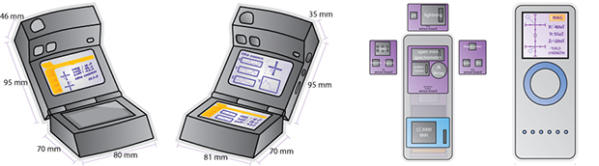
[Peter]’s first tricorders borrowed their design heavily from The Next Generation props with a fold-out section, two displays, and a bulky front packed to the gills with sensors and detectors. Accurate if you’re cosplaying, but not the most practical in terms of interface and human factors consideration. These constraints led [Peter] to completely redesign his tricorder, disregarding the painted wooden blocks found on Enterprise and putting all the electronics in a more usable form factor.
A muse of sorts was found in the Radiation Watch, a tiny, handheld Geiger counter meant as an add-on to smartphones. [Peter] envisions a small ~1.5″ OLED display on top, a capacitive sensing wheel in the middle, and a swipe bar at the bottom. Basically, it looks like a 1st gen iPod nano, but much, much more useful.
Plans for what to put in this improved tricorder include temperature, humidity, pressure, and gas sensors, a 3-axis magnetometer, x-ray and gamma ray detectors, a polarimeter, colorimeter, spectrometer, 9-axis IMU, a microphone, a lightning sensor, and WiFi courtesy of TI’s CC3000 module. Also included is something akin to a nuclear event detector; if it still exists, there has been no nuclear event.
It’s an astonishing array of technology packed into an extremely small enclosure – impressive for something that is essentially a homebrew device.Even if it doesn’t win the Hackaday Prize, it’s still an ambitious attempt at putting data collection and science in everyone’s pocket – just like in Star Trek.
The project featured in this post is an entry in The Hackaday Prize. Build something awesome and win a trip to space or hundreds of other prizes.
This week we’re getting to know The Hackaday Prize Judge [Jack Ganssle] a little better. His depth of experience with embedded systems is formidable, and recently I was very interested to learn about his mission to improve the quality of the product in the embedded code universe. We’ll get to that in a little bit, but I wanted to start off with [Jack’s] answer to my final question.
Is there anything else you’d like our audience to know about you?
My entry into this field was when the first 8 bit processor (the 8008) came out, and still find it endlessly fascinating. I write a lot about embedded topics, and give talks and seminars, on all of the continents except Antarctica (so far!). We live in heavily-wooded Finksburg, MD, which is just stunning this time of year, and, since my office is in the house, the commute is pretty tolerable. Other passions include sailing; I wrote an on-line book (www.ganssle.com/jack) about racing alone across the Atlantic. Great trip, other than losing the boat.
For years now, people have been trying to develop an affordable, RepRap-derived 3D printer that will create objects in metal. There has been a lot of work with crazy devices like high-powered lasers, and electron beams, but so far no one has yet developed a machine that can print metal objects easily, cheaply and safely. For The Hackaday Prize, [Sagar] is taking a different tack for his metal 3D printer: he’s extruding low temperature alloys just like a normal 3D printer would extrude plastic.
[Sagar]’s printer is pretty much a carbon copy of one of the many ‘plastic-only’ 3D printers out there, the only change being in the extruder and hot end. As a material, he’s using an alloy of 95.8% tin, 4% copper, and 0.2% silver in a 3mm diameter spool. This alloy melts at 235° C, about the same temperature as the ABS plastic these printers normally use.
The only real problems with this build are the extruder and nozzle. [Sagar] is milling his own nozzle and hot end out of stainless steel; a challenging bit of machining, but still within the realm of a hobbyist. He has some doubts about the RepRap derived plastic geared extruder being able to handle metal, so he’s also looking at designing a new version and milling that out of stainless as well.
It’s an awesome project, and we hope we’ll be seeing some updates to the project shortly. While a 3D printer that produces objects out of a low temperature alloy won’t be building rocket engines any time soon, it could be a great way to fabricate some reasonably high-strength parts at home.
The project featured in this post is an entry in The Hackaday Prize. Build something awesome and win a trip to space or hundreds of other prizes.
The future is a scary place, full of robots, drones, and smart appliances with cameras and vision systems that will follow your dog, your child, or your face around, dutifully logging everything they see, reporting back to servers, and compiling huge datasets that can be sold to marketing companies. We’re not too keen on this view of the future, but the tech behind it – cheap cameras in everything – is very cool. [Ibrahim] is doing his part to bring about the age of cheap cameras that are easy to interface with his entry to The Hackaday Prize, the OpenMV.
The idea of a digital camera that is easy to interface with microcontrollers and single board computers isn’t new. There are serial JPEG cameras and the CMUcam5 Pixy, but they cost somewhere around $70. It’s not something you would design a product around. [Ibrahim]’s OpenMV costs about $15, and offers some interesting features like on-board image processing, a huge amount of RAM, and even a wireless expansion thanks to TI’s CC3000 WiFi module.
Currently, the OpenMV is capable of doing face detection at 25fps, color detection at better than 30fps, all thanks to the STM32F4 ARM micro running at 180MHz. There’s support for up to 64MB of RAM on board, with IO available through serial, SPI, I2C, USB 2.0, and WiFi.
It’s an interesting project on its own, but the really cool thing about this build is the price: if [Ibrahim] can actually produce these things for $15 a pop, he has an actual product on his hands, one that could easily be stuffed inside a drone or refrigerator for whatever cool – or nefarious – purposes you can imagine.
The project featured in this post is an entry in The Hackaday Prize. Build something awesome and win a trip to space or hundreds of other prizes.
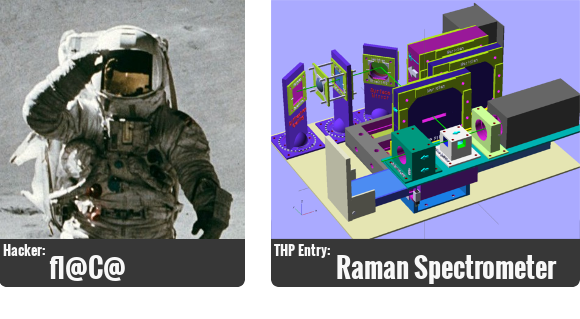
Now that we’re starting to get serious about The Hackaday Prize we thought we’d take a look at the lives of some of the hackers who have submitted entries. Meet fl@C@, who is working on a Raman Spectrometer which is largely 3D printed and uses a Raspberry Pi. He was kind enough to answer all of our questions, some serious and some not so.
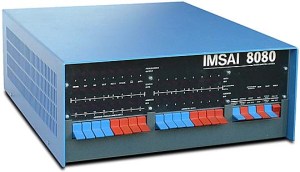
Creating. It’s probably no surprise that I have many hobbies…but hardware hacking is my life. I got my first taste with my dads Imsai 8080 (showing my age, but I was fairly young!)..Then it was an Apple][.. I really dove into that. I built my own from a bare pcb to a working machine when I was around 11 or 12. Just moved up from there.. Really went nuts when I got a job at a surplus electronics store in the silicon valley.. I rarely took home a paycheck.. I have a few other hobbies, I’m a private pilot…love flying. I built a pretty cool device that allowed me to datalog my flights, my heartrate, keep track of the fuel, it speaks and connects to the comm to remind me when to switch tanks, etc.. I’ll have to put that up on the project page.
Well…For my day job, I am a Network Engineer.. I can’t really say for which company, but it’s big.
My Passion is Going Big
I would say my passion is going big..if it’s worth doing…..it’s worth overdoing. I love coming up with ideas that would make a difference. The spectrometer I am working on is actually only a small part of a larger project I am working toward. There are never enough hours, or dollars to cover all of my ideas…but I always work as hard as I can to get there.. TLDR- I’m excited every day to wake up and make another step towards changing the world.
I work from home, but in the office… it’s definitely the snack machine. Seriously? We can’t build a machine that dispenses snacks without getting them stuck?
I’d say linux. I’ve been a fan of ubuntu for a while.. lately I’ve been playing with xubuntu. I don’t care for messing with computers..lol. I love electronics, hardware, software and all that.. but I do not geek out over PC hardware..I consider them another tool…they need to work when I need them to work. lol
Not sure if you want a breakdown of what gear I have….I have quite a bit and a pretty elaborate lab setup..but I’m really a bit of a minimalist when it comes to day to day use.. I use my scope when it’s appropriate..my logic analyzer (saelae logic rocks) pretty often.. but I’d say my go to device is usually my DMM since it’s what I tend to use most often…I have a few, but I like to use the one that connects up to my PC so I can make screenshots, and/or see it from a distance..
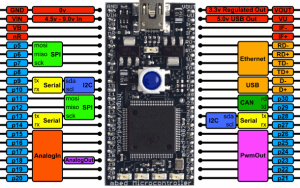
I would have to default to the mBed for this one..for general purpose. I started out like most people probably with the basic stamp waaaay back…and went through a few others..and settled on the mBed when there was just one device, but now they have so many platforms that you can fit to whatever need..and some of them are dirt cheap. I’m using the ST Nucleo041RE for the spectrometer project, and it’s only $10 at mouser. I have just started peering into FPGA stuff, I hope to get some more time to work with them very soon, I see lots of potential.. I never really used Arduino’s until the past year or two when I got into quadcopters..they have a purpose..and are ok for quick and dirty stuff since you can source a pro mini on ebay for like 3 bucks..
Python has become my best friend. C++ is great and all, I’ve been forced to use VB6 for work…where they even use winbatch……. But python works.. and it’s easy to crank something out quickly, and you can build some pretty robust stuff with it..
Well, I have a couple that come to mind immediately that I honestly would love to share with the world…but won’t just yet.. =) So, I’ll go with what is left…hopefully it’s plenty for now..
I’d love to build a fusor. I built my first tesla coil when I was 17.. I’d love to take the hobby fusor to the next step..
A Moon Rover. Seriously. And the vehicle to get it there. I think we all agree rockets and gasoline both need to go away. Mankind needs to reach out beyond what we’re confortable with.
A fully autonomous multirotor. I actually started this project..have it all layed out..but it’s not high enough on my priority list to make it the rest of the way..I have probably 80% of the parts new in a box..I’ve started doing a writeup on it..and hope to get it up soon.
Learn the Value of Knowing Where and How to Find the Information [You] need
I wish that everyone would learn the value of knowing where and how to find the information they need to accomplish a goal. Schools typically force you to memorize facts and information that is often worthless. I would like for people to learn instead how to be adaptive in their approach to problems, and understand that there is always more than one answer.. and there is a huge resource out there that will enable you to make educated decisions and reach grander goals. We live in a great time with that…and in that way, the internet is underutilized…
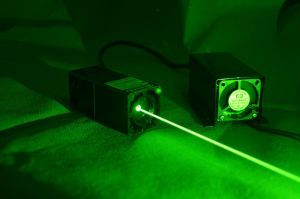
The timing was right…I thought this was an interesting and unique project..I had promised myself to try to be more open and share..this project was perfect since it has 3d parts people can print themselves, a raspberryPi, a sorta arduino and a cool laser…plus I figured there are several people out there that could either benefit from a low cost raman spectrometer, or at least benefit from some part of it..be it the parts I designed or just the understanding of how it works and what they’re used for…
I always keep an open mind, and consider any advice given.. There have been many aspects of this project that created a challenge.. This is my first serious venture into 3d printing this much stuff…I’ve never really worked with lasers and optics in such a way.. Avoiding spending thousands on optics was a major challenge. I have been doing all the research I can to understand the best approach to imaging…My first idea was to modify a webcam to take long exposures since the light reaching the camera will be fairly faint..after looking into that, it’s not just a lot of work and difficult to reproduce…but the cameras that others have modified are ancient and next to impossible to find. I wanted to go with a camera that anyone could find…the raspiCam kept surfacing as the best choice…so, the next challenge was how to get the long exposure…the raspiCam driver doesn’t really allow for 10-30 second exposures… so the next idea was to take several shots, and stack them to build a usable image.. so my latest approach is to take a 90fps video for a couple seconds, split that into individual frames, and stack those.. If anyone has suggestions in this area, I’d love to hear them.. I planned on using either mathematica or qtoctave from python, etc..
A Moon Rover. =) It’d probably most definately be a team effort.. But I think as a community, the skills are out there. And the google XPrize shouldn’t be the only game in town.. I think things are building up to this kind of stuff anyway, but someone’s got to be first.
Live Out Loud Every Day
I’d just like to say…putting this project on this site was a major debate for me. I grew up with parents that had secret clearances, and privacy was central. I’ve been trying to build up the courage to share my work and ideas with the world because I think it benefits everyone. This project is my first to share, and for it to be featured here, and for me to be honored with being the first the be featured is really amazing. I appreciate this whole community, I’ve learned a lot from it over the years and I hope to be able to give back and contribute more soon!

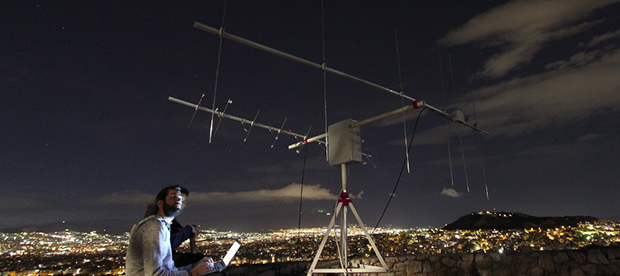 Here’s an interesting thought: it’s possible to build a cubesat for perhaps ten thousand dollars, and hitch a ride on a launch for free thanks to a NASA outreach program. Tracking that satellite along its entire orbit would require dozens of ground stations, all equipped with antennas, USB TV tuners, and a connection to the Internet. It’s actually more expensive to build and launch a cubesat than it costs to build a network of ground stations to get reasonably real-time telemetry from a cubesat. The future is awesome and weird, it seems.
 The project featured in this post is an entry in The Hackaday Prize. Build something awesome and win a trip to space or hundreds of other prizes.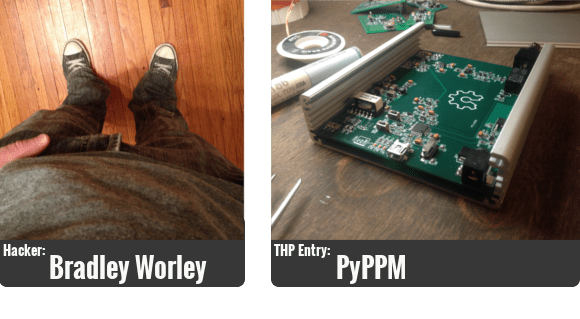


 Is there anything else you’d like our audience to know about you?
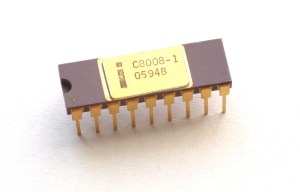 My entry into this field was when the first 8 bit processor (the 8008) came out, and still find it endlessly fascinating. I write a lot about embedded topics, and give talks and seminars, on all of the continents except Antarctica (so far!). We live in heavily-wooded Finksburg, MD, which is just stunning this time of year, and, since my office is in the house, the commute is pretty tolerable. Other passions include sailing; I wrote an on-line book (www.ganssle.com/jack) about racing alone across the Atlantic. Great trip, other than losing the boat.
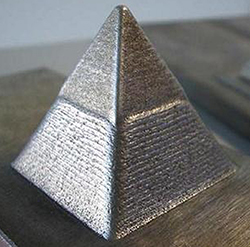 For years now, people have been trying to develop an affordable, RepRap-derived 3D printer that will create objects in metal. There has been a lot of work with crazy devices like high-powered lasers, and electron beams, but so far no one has yet developed a machine that can print metal objects easily, cheaply and safely. For The Hackaday Prize,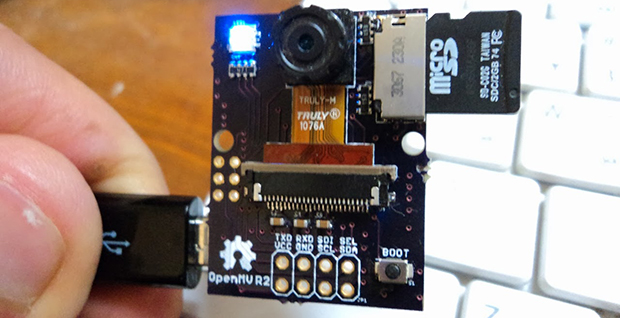
 Now that we’re starting to get serious about The Hackaday Prize we thought we’d take a look at the lives of some of the hackers who have submitted entries. Meet
 Well…For my day job, I am a Network Engineer.. I can’t really say for which company, but it’s big.

 I’d say linux. I’ve been a fan of ubuntu for a while.. lately
  I love electronics, hardware, software and all that.. but I do not geek out over PC hardware..I consider them another tool…they need to work when I need them to work. lol
 Not sure if you want a breakdown of what gear I have….I have quite a bit and a pretty elaborate lab setup..but I’m really a bit of a minimalist when it comes to day to day use.. I use my scope when it’s appropriate..my logic analyzer (saelae logic rocks) pretty often.. but I’d say my go to device is usually my DMM since it’s what I tend to use most often…I have a few, but I like to use the one that connects up to my PC so I can make screenshots, and/or see it from a distance..
 Python has become my best friend. C++ is great and all, I’ve been forced to use VB6 for work…where they even use winbatch……. But python works.. and it’s easy to crank something out quickly, and you can build some pretty robust stuff with it..
 Well, I have a couple that come to mind immediately that I honestly would love to share with the world…but won’t just yet.. =) So, I’ll go with what is left…hopefully it’s plenty for now..
 The timing was right…I thought this was an interesting and unique project..I had promised myself to try to be more open and share..this project was perfect since it has 3d parts people can print themselves, a raspberryPi, a sorta arduino and a cool laser…plus I figured there are several people out there that could either benefit from a low cost raman spectrometer, or at least benefit from some part of it..be it the parts I designed or just the understanding of how it works and what they’re used for…

 A Moon Rover. =) It’d probably most definately be a team effort.. But I think as a community, the skills are out there. And the google XPrize shouldn’t be the only game in town.. I think things are building up to this kind of stuff anyway, but someone’s got to be first.
 I’d just like to say…putting this project on this site was a major debate for me. I grew up with parents that had secret clearances, and privacy was central. I’ve been trying to build up the courage to share my work and ideas with the world because I think it benefits everyone. This project is my first to share, and for it to be featured here, and for me to be honored with being the first the be featured is really amazing. I appreciate this whole community, I’ve learned a lot from it over the years and I hope to be able to give back and contribute more soon!








