Lathe Modification

[youtube=http://www.youtube.com/watch?v=maB28gXoZV4]

The folks over at NerdKits got a shiny new Smithy 1220xl lathe/ mill. They found, however that adjusting the Z axis wasn’t as accurate as they desired. They decided to resolve this by installing a digital caliper and an LCD interface to display the adjustments. The writeup is quite detailed and the results seem to work great.

Microscope Lens Hack

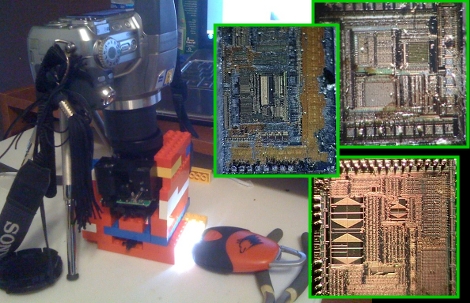
Who doesn’t need to take pictures of the microscopic bits inside of an integrated circuit? [Mojobojo] made an end-run around the expensive equipment by building a microscopic lens from an old camcorder. He’s using a regular digital camera with the lens set to its largest zoom level. The camera is pointed into the salvaged camcorder lens where the fine tuning is done. His first iteration was just taped to the desk with a small hand flashlight illuminating the subject. He upgraded that setup by building a LEGO enclosure and changing to a much brighter light source. The images he’s getting are quite surprising and this will be very useful during those extreme hacks when you need to tap into an IC’s internal data rails.

[Thanks Julius]

Transparent Rubber Enclosures

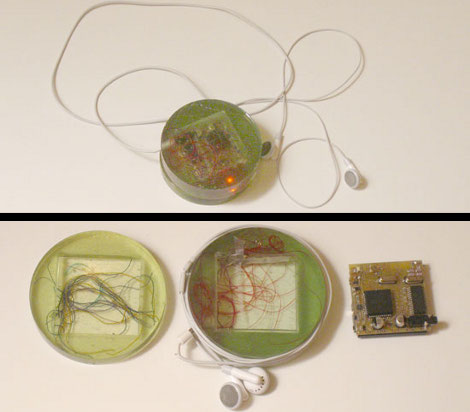
This clear rubber puck serves as the enclosure for a diy mp3 player. The wires encapsulated in the rubber are just there for looks but the utility of using this material as a case is fascinating.  Alas, there’s no details on the material other than that it’s clear rubber. Update: [Reboots] picked up on some info that we originally missed. Looks like this is made from some Smooth-On PCM 780 urethane rubber.

We’ve looked into casting our own molds from silicone rubber in the past.  That may be the process used here but we can’t tell what allows the two halves to be pried apart. We’ve embedded video after the break that details casting rubber around a part in one solid block, then cutting the rubber off of that to create a mold. We’re also familiar with the mold making kits from Tap plastics but as far as we know, they’re always colored and never clear.

We keep our eyes peeled for new prototyping products and we want to know more about the materials and the process used to make this cylindrical elastomer. If you’ve got the goods on how this is done, please share them in the comments.

Continue reading “Transparent Rubber Enclosures”

Use An Analog Oscilloscope To Display Digital Logic

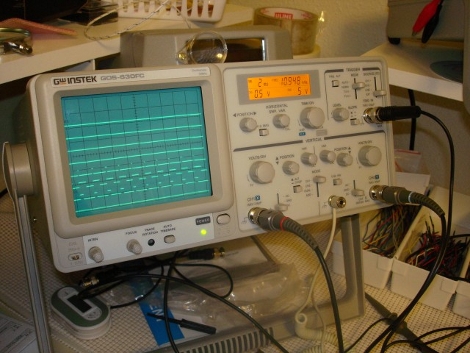
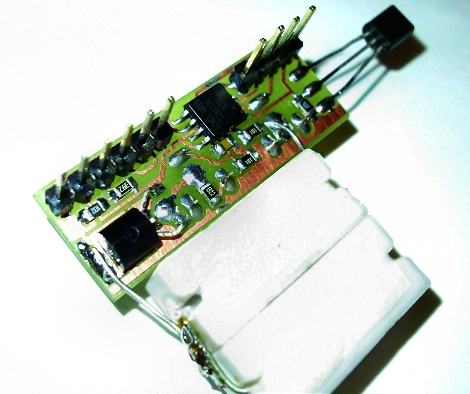
[Mike Bradley] wanted to use his oscilloscope to display 8 channels of digital signals. Alas, the analog unit didn’t have this capability. Not to worry, he threw together an adapter module that does the trick. Using a PIC 18F26K20 microcontroller he inputs four or eight channel digital logic (at 5V) and filters the output to an analog signal that the oscilloscope can interpret. What you see in the photo above is the result.

‘tiny’ Power Supply Monitor

[Manekinen] built a power supply monitor based around an AVR ATtiny13. Voltage and amperage are displayed on a 16×2 LCD character display (we’re not sure what the third number is… samples per second?). This is no small feat considering that the tiny13 is an 8-pin chip. He makes it happen by using the pins for both LCD control and ADC input. To make this happen the HD44780 compliant display is used in 4-bit mode. Check out the video after the break and hit up the non-translated page if you want to download the source code and PCB artwork. A note of warning, he’s using the RESET pin for I/O which means once you burn the fuses you’ll need a programmer that has High Voltage Serial Programming capabilities if you want to reprogram the chip. Continue reading “‘tiny’ Power Supply Monitor”

Update: Adafruit Eagle Library, Now With Arduino

Adafruit Industries has just added an Arduino shield footprint to their EagleCAD library. If you don’t know, the Arduino headers use non-standard pin spacing. Learn to deal with it, there’s too many Arduino shields in production to have any hope for a change in the future. This footprint should make it a lot easier to design your own boards. If you use this package make sure you’re getting the library from their github, they’ve been adding parts regularly. Setting up version control will make sure you always have the latest libraries.

[Thanks pt]

Battery Holder Reuses Blister Pack

In need of a portable power supply, [Alastair] threw some batteries into an Altoids tin. The problem was he didn’t have a holder for these size A23 cells. Inspiration struck and he realized the blister pack they came in fits them snuggly and just needs some conductors to complete the circuit. He pulled some battery contacts from a broken CD player. Using foam-based double-stick tape he added some spring to the contacts and came up with a perfectly sized holder that works wonderfully.

We’ve tried making battery packs by wrapping the entire thing in clods of duct tape. This looks like it works a lot better and there’s still room to fit the batteries and a switch inside of this minty enclosure.