Dummy Loads And Heat Sinks

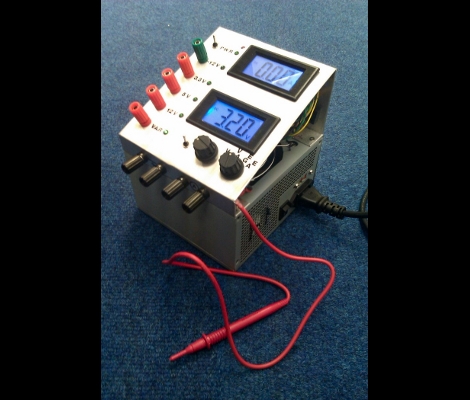
In [Dave’s] latest episode of the EEVblog he takes a look at constant current dummy loads. These are used to test power supply designs and instead of just chaining resistive loads together every time he’s decided to look into building a tool for the job. What he ends up with is a reliable constant current load that can be dialed anywhere from 1.5 mA up to just over 1A. There’s even an onboard meter so you don’t have to probe the setting before use.

It may look like he sent his design off to the board house for production but that’s actually a re-purposed PCB. In walking though his junk-box assembled dummy load [Dave] shares some great tips, like using multiple 1% resistors instead of shelling our for one large and accurate power resistor. But our favorite part comes at about 12:00 when he takes us through some rough math in calculating heat sinks. We’ve always just guessed, but like any good teacher, [Dave] explains the theory and then measures the actual performance taking the guesswork out of the design. See for yourself after the break. Continue reading “Dummy Loads And Heat Sinks”

Driving With Android

[youtube=http://www.youtube.com/watch?v=tIx2ihZ7728]

[Elrik] converted an RC car so that it can be controlled with an Android phone. He wisely uses the accelerometer for steering with a button for forward and another for reverse. There’s even control for the headlights. The car itself has had a servo retrofit for steering but it’s the Bluetooth module that catches our eye. It’s a GP-GC021 which you can get your hands on for under $20. It has a serial UART for easy interface with a microcontroller at up to 9600 baud.

Now you can convert over that larger vehicle to use Bluetooth instead of WiFi, just don’t hurt yourself. And if you’re just starting out with writing Android apps, don’t miss our series: Android Development 101.

Multi-purpose Welding Cart

[Todd Harrison] put together a welding cart that has all kinds of tricks built-in. The carcass is a cheap rolling cart that has been reinforced with steel plate and beefier wheels. The top tray can be loaded up with fire brick for oxygen-acetylene welding or with a grate for cutting. That grate lets the slag fall through and into the red-rimmed fire-box below. Finally, there’s a steel plate to the right of the cart that rotates and slides over the top of the unit to prepare it for MIG welding. Todd walks us through his versatile invention in the video after the break. This will nicely augment your other welding hacks.

Continue reading “Multi-purpose Welding Cart”

DS1307 Breakout Board

Adafruit’s got a handy breakout board for the DS1307 RTC available. This chip isn’t nearly as accurate as the DS3231 used in the Chronodot but it’s quite a bit cheaper. The breakout makes this easy to breadboard or plug into an Arduino and has everything you need; clock crystal, a backup battery, filtering capacitor, and pull-up resistors. Our favorite part is that Adafruit designs are open source so you can etch the board yourself if you checkout the files from their git repository. This will make a great addition to our prototyping hardware collection.

Incidentally, we were surprised to see the choice of 2.2k resistors for the I2C bus pull-ups. We were under the impression that 4.7k was a standard value here. We’d love to hear your thoughts on this in the comments.

[via Dangerous Prototypes]

Extremely Organized Prototyping

We’ve got a couple of very high-tech shoe boxes in which we store our prototyping accessories. You’ll find a collection of LCD modules, chips on breakout boards, switches soldered to homemade boards for easy breadboarding, and much more. That is assuming you can find anything in that mess of components.

[Shahriar] took a different approach. He’s mounted all of his prototyping gear inside of a briefcase. This large collection of high-end boards include PIC prototyping, various LCD screens, and a large portion of SparkFun’s stocked boards. It’s much more advanced than the Arduino to-go platform, and you can see a full walk through of the system after the break.

Continue reading “Extremely Organized Prototyping”

3D Printing With Chemicals

From the horse’s mouth,

“In this lithography experiment light creates free radicals from phenylbis(2,4,6-trimethylbenzoyl)phosphine oxide which induce polymerization of 1,6-hexanediol diacrylate.”

Or for those without a Chemical Engineering degree, light from a (high resolution) projector interacts with a special liquid, producing a hard polymer on the surface. A platform within the liquid is lowered, taking the layer of polymer with it. Shine the projector again to produce another layer: lather, rinse, repeat. Long story short, an atypical 3D printer using light on a very small scale.

You get the chemicals and lab equipment, we’ll get the laptop and projector, and for goodness sake [Jimmie] stop bumping the table.

[Thanks Tomas]