Open Source Logic Analyzer Software

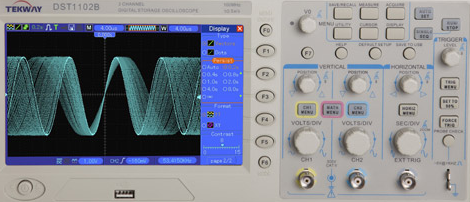
[Christian Weichel] has been hard at work developing LogicAnalyzer, an open source tool that may interest you. It is designed with SUMP Logic Analyzers in mind but a main goal is expandability. What this means is that it plays nicely with things like the Open Workbench Logic Sniffer or you can do a bit of fiddling to get it to work with your own designs. The program is based on Eclipse so you should be familiar with how it works and you can get it running easily on multiple platforms. Take a look at the wiki for a quick start.

How To Design Your Gears

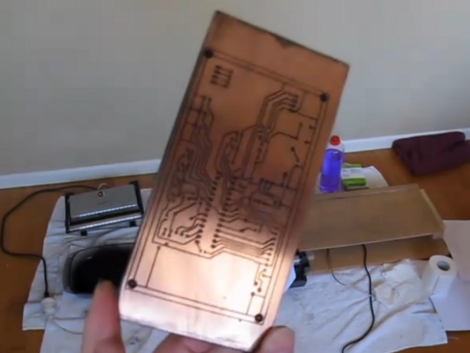
[Dustyn Roberts] takes us through the process of designing gears for a specific application. Using Inkscape and Ponoko.com [Dustyn] takes us from equation to physical gear. While there is a plugin for Inkscape that allows you to basically drag and drop gears, this writeup will take you through the math to get exactly what you need. Those laser cut wooden gears are pretty cool looking too.

Electro Luminescent Fun With Jeri Ellsworth

[youtube=http://www.youtube.com/watch?v=ZuDZnJX5kqw]

[Jeri] got her hands on some of the DuPont Luxprint EL ink and had some fun conducting experiments. She tried different materials for the base and the display itself.  Not only does she just play with materials, she also tears apart a VFD and an LCD to see if she could use them for parts. The LCD turned out to be the most successful. We saw this stuff show up at the Bay Area Maker Faire and we’re excited to see it become more accessible.

[via Makezine]

Superprobe

The Superprobe is a logic analyzer, multimeter, and much more rolled into a fun to build project. [Ben Ryves] didn’t come up with the original idea, but he definitely took a good thing and made it better. You can use it to test logic, inject logic into a circuit, read capacitors and resistors, test frequency, read the device address from 1-wire devices, and more. Interchangeable probes, choice of internal or external power, simple two-button operation, and a powerful PIC microcontroller at the heart of it all make this a fantastic tool for your electronics workbench. Check out the quality video after the break that  [Ben] put together to show off the results of his tinkering.

Continue reading “Superprobe”

USBasp: AVR Programmer Based On ATmega8

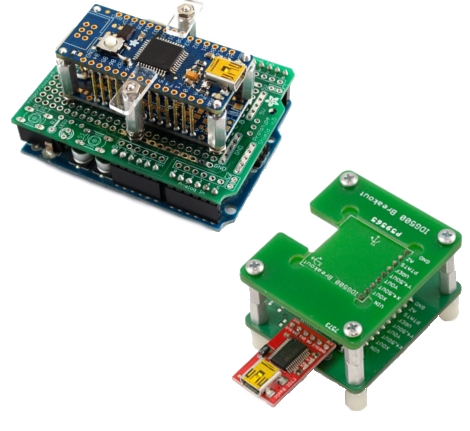
We love our AVR Dragon programmer but it can be nice to have a cheap and simple in system programmer on hand too. The USBasp is one such programmer that uses and ATmega8 as its only IC. It requires just a handful of components and can be purchased as a kit, or etched and assembled at home. If you source your own parts the chip does need to be programmed which makes for a chicken-or-egg scenario. We’ve used the Parallel-port dongle (schematic) from Adafruit’s Spoke POV before. It’s basically just a DAPA cable and a few resistors, a ribbon cable (use and old IDE cable if you have to) and a parallel port connector can have you up and running in no time. This is also a great way to get a friend into working with embedded systems. Order parts for a few of these and give them away to your buddies.