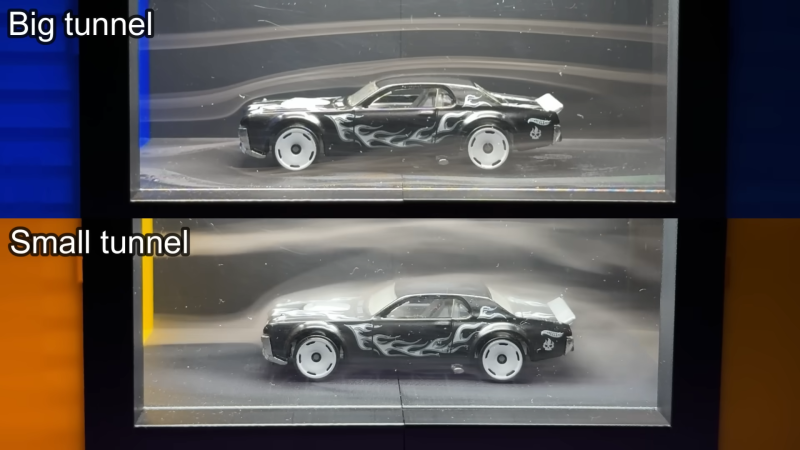
The best-practice wind tunnel (above) vs a compact version (below)

Optimizing A Desktop, 3D Printed Wind Tunnel

You’ve heard of wind tunnels– get some airflow going over a thingy, put some some smoke on, and voila! Flow visualization. How hard could it be? Well, as always, the devil is in the details and [toast] is down in there with him with this Hot-Wheels sized wind tunnel video.

To get good, laminar flow inside of a wind tunnel, there are important ratios to be followed– the inlet and outlet diameters must relate to the interior size to get the correct slope on the contraction and exhaust cones. You need a flow straightener on both ends. All of it can be easily 3D printed, as [toast] shows, but you have to know those design rules and pay attention to, which [toast] does… this time. One of his “don’t do this” examples in this video is previous build of his where he did not follow all the rules, and the difference is clear.

Now, unless you’re hooked on flow visualizations —guilty— or are a Hot-Wheels aficionado, since that’s what this wind tunnel is sized for, you probably won’t rush to gumroad to buy [toast]’s STLs. On the other hand, if you pay attention to the lessons [toast] has learned in this video you can apply them to wind tunnels of whatever size and construction technique you need, be it cardboard or junk box plastic and get a more stable result.

Continue reading “Optimizing A Desktop, 3D Printed Wind Tunnel”

Reverse-Engineering The Tamagotchi IR Connection

The Tamagotchi Connection is a series of Tamagotchi toys that took the original portable pet concept and mixed things up with a wireless connection, which allowed you to interact with the pets of other proud Tamagotchi owners. This wireless connection is implemented using an infrared transceiver, somewhat like IrDA, but as [Zach Resmer] discovered while reverse-engineering this connection, it’s actually what is called ‘Nearly NEC’ by [Natalie Silvanovich], who has a GitHub repository full of related Tamagotchi hacking tools and ROM dumps.

With the protocol figured out, creating a transceiver for low-bitrate infrared communication isn’t particularly hard. In this case, it was implemented using an RP2040 MCU and an appropriate IR LED and receiver pair. This Tamagometer project was also implemented as an app for the Flipper Zero, and a custom PCB called the Pico TamaBadge by [Daniel Weidman].

There’s a web application associated with [Zach]’s project using a Web Serial-enabled browser (i.e. Chrome). The serial protocol is somewhat documented in the patent for the device’s connection feature, which makes it relatively easy to implement yourself.

Making The Fastest LEGO Technic Air-Powered Engine

Just because LEGO Technic is technically a toy doesn’t mean that you cannot do solid engineering with it, like building air-powered engines. After first building a simple air-powered piston engine, this time around [Jamie’s Brick Jams] sought to not only optimize the engine, but also build a clutch and something to power with said engine.

The four-piston design in radial configuration. (Credit: Jamie's Brick Jams, YouTube)
The four-piston design in radial configuration.

The piston head is one of the handful of 3D printed parts, with the new design featuring twin rubber o-rings as a seal instead of a single big one as in the old design. This incidentally matches the multiple seal rings on an internal combustion engine’s pistons, probably for similar blow-by related reasons. The air hose diameter was also increased from 2 to 3 mm to give the engine a larger volume of air to work with, which along with a new flywheel gave a lot more torque. Next the piston rod length was optimized.

The final radial 4-piston engine turns out to work pretty well, with the clutch engaging smoothly. This was used to drive a DIY generator that turned out to produce about 3 Watt of usable power in its final configuration at 6 V, though it’s admittedly a rather crude generator that could be further optimized. When trying a twin-piston configuration with the highest air pressure before air hoses began to pop off, it hit a dizzying 14,600 RPM.

These aren’t half bad results for some LEGO Technic together with some 3D printed bits, rubber o-rings and some lube.

Continue reading “Making The Fastest LEGO Technic Air-Powered Engine”

All Projections Suck, So Play Risk On A Globe Instead

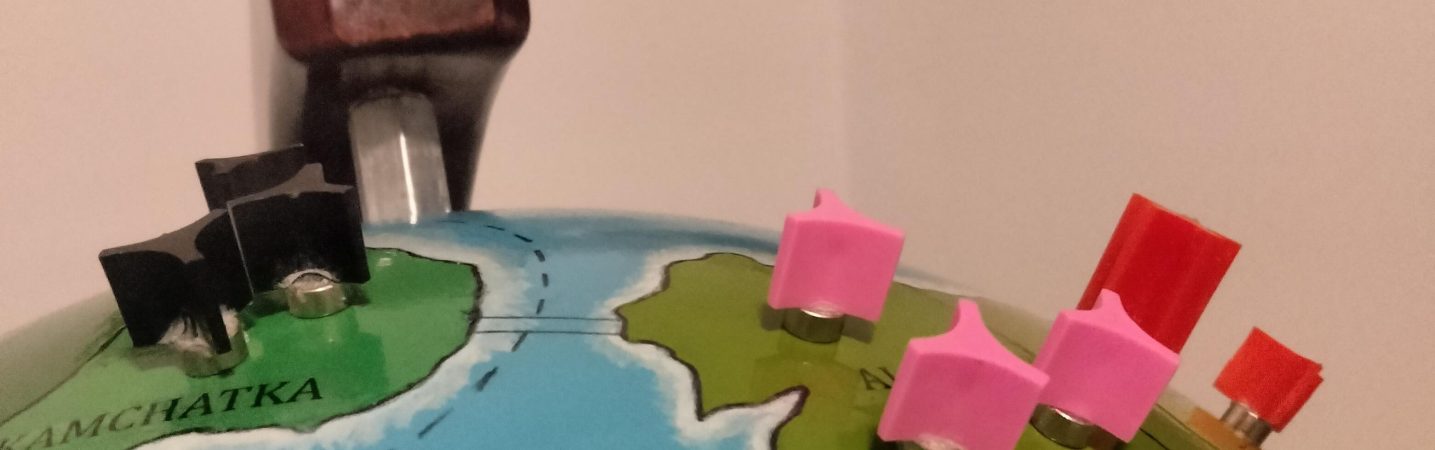
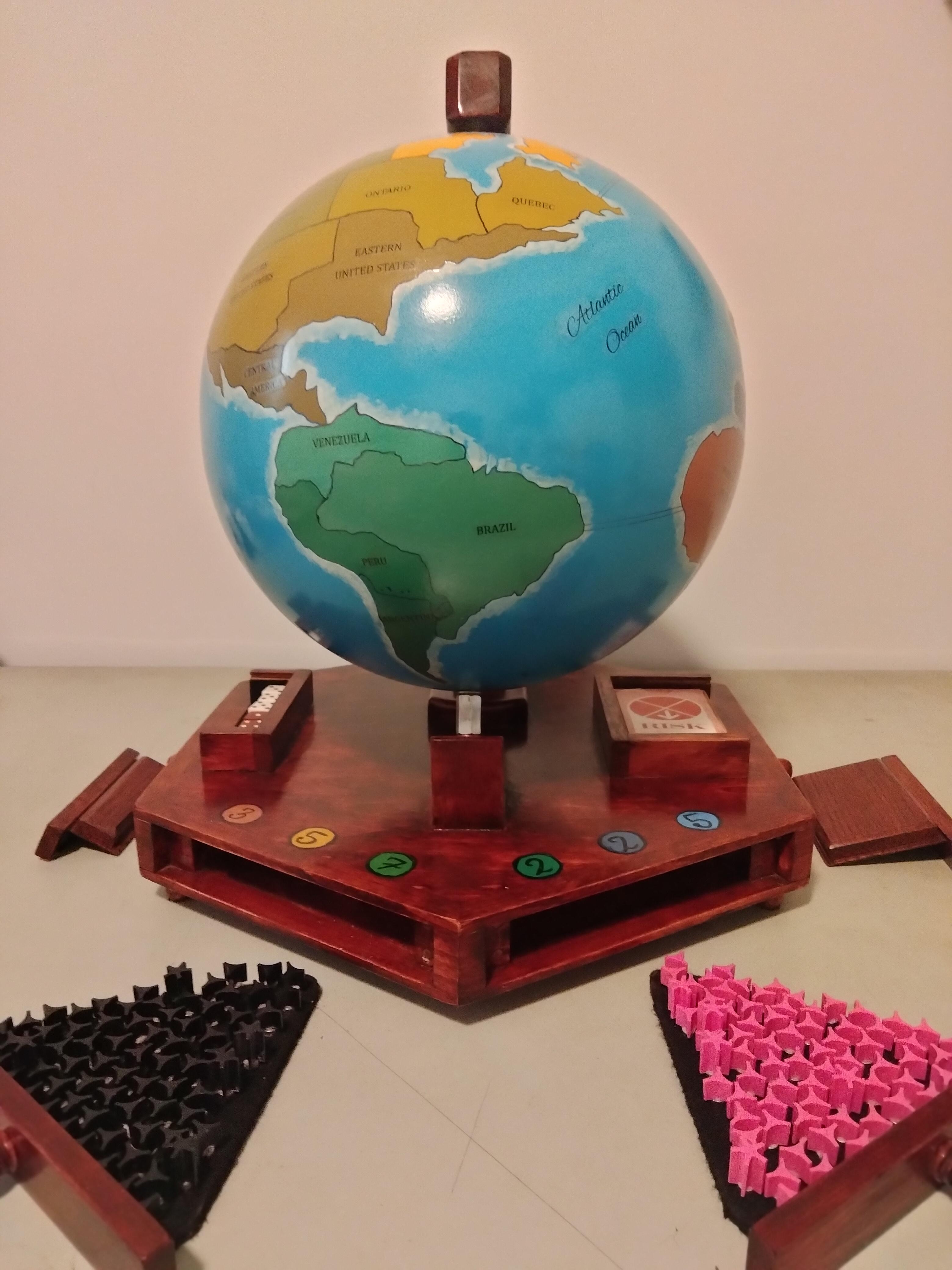
The worst thing about the getting people together is when everyone starts fighting over their favourite map projection– maybe you like the Watterman Butterfly, but your cousin really digs Gall-Peters, and that one Uncle who insists on defending Mercator after a couple of beers. Over on Instructables [madkins9] has an answer to that problem that will still let you play a rousing game of Risk– which will surely not drag on into the night and cause further drama– skip the projection, and put the game on a globe. 

The pieces are from a 1960s version. The abstract tokens have a certain charm the modern ones lack.

Most globes, being cardboard, aren’t amenable to having game pieces cling to them. [madkins9] thus fabricates a steel globe from a pair of pre-purchased hemispheres. Magnets firmly affixed to the bases of all game pieces allow them to stick firmly to the spherical play surface. In a “learn from my mistakes” moment, [madkins] suggests that if you use two pre-made hemispheres, as he did, you make sure they balance before welding and painting them.

While those of us with less artistic flair might be tempted to try something like a giant eggbot, [madkins] was able to transfer the Risk world map onto his globe by hand. Many coats of urethane mean it should be well protected from the clicking or sliding magnet pieces, no matter how long the game lasts. In another teachable moment, he suggests not using that sealer over sharpie. Good to know.

Once gameplay is finished, the wooden globe stand doubles as a handsome base to hold all the cards and pieces until the next time you want to end friendships over imaginary world domination. Perhaps try a friendly game of Settlers of Catan instead. 

An HO Model Power Bogie For Not A Lot

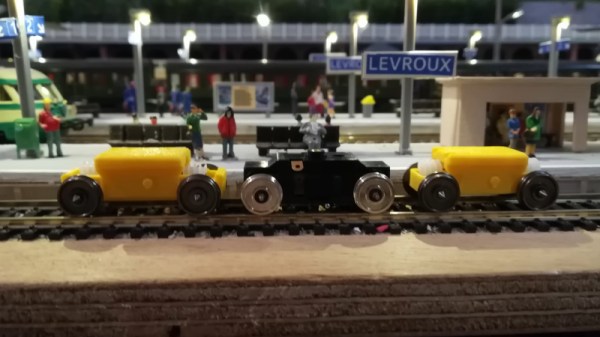
For people who build their own model trains there are a range of manufacturers from whom a power bogie containing the motor and drive can be sourced. But as [Le petit train du Berry] shows us in a video, it’s possible to make one yourself and it’s easier than you might think (French language video with truly awful YouTube auto-translation).

At the heart of the design is a coreless motor driving a worm gear at each end that engages with a gear on each axle. The wheelsets and power pickups are off-the-shelf items. The chassis meanwhile is 3D printed, and since this is an ongoing project we see two versions in the video. The V5 model adds a bearing, which its predecessor lacked.

The result is a pretty good power bogie, but it’s not without its faults. The gear ratio used is on the high side in order to save height under a model train body, and in the version without a bearing a hard-wearing filament is required because PLA will wear easily. We’re guessing this isn’t the last we’ll see of this project, so we hope those are addressed in future versions.

We like this project and we think you will too after you’ve watched the video below the break. For more home-made model railway power, how about a linear motor?

Continue reading “An HO Model Power Bogie For Not A Lot”

A picture of a life sized magikarp from pokemon

Magic Magikarp Makes Moves

One of the most influential inventions of the 20th century was Big Mouth Billy Bass. A celebrity bigger than the biggest politicians or richest movie stars, there’s almost nothing that could beat Billy. That is, until [Kiara] from Kiara’s Workshop built a Magikarp version of Big Mouth Billy Bass.

Sizing in at over 2 entire feet, the orange k-carp is able to dance, it is able to sing, and it is able to stun the crowd. Magikarp functions the same way as its predecessor; a small button underneath allows the show to commence. Of course, this did not come without its challenges.

Starting the project was easy, just a model found online and some Blender fun to create a basic mold. Dissecting Big Mouth Billy Bass gave direct inspiration for how to construct the new idol in terms of servos and joints. Programming wasn’t even all that much with the use of Bottango for animations. Filling the mold with the silicone filling proved to be a bit more of a challenge.

After multiple attempts with some minor variations in procedure, [Kirara] got the fish star’s skin just right. All it took was a paint job and some foam filling to get the final touches. While this wasn’t the most mechanically challenging animatronic project, we have seen our fair share of more advanced mechanics. For example, check out this animatronic that sees through its own eyes!

Continue reading “Magic Magikarp Makes Moves”

Wiring Up The Railway, All The Live-Long Day

For those of you who haven’t spent time in North America around this time of year, you may be unaware of two things: one, the obligatory non-stop loop of “All I Want For Christmas Is You” retail workers are subjected to starting November first, and two: there is a strong cultural association between Christmastime and model railroading that may not exist elsewhere. That may down to childhood memories of when we got our first trainsets, or an excellent postwar marketing campaign by Lionel. Either way, now that Mariah Carey is blaring, we’re thinking about our holiday track layouts. Which makes this long presentation on Wiring for Small Layouts by [Chicago Crossing Model Railroad] quite timely.

There are actually three videos in this little course; the first focuses mostly on the tools and hardware used for DCC wiring (that’s Digital Command Control), which will be of less interest to our readers– most of you are well aware how to perform a lineman’s splice, crimp connectors onto a wire, and use terminal blocks.

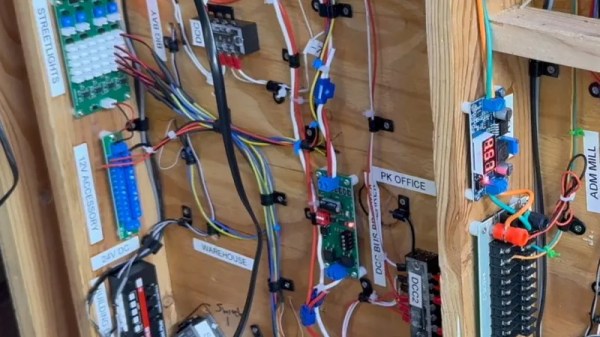
The second two videos are actually about wiring, in the sense of routing all the wires needed for a modern layout– which is a lot more than “plug the rheostat into the tracks in one spot” that our first Lionel boxed set needed. No, for the different accessories there are multiple busses at 5V, 12V and 24V along with DCC that need to be considered. Unsurprisingly enough given those voltages, he starts with an ATX power supply and breaks out from there.

Even if you’re not into model railroading, you might learn something from these videos if you haven’t done many projects with multiple busses and wire runs before. It’s far, far too easy to end up with a rats nest of wires, be they DCC, I2C or otherwise. A little planning can save some big headaches down the line, and if this is a new skill for you [Chicago Crossing Model Railroad] provides a good starting point for that planning. Just skip ahead a couple minutes for him to actually start talking if you don’t want the musical cliff notes montage at the start of the videos.

If you don’t have any model trains, don’t worry, you can 3D print them.  Lack of room isn’t really an excuse.

Continue reading “Wiring Up The Railway, All The Live-Long Day”