Should All Quadrotors Look Like This?

In recent years, quadrotors have exploded in popularity. They’ve become cheap, durable, and can do some really impressive things, but are they the most efficient design? The University of Queensland doesn’t think so.

Helicopters are still much more efficient and powerful due to their one big rotor, and with the swashplate mechanism, perhaps even more maneuverable — after all did you see our recent post on collective pitch thrust vectoring? And that was a plane! A few quick searches of helicopter tricks and we think you’ll agree.

The new design, which is tentatively called the Y4, or maybe a “Triquad” is still a quadrotor, but it’s been jumbled up a bit, taking the best of both worlds. It has a main prop with a swashplate mechanism, and three smaller rotors fixed at 45 degree angles, that provide the counter torque — It’s kind of like a helicopter with three tails.

Regarding efficiency, the researchers expect this design could achieve an overall increase of about 25% in performance, compared to that of a standard quadrotor. So, they decided to test it and built a quad and a Y4 as similar as possible — the same size, mass, batteries, arms, and controller board. The results? The Y4 had an increased run time of 15%! They think the design could very well make the 25% mark, because in this test study, the Y4 was designed to meet the specifications of the quad, whereas a more refined Y4 without those limitations could perhaps perform even better.

Unfortunately there’s no video we can find, but if you stick around after the break we have a great diagram of how (and why) this design works!

Continue reading “Should All Quadrotors Look Like This?”

Collective Pitch Thrust Vectoring On A RC Plane

The RC plane shown above is hovering in that position. And that’s about the least impressive thing it can do. This is the power of Collective Pitch Thrust Vectoring… on a plane.

So what exactly is Collective Pitch Thrust Vectoring anyway? Put simply, it’s like strapping a helicopter rotor to the front of a plane. We think the basic mechanism behind this is called a Swashplate (as found on a helicopter rotor), which allows for thrust vectoring, meaning the propeller blades can actually change their pitch cyclically, while still spinning at high speeds! This is what allows helicopters to do crazy tricks like barrel rolls.

A normal RC plane can only increase or decrease thrust with the speed of the engine. But with this, the thrust can be changed cyclically as the blades spin allowing for thrust vectoring (advanced steering). Couple that with some huge control surfaces and wing stabilizers and that means some seriously crazy aerodynamic feats.

Watch the video after the break, it’s amazing.

Continue reading “Collective Pitch Thrust Vectoring On A RC Plane”

View-Master Video Player!

view master 3d video player

[Alec] just sent us this great project he’s been working on. Converting an antique View-Master from the early 50’s into a modern 3D video player, capable of reading Mini-CDs.

Most View-Masters don’t have much space for tinkering, let alone adding a Raspberry Pi, two displays and a CD drive, so [Alec] really lucked out when he found this model — complete with light and D-cell battery pack. Tons of space! He originally looked into getting some cheap digital photo frame LCDs from China, but soon realized the effort involved with making those work just wouldn’t be worth it, so instead he picked up some 0.9″ OLED displays from Adafruit. He still forgot to check if they had drivers for the Raspberry Pi though, and ended up on another detour of modifying FBTFT drivers to make it all work.

After that headache he got to the fun part — cramming all the hardware inside. He picked up a cheap laptop CD drive off of eBay, and discovered that using the 80MM Mini-CD standard, the discs would just fit inside of the View-Master, sticking out just a little bit, kind of like the original photo wheels!

Quite a bit of fiddling later, he managed to assemble the entire thing in layers, without damaging the external shell of the View-Master. Since it is an antique, it was important for him that his hack be reversible — and for the most part, it is! Stick around after the break to see a short video explanation!

Continue reading “View-Master Video Player!”

Flying RC Toaster

Do you remember that screen saver from the 80’s of flying toasters? Well the guys over at Flite Test just made a real flying toaster.

The first challenge was converting a toaster to run off batteries, which [David] accomplished by splitting the elements in the 110V toaster into 4 segments, and running them off of 6-cell LiPo — when the toaster is on, it draws almost 700W. The next question was — how much of an effect does air flow have on a toaster’s ability to toast? As it turns out, not that much! They tested the system by driving down the street holding a toaster out of the passenger window of the car, and while they got some strange looks, they also successfully toasted the bread.

The next step was making a plane capable of carrying the extra batteries, and a bulky, not-so-aerodynamic toaster. This was probably the easiest part, as they have made a flying 20kg cinder block before. Needless to say, making a toaster capable of flight was not much of a challenge.

Our favorite part of the video is the test flight, where [Josh] wears a POV visor system to, wait for it… watch the bread toasting. Check it out after the break!

Continue reading “Flying RC Toaster”

A Simple Servo Hack For An Iron Man Helmet

iron man helmet

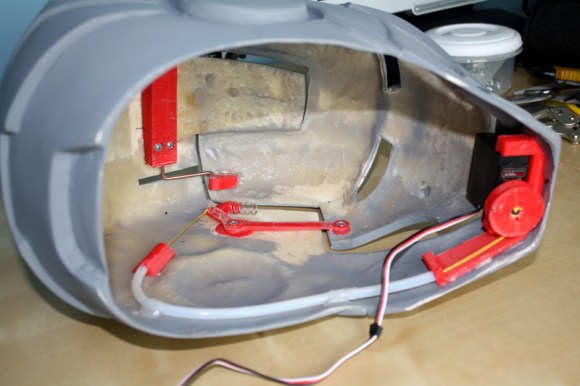
[James] makes some seriously awesome Iron Man props. In one of his latest helmet builds, he came across a handy hack to lock the faceplate servo in place.

You see, as awesome as it is walking around like Iron Man all day, you’re going to want to keep your faceplate up for extended periods of time. Simply holding the servo in place electronically is a waste of power, and results in the annoying sound of a servo under strain. On the other hand, cutting power to it will keep it in place momentarily — but it will also start to close under the force of gravity.

The solution is actually quite simple, by reprogramming the Picaxe-08M microcontroller, the board now shorts the motor terminals to hold it in place. This is called magnetic motor braking, and it works by creating a closed loop that makes it much harder to induce a current under load. We once added this feature to a motorized push-scooter — it’d stop on a dime, although you wouldn’t…

Stick around after the break to see an extremely in depth video on how he setup the entire system.

Continue reading “A Simple Servo Hack For An Iron Man Helmet”

Robotic Sloth Haunts Your Dreams

robotic sloth

Have you ever seen a wet sloth? They’re pretty scary. If that’s not bad enough, how do you feel about a robotic one?

Named the X-4 “Sloth”, this is one of [222Doc’s] hardest projects to date — a highly experimental quadra-ped that can climb up and across ladders. It makes use of a Lego Mindstorms NXT controller, 8 servo motors for the joints, 4 Power Function Motors for the hands, and a whole lot of Lego. Due to the number of motors, he also had to multiplex the Power Function servos to make it all work!

Sure, it’s Lego, but it was far from an easy project, as [222Doc] estimates he spent well over a hundred hours on it, and it still isn’t complete. He says he’ll never say to himself “this will be easy…” ever again.

Stick around after the break to see it scale this ladder — we wish they sped up the video though, it appears the movement speed is modeled after a real sloth…

Continue reading “Robotic Sloth Haunts Your Dreams”

GameBoy Color Costume

game boy costume

Okay, okay. We know it’s November now, but when [John] sent this project in, we just had to share it. He made a fully functional Gameboy Color costume!

The costume makes use of a Raspberry Pi (located on his back), running RetroPie, which is an open source project dedicated to creating a universal console emulator.  To create the controllers he used two Teensy microcontrollers in his gloves, setup to emulate two USB keyboards on the Pi. Since he’s using Teensy 3.0, it supports capacitive touch sensing, so all he had to do was wire pieces of aluminum to the input pins to create touch-sensitive metal buttons on the gloves. He then slapped a cheap 10″ LCD from Adafruit onto his chest, stuffed a few 12V LiPo batteries in his pockets, and was ready to be the hit of any party he went to.

The costume was a great success, although a pesky pair of Mario and Luigi kept holding his hands all night… Stick around after the break to see a demonstration video!

Continue reading “GameBoy Color Costume”