Modular 18650 Packs, No Spot Welding Required

Building a battery pack from 18650 cells traditionally requires patience, a spot welder, and a supply of nickel strip. But what if there was another way? [Ben] is here with Cell-Lock, a modular battery assembly system.

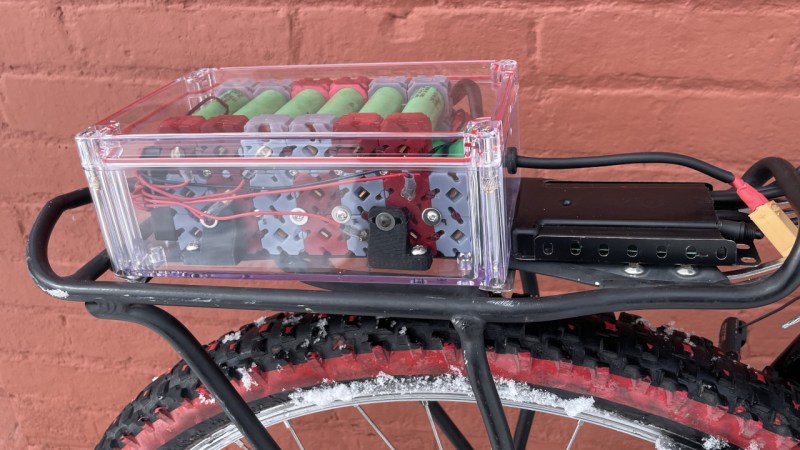
At the system’s heart are a set of interlocking end caps and connection pieces that function as locking cams as well as the electrical connections where needed. They were inspired by the cam systems used for furniture assembly, and are activated by rotation with a screwdriver. The result is a mechanically stable battery system in which different configurations can easily be assembled.
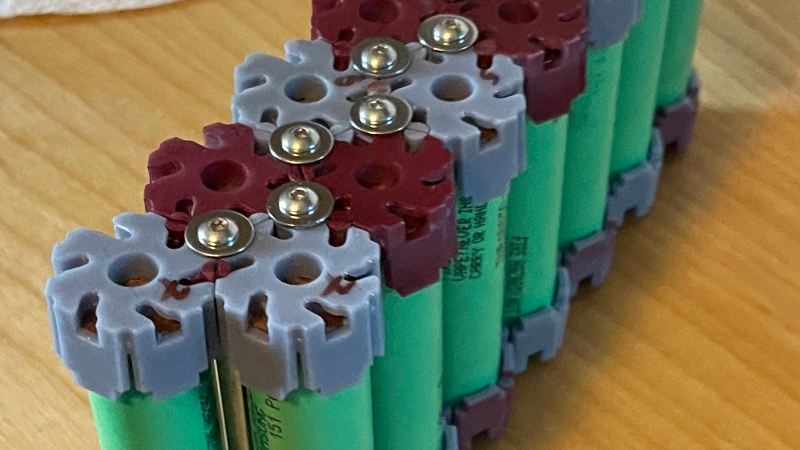
We like that it doesn’t involve any heat near those cells; in part because we’ve seen our share of dodgy connections overheating. But we do have a few concerns. These include how reliable a connection those cams would make, as well as how much current they could safely take without overheating. If both of those could be addressed, we can see that this is an idea with a future.

You can see plenty of examples on the linked project, including an e-bike pack which seems to return no problems. Meanwhile this is by no means the first modular battery pack system we’ve seen.

180 Shots On A Roll With The Little Stupid Camera

If you want to play with the coolest kids on the block when it comes to photography, you have to shoot film. Or so say the people who shoot film, anyway. It is very true though that the chemical medium has its own quirks and needs a bit of effort in a way digital cameras don’t, so it can be a lot of fun to play with.

It’s expensive though — film ain’t cheap, and if you don’t develop yourself there’s an extra load of cash. What if you could get more photos on a roll? It’s something [Japhy Riddle] took to extremes, creating a fifth-frame 35mm camera in which each shot is a fifth the size of the full frame.

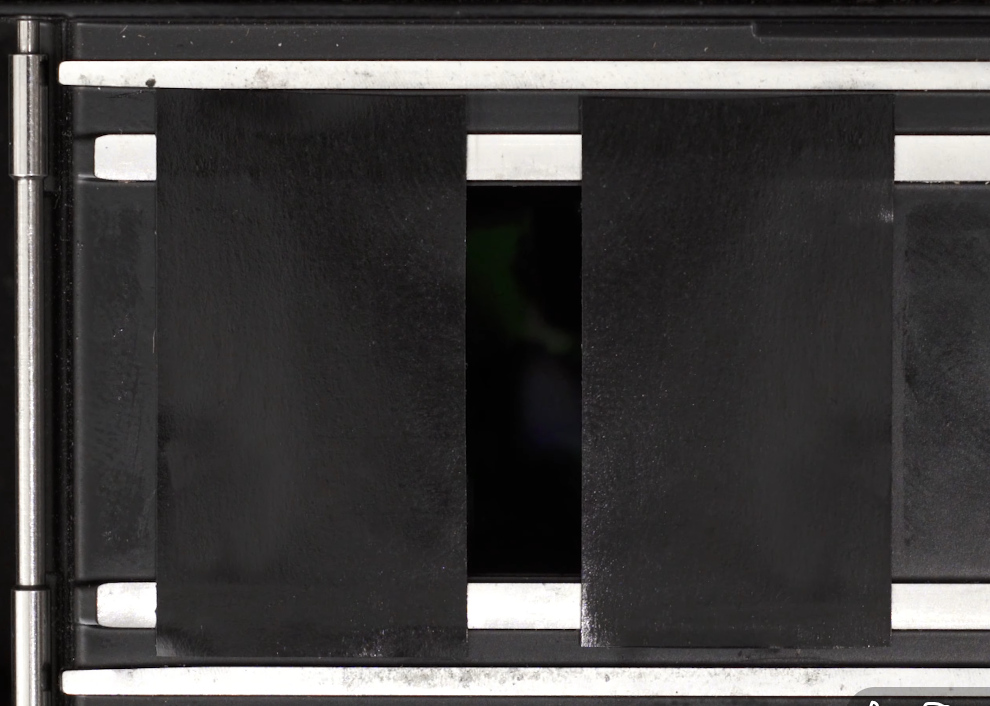
The focal plane of a 35mm camera with tape masking most of the frame
We’re slightly worried about that much sticky tape next to the shutter, but hey.

Standard 35mm still film has a 24x36mm frame, in modern terms not far off the size of a full-size SD card. A standard roll of film gives you 36 exposures. There are half-frame cameras that split that frame vertically to give 72 exposures, but what he’s done is make a quarter-frame camera.

It’s a simple enough hack, electrical tape masking the frame except for a vertical strip in the middle, but perhaps the most interesting part is how he winds the film along by a quarter frame. 35mm cameras have a take-up reel, you wind the film out of the cartridge bit by bit into it with each shot, and then rewind the whole lot back into the cartridge at the end. He’s wound the film into the take-up reel and it winding it back a quarter frame at a time using the rewind handle, for which we are guessing he also needs a means to cock the shutter that doesn’t involve the frame advance lever.

We like the hack, though we would be worried about adhesive tape anywhere near the shutter blind on an SLR camera. It delivers glorious widescreen at the cost of a bit of resolution, but as an experimental camera it’s in the best tradition. This is one to hack into an unloved 1970s snapshot camera for the Shitty Camera Challenge!

Continue reading “180 Shots On A Roll With The Little Stupid Camera”

Lumafield battery quality report cover page

Lumafield Peers Into The 18650 Battery

[Alex Hao] and [Andreas Bastian] of Lumafield recently visited with [Adam Savage] to document their findings after performing X-ray computed tomography scans on over 1,000 18650 lithium-ion batteries.

The short version — don’t buy cheap cells! The cheaper brands were found to have higher levels of manufacturing defects which can lead them to being unsafe. All the nitty-gritty details are available in the report, which can be downloaded for free from Lumafield, as well as the Tested video they did with [Adam] below.

Actually we’ve been talking here at Hackaday over at our virtual water-cooler (okay, okay, our Discord server) about how to store lithium-ion batteries and we learned about this cool bit of kit: the BAT-SAFE. Maybe check that out if you’re stickler for safety like us! (Thanks Maya Posch!)

We have of course heard from [Adam Savage] before, check out [Adam Savage] Giving A Speech About The Maker Movement and [Adam Savage]’s First Order Of Retrievability Tool Boxes.

Continue reading “Lumafield Peers Into The 18650 Battery”

Hackaday Links Column Banner

Hackaday Links: January 18, 2026

Looking for a unique vacation spot? Have at least $10 million USD burning a hole in your pocket? If so, then you’re just the sort of customer the rather suspiciously named “GRU Space” is looking for. They’re currently taking non-refundable $1,000 deposits from individuals looking to stay at their currently non-existent hotel on the lunar surface. They don’t expect you’ll be able to check in until at least the early 2030s, and the $1K doesn’t actually guarantee you’ll be selected as one of the guests who will be required to cough up the final eight-figure ticket price before liftoff, but at least admission into the history books is free with your stay.

Mars One living units under regolith
This never happened.

The whole idea reminds us of Mars One, which promised to send the first group of colonists to the Red Planet by 2024. They went bankrupt in 2019 after collecting ~$100 deposits from more than 4,000 applicants, and we probably don’t have to tell you that they never actually shot anyone into space. Admittedly, the Moon is a far more attainable goal, and the commercial space industry has made enormous strides in the decade since Mars One started taking applications. But we’re still not holding our breath that GRU Space will be leaving any mints on pillows at one-sixth gravity.

Speaking of something which actually does have a chance of reaching the Moon on time — on Saturday, NASA rolled out the massive Space Launch System (SLS) rocket that will carry a crew of four towards our nearest celestial neighbor during the Artemis II mission. There’s still plenty of prep work to do, including a dress rehearsal that’s set to take place in the next couple of weeks, but we’re gettingĀ very close. Artemis II won’t actually land on the Moon, instead performing a lunar flyby, but it will still be the first time we’ve sent humans beyond Low Earth Orbit (LEO) since Apollo 17 in 1972. We can’t wait for some 4K Earthrise video.

Continue reading “Hackaday Links: January 18, 2026”

Putting A Cheapo 1800W DC-DC Boost Converter To The Test

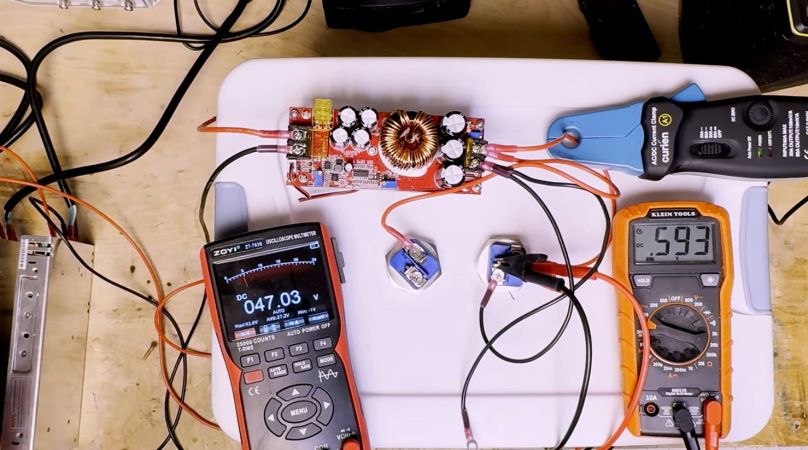
These days ready-to-use DC-DC converters are everywhere, with some of the cheaper ones even being safe to use without an immediate risk to life and limb(s). This piques one’s curiosity when browsing various online shopping platforms that are quite literally flooded with e.g. QS-4884CCCV-1800W clones of a DC-DC boost converter. Do they really manage 1800 Watt even without active cooling? Are they perhaps a good deal? These were some of the questions that [Josh] over at the [Signal Drift] channel set out to answer.

The only real ‘datasheet’ for this module seems to come courtesy of a Floridian company who also calls it the 36843-PS, but it features specifications that are repeated across store listings so it might as well by the official ‘datasheet’. This module is marketed as being designed for the charging of lead-acid and similar batteries, including the boosting of PV solar panel outputs, though you’d really want to use an MPPT charger for that.

With this use case in mind, it’s probably no surprise to see on the oscilloscope shots under load that it has a tragic 100 kHz switching frequency and a peak-to-peak noise on the output of somewhere between 1-7 VDC depending on the load. Clearly this output voltage was not meant for delicate electronics.

Continue reading “Putting A Cheapo 1800W DC-DC Boost Converter To The Test”

Lumafield Shows Why Your Cheap 18650 Cells Are Terrible

Lithium-ion cells deliver very high energy densities compared to many other battery technologies, but they bring with them a danger of fire or explosion if they are misused. We’re mostly aware of the battery conditioning requirements to ensure cells stay in a safe condition, but how much do we know about the construction of the cells as a factor? [Lumafield] is an industrial imaging company, and to demonstrate their expertise, they’ve subjected a large number of 18650 cells from different brands to a CT scan.

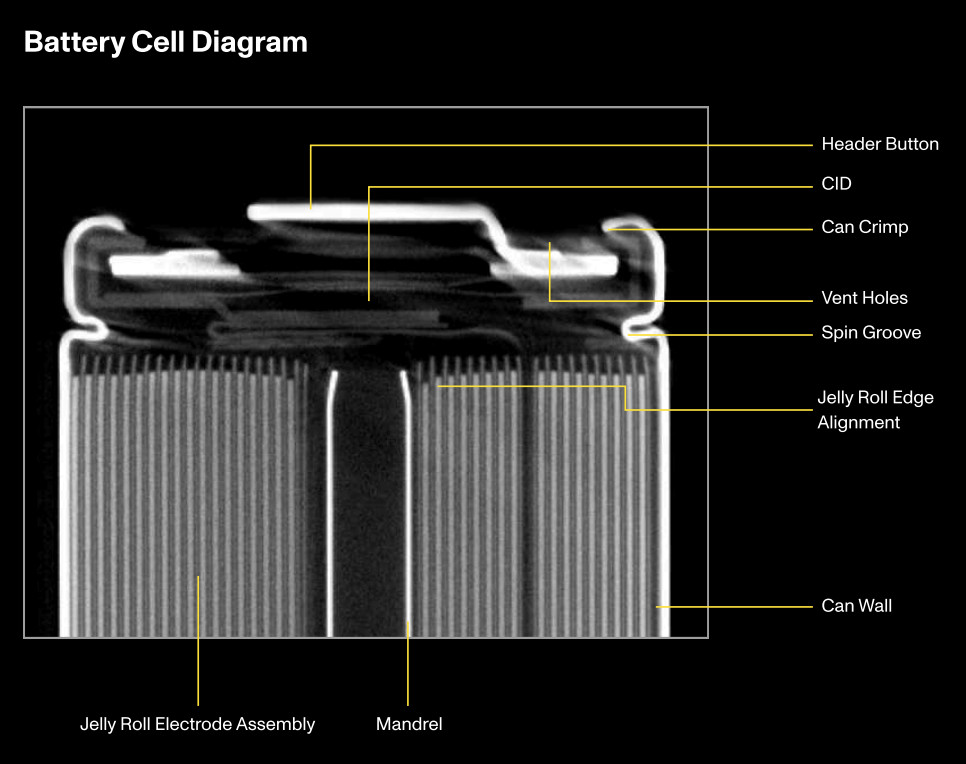
The construction of an 18650 sees the various layers of the cell rolled up in a spiral inside the metal tube that makes up the cell body. The construction of this “jellyroll” is key to the quality of the cell. [Lumafield’s] conclusions go into detail over the various inconsistencies in this spiral, which can result in cell failure. It’s important that the edges of the spiral be straight and that there is no electrode overhang. Perhaps unsurprisingly, they find that cheap no-name cells are poorly constructed and more likely to fail, but it’s also interesting to note that these low-quality cells also have fewer layers in their spiral.

We hope that none of you see more of the inside of a cell in real life than you have to, as they’re best left alone, but this report certainly sheds some light as to what’s going on inside a cell. Of course, even the best cells can still be dangerous without protection.

Reverse-Engineering The Milwaukee M18 Diagnostics Protocol

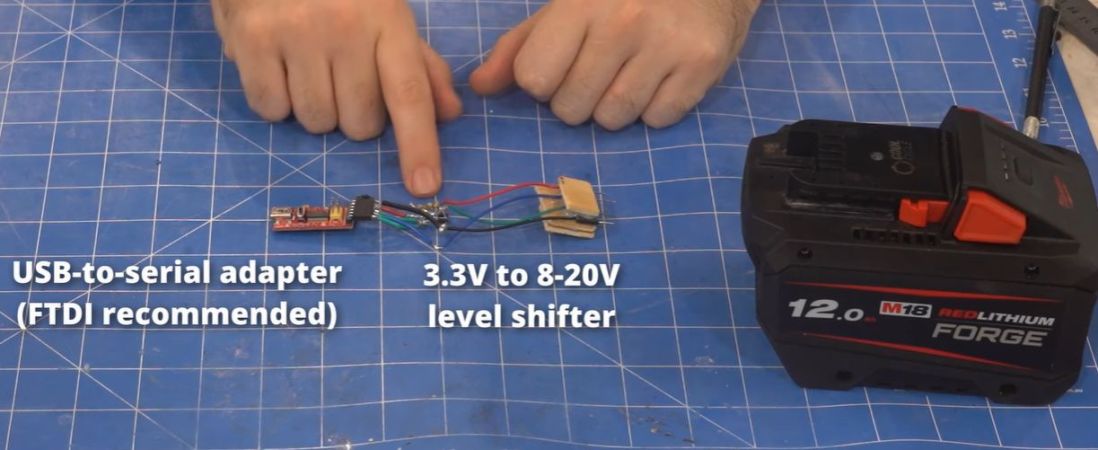
As is regrettably typical in the cordless tool world, Milwaukee’s M18 batteries are highly proprietary. Consequently, this makes them a welcome target for reverse-engineering of their interfaces and protocols. Most recently the full diagnostic command set for M18 battery packs were reverse-engineered by [ToolScientist] and others, allowing anyone to check useful things like individual cell voltages and a range of statistics without having to crack open the battery case.

These results follow on our previous coverage back in 2023, when the basic interface and poorly checksummed protocol was being explored. At the time basic battery management system (BMS) information could be obtained this way, but now the range of known commands has been massively expanded. This mostly involved just brute-forcing responses from a gaggle of battery pack BMSes.

Interpreting the responses was the next challenge, with responses like cell voltage being deciphered so far, but serial number and the like being harder to determine. As explained in the video below, there are many gotchas that make analyzing these packs significantly harder, such as some reads only working properly if the battery is on a charger, or after an initial read.

Continue reading “Reverse-Engineering The Milwaukee M18 Diagnostics Protocol”