The Kentucky Cave Wars, And Going Viral In 1925

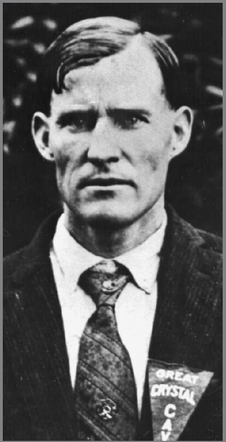
Floyd Collins, the unfortunate star of this post. (Public Domain)

Information, it seems, flows at the speed of media. In the old days, information traveled with people on ships or horses, so if, say, a battle was won or lost, it could be months or even years before anyone back home knew what happened. While books and movable type let people store information, they still moved at the speed people moved. Before the telegraph, there were attempts to use things like semaphores to speed the flow of information,  but those were generally limited to line-of-sight operations. Carrier pigeons were handy, but don’t really move much faster than people.

The telegraph helped, but people didn’t have telegraph stations in their homes. At least not ordinary people. But radio was different. It didn’t take long for every home to have a radio, and while the means of broadcasting remained in the hands of a few, the message could go everywhere virtually instantly. This meant news could go from one side of the globe to the other in seconds. It also meant rumors, fads, and what we might think of today as memes could, too.

You might think that things “going viral” is a modern problem, but, in reality, media sensations have always been with us. All that changes is the number of them and their speed.

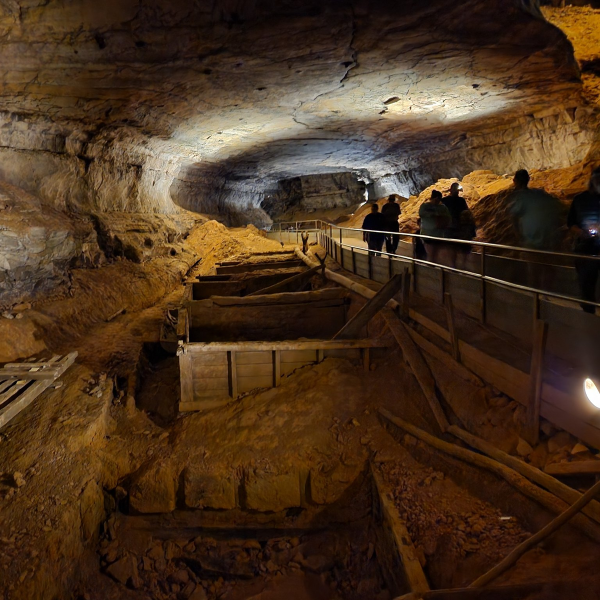
One of the earliest viral media sensations dealt with William Floyd Collins, an unfortunate man who was exploring caves during the Kentucky Cave Wars.

Continue reading “The Kentucky Cave Wars, And Going Viral In 1925”
Making The Forgotten 1982 Game Adventure Canoe Run On MAME

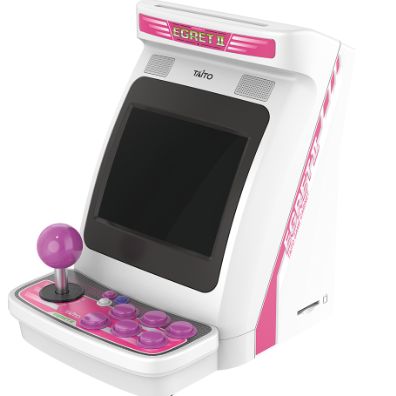
A Taito Egret II mini arcade cabinet.

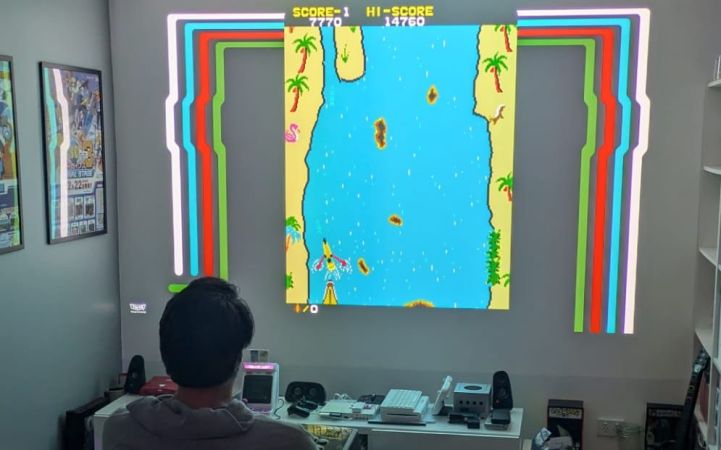
A while back [Jack] came across a Taito arcade game that neither he nor any of his mates recognized. The game was Adventure Canoe and part of the collection of forty preinstalled games on a Taito Egret II mini arcade cabinet. Yet despite [Jack] and his buddies being avid 1980s arcade enthusiasts, this 1982 title for the Z80-based Taito SJ system was completely unfamiliar to them.

When even a web search turned up extremely few details, [Jack] did the only reasonable thing and borrowed the rather expensive mini arcade for hopefully some extracting of the game ROM.

As expensive as this mini arcade is, it features the typical ARM-based SoC and Linux-based firmware. Although you can totally dump the Flash, [Jack] found that the firmware update ZIP file was a much easier target to poke at and hopefully extract the ROMs from.

Of course, Taito used password-protected ZIP files within the firmware, leading to some reverse-engineering to find the passwords. The first was ‘hidden’ as plain text in the egret2 binary. For the remainder of the ZIP files the password wasn’t as readily found, but required some sleuthing. This took the form of dynamic runtime analysis with gdb, using information previously gleaned from a Ghidra analysis. Eventually this yielded the final passwords.

Extracting the game’s ROM files this way allowed for them to be adapted to the format that MAME expects, after which the game just had to be added to the emulator’s source files. With this done the game fired right up, and [Jack] was able to play the game without any trouble.

Sega Meganet: Online Gaming In 1990

It’s easy to think of online console gaming as an invention of the 2000s. Microsoft made waves when Xbox Live dropped in 2002, with Nintendo and Sony scrambling to catch up with their own offerings that were neither as sleek or well-integrated.

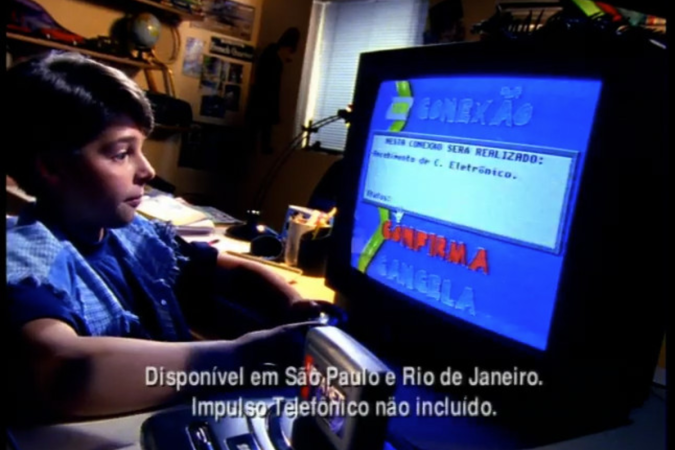
However, if you were around a decade earlier, you might have experienced online console gaming much closer to the dawn of the Internet era. As far back as 1990, you could jump online with your Sega Mega Drive. But what did an online console feel like in the dial-up era?

Continue reading “Sega Meganet: Online Gaming In 1990”

Training A Transformer With 1970s-era Technology

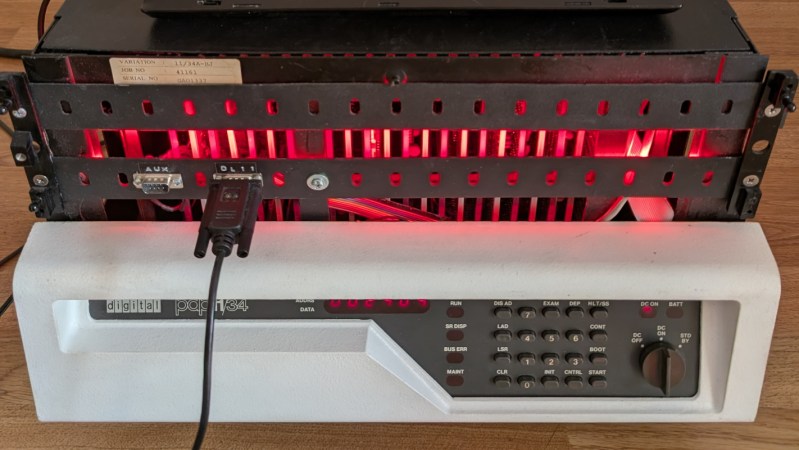
Although generative language models have found little widespread, profitable adoption outside of putting artists out of work and giving tech companies an easy scapegoat for cutting staff, their their underlying technology remains a fascinating area of study. Stepping back to the more innocent time of the late 2010s, before the cultural backlash, we could examine these models in their early stages. Or, we could see how even older technology processes these types of machine learning algorithms in order to understand more about their fundamentals. [Damien Boureille] has put a 60s-era IBM as well as a PDP-11 to work training a transformer algorithm in order to take a closer look at it.

For such old hardware, the task [Damien Boureille] is training his transformer to do is to reverse a list of digits. This is a trivial problem for something like a Python program but much more difficult for a transformer. The model relies solely on self-attention and a residual connection. To fit within the 32KB memory limit of the PDP-11, it employs fixed-point arithmetic and lookup tables to replace computationally expensive functions. Training is optimized with hand-tuned learning rates and stochastic gradient descent, achieving 100% accuracy in 350 steps. In the real world, this means that he was able to get the training time down from hours or days to around five minutes.

Not only does a project like this help understand these tools, but it also goes a long way towards demonstrating that not every task needs a gigawatt datacenter to be useful. In fact, we’ve seen plenty of large language models and other generative AI running on computers no more powerful than an ESP32 or, if you need slightly more computing power, on consumer-grade PCs with or without GPUs.

Testing A Soviet 1000 Volt Insulation Tester From 1985

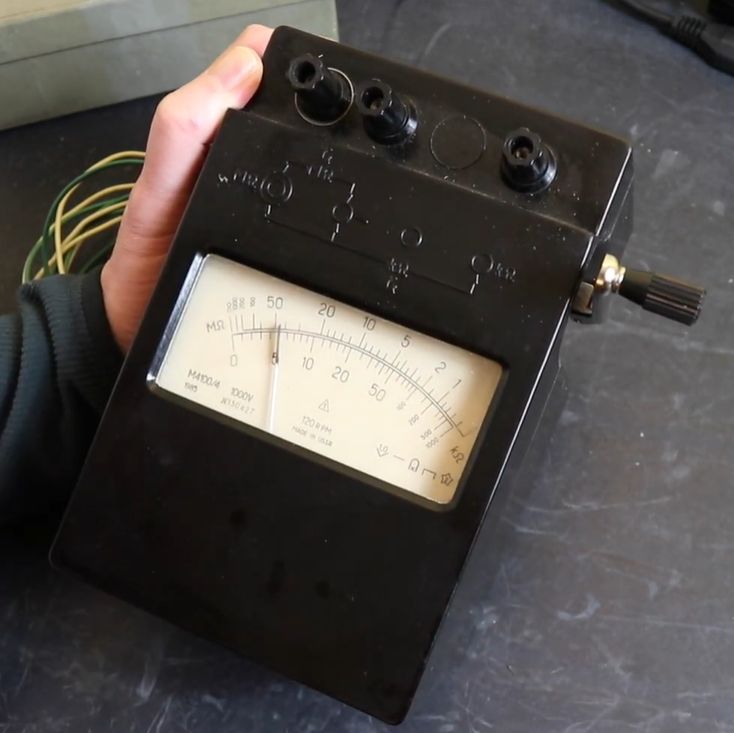
Although the term ‘Iron Curtain’ from the Cold War brings to mind something like the Berlin Wall and its forbidding No Man’s Land, there was still active trade between the Soviet Union and the West. This included devices like the M4100/4 insulation tester that the [Three-phase] YouTube channel recently looked at, after previously poking at a 1967 USSR resistance bridge.

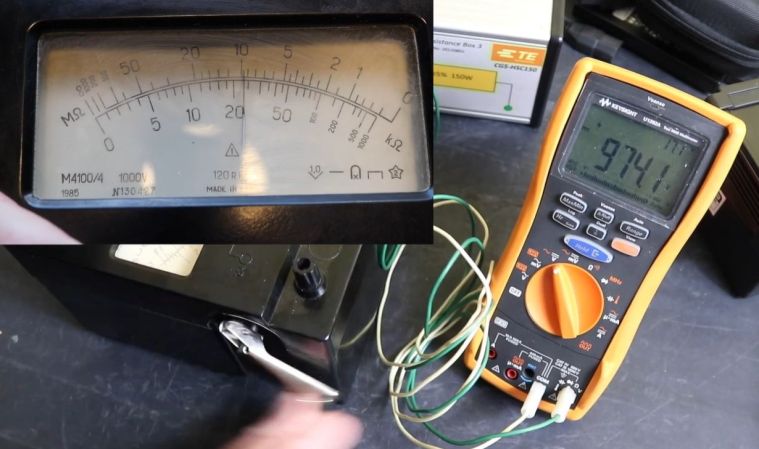
This particular unit dates to 1985, and comes in a rather nice-looking case that somewhat looks like bakelite. It’s rated for up to 1 gigaohm, putting out 1,000 V by using the crank handle. Because of the pristine condition of the entire unit, including seals, it was decided to not look at the internals but only test its functionality.

After running through the basic usage of the insulation tester it’s hooked up to a range of testing devices, which shows that it seems to be mostly still in working condition. The first issue noticed was that the crank handle-based generator was a bit tired, so that it never quite hit the maximum voltage.

With no parallax correction and no known last calibration date, it still measured to about 10% of the actual value in some tests initially, but in later tests it was significantly off from the expected value. At this point the device was suspected of being faulty, but it defied being easily opened, so any repair will have to be put off for now. That said, it being in such good condition raises the prospect of it being an easy repair, hopefully in an upcoming video.

Continue reading “Testing A Soviet 1000 Volt Insulation Tester From 1985”

It’s 1979 – What Exactly Did That ∫ Key Do?

[Michel Jean] asked a question few others might: what exactly is going on under the hood of a classic HP scientific calculator when one presses the key? A numerical integration, sure, but how exactly? There are a number of useful algorithms that could be firing up when the integral button is pressed, and like any curious hacker [Michel] decided to personally verify what was happening.

[Michel] implemented different integration algorithms in C++ and experimentally compared them against HP calculator results. By setting up rigorous tests, [Michel] was able to conclude that the calculators definitely use Romberg-Kahan, developed by HP Mathematician William Kahan.

Selected by HP in 1979 for use in their scientific calculators, the Romberg-Kahan algorithm was kept in service for nearly a decade. Was it because the algorithm was fast and efficient? Not really. The reason it was chosen over others was on account of its robustness. Some methods are ridiculously fast and tremendously elegant at certain types of problem, but fall apart when applied to others. The Romberg-Kahan algorithm is the only one that never throws up its hands in failure; ideal for a general-purpose scientific calculator that knows only what its operator keys in, and not a lick more.

It’s a pretty neat fact about classic HP calculators, and an interesting bit of historical context for these machines. Should you wish for something a bit more tactile and don’t mind some DIY, it’s entirely possible to re-create old HP calculators as handhelds driven by modern microcontrollers, complete with 3D-printed cases.

Thanks to [Stephen Walters] for the tip!

How The Chornobyl NPP Got Modernized In The 1990s

During the 1990s the Chornobyl Nuclear Power Plant – formerly the Chernobyl NPP – continued operating with its remaining three RBMK reactors, but of course the 1970s-era automation with its very limited SKALA computer required some serious modernization. What was interesting here is that instead of just replacing this entire Soviet-era mainframe with a brand-new 1990s one, the engineers responsible opted to build a new system – called DIIS – around it. This is detailed in a recent video by the [Chornobyl Family] on YouTube.

This SKALA industrial control system was previously detailed in a video, covering this 24-bit mainframe computer and its many limitations. It wasn’t quite a real-time control system, but it basically did what it was designed to do. Since at the time it was not clear for how long these three RBMKs would be kept running, they didn’t want to go overboard with investments either.

Ultimately Unit 2 only was active until 1991 due to a turbine fire, Unit 1 until 1996 and Unit 3 was shutdown for the last time in 2000, so this a sensible decision. During those years, an auxiliary information-measurement system (DIIS) was the big upgrade, which got bridged into SKALA via a Ukrainian-made SM-1210 minicomputer, with the latter connected to an 80386 PC which itself was connected to an ARCnet hub.

Continue reading “How The Chornobyl NPP Got Modernized In The 1990s”