Simple Jig Uses Electromagnet For Clean Angle Grinder Cuts

We like it when hacks are literal hack jobs, put together with what’s on hand to do a specific job. This quick and dirty angle grinder circle cutter certainly fills the bill, and makes decent cuts in sheet metal to boot.

The build starts with an unlikely source for parts – an old automotive AC compressor. The one that [Made in Poland] chose to sacrifice was particularly nasty and greasy, but after popping off the pulley, the treasure within was revealed: the large, ring-shaped clutch electromagnet. Liberated from the compressor, the electromagnet was attached to a small frame holding a pillow block. That acts as an axis for an adjustable-length arm, the other end of which holds a modified angle grinder. In use, the electromagnet is powered up by a small 12-volt power supply, fixing the jig in place on the stock. The angle grinder is traced around and makes a surprisingly clean cut. Check out the build and the tool in use in the video below.

At the time [Made in Poland] recorded the video, he noted that he did not have a plasma cutter. That appears to have changed lately, so perhaps he’ll swap out the angle grinder for plasma. And maybe he’ll motorize it for even smoother cuts.

Continue reading “Simple Jig Uses Electromagnet For Clean Angle Grinder Cuts” →

Cryptanalyse Your Air Con

Infrared remote controls are simple and ubiquitous. Emulating them with the aid of a microcontroller is a common project that hackers use to control equipment as diverse as televisions, cable boxes, and home stereos. Some air conditioners can be a little more complicated, however, but [Ken]’s here to help.

The root of the problem is that the air conditioner remote was using a non-obvious checksum to verify if commands received were valid. To determine the function generating the checksum, [Ken] decided to bust out the tools of differential cryptanalysis. This involves carefully varying the input to a cryptographic function and comparing it to the differences in the output.

With 35 signals collected from the remote, a program was written to find input data that varied by just one bit. The checksum outputs were then compared to eventually put together the checksum function.

[Ken] notes that the function may not be 100% accurate, as they’re only using a limited sample of data in which not all the bytes change significantly. However, it shows that a methodical approach is valuable when approaching such projects.

Thirsty for more checksum-busting action? Check out this hacked weather station.

Air Conditioner Speaks Serial, Just Like Everything Else

Like so many other home appliances, it’s likely that even your air conditioner has a serial interface buried inside it. If you’re wondering why, it’s because virtually every microcontroller on the planet has a UART built in, and it’s highly useful for debugging during the development process, so it makes sense to use it. Thus, it was only a matter of time before we saw a hacked airconditioner controlled by a Raspberry Pi.

[Hadley] was growing frustrated with the IR remote for his Mitsubishi air conditioner; it can issue commands, but it’s a one way interface – there’s no feedback on current status or whether commands are received, other then the occasional beep or two. Deciding there had to be a better way, [Hadley] grabbed a Saleae Logic Analyser and started probing around, determining that the unit spoke 5 V TTL at 2400 bps with even parity. The next step was to start talking back.

Continue reading “Air Conditioner Speaks Serial, Just Like Everything Else” →

Arduino Replaces Bad AC Thermostat, Hacker Stays Cool

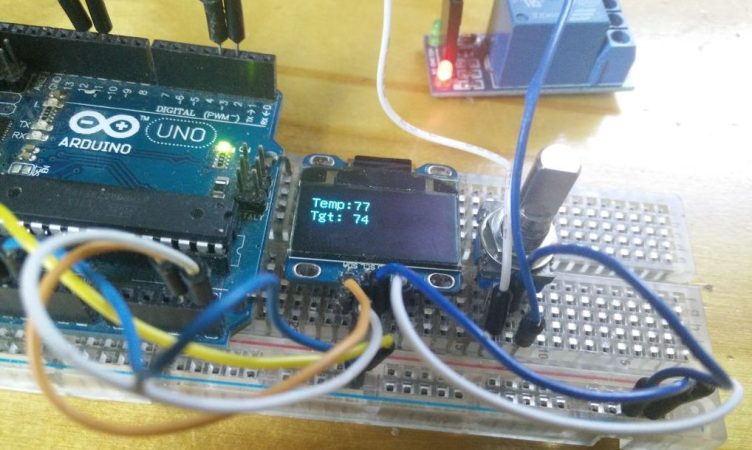
Most of North America has been locked in a record-setting heat wave for the last two weeks, and cheap window AC units are flying out of the local big-box stores. Not all of these discount units undergo rigorous QC before sailing across the Pacific, though, and a few wonky thermostats are sure to get through. But with a little sweat-equity you can fix it with this Arduino thermostat and temperature display.

We’ll stipulate that an Arduino may be overkill for this application and that microcontrollers don’t belong in every project. But if it’s what you’ve got on hand, and you’re sick of waking up in a pool of sweat, then it’s a perfectly acceptable solution. It looks like [Engineering Nonsense] got lucky and had a unit with a low-current power switch, allowing him to use a small relay to control the AC. The control algorithm is simple enough – accept a setpoint from an encoder, read the temperature sensor, and turn the AC on or off accordingly. Setpoint and current temperature are displayed on an OLED screen. One improvement we’d suggest is adding a three-minute delay between power cycles like the faceplate of the AC states.

This project bears some resemblance to this Arduino-controlled AC, but it seems more hackish to us. And that’s a good thing – hackers have to keep cool somehow.

Continue reading “Arduino Replaces Bad AC Thermostat, Hacker Stays Cool” →

Arduino Controlled AC

Arduino Controlled Air Conditioner

Now that summer is coming, it’s time to break out the Air Conditioners! There are some old AC units out there that still work just fine, but nowadays we are used to everything being remotely controlled and automatic. [Phil] had an old window-mounted AC unit that still worked but was installed in a not-so-convenient place. To access the AC’s controls, one would have to climb over a large desk. This is a perfect opportunity to use the plethora of widely available hobby electronics to make an automatic AC controller retrofit.

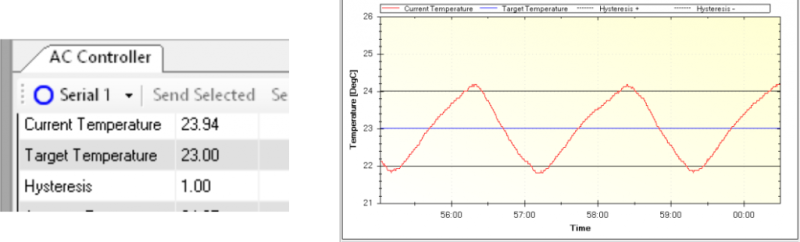
First things first, there needs to be a way to turn the current control knob on the AC. [Phil] modeled up a 3D bracket to hold an RC car servo to the AC control panel. Attached to the servo horn is a slotted cylinder sized appropriately to fit the shape of the control knob. An Arduino measures the temperature of the room via a DS18B20 temperature sensor which then has the servo turn the control knob to the appropriate position, on or off. The Arduino sends temperature data back to a PC via MegunoLink Pro which graphs past data and also displays current temperature data. Using MegunoLink Pro, the min/max temperature points can also be set without uploading a new sketch to the Arduino.

Arduino Controlled AC

From the temp vs time graph, it looks like the room temperature stays a consistent 23 +/- 1 °C. [Phil] did us summer-swelterers a favor and made all his design files available. This is a great idea but wonder if leaving the air conditioner unit switch in the ‘on’ position and turning the unit on/off via a relay connected to the 120vac line would work just as well.

portable ice AC

DIY AC For The Hot Shop

Working out in the shop is usually super fun but if it’s summertime, watch out, it can get hot! We’ve all been there and we’ve all wished we could do something about it. Well, woodworker and general DIYer [April] has stepped up to the plate and built a portable low-buck AC unit to cool her shop down to an acceptable temperature.

The unit is very simple and starts off with an old thrift store cooler. A hole is cut in the back of the cooler to make room for a fan that is directed to blow air inside the cooler and across blocks of ice. The air cools down as it passes over the ice and leaves out the top of the cooler through five 90-degree PVC elbows. After all the inlets and outlets were caulked, the entire unit was given a monochromatic black paint job.

[April] says you can feel the cool air blowing from about 5 feet away from the unit. She has measured the output air temperature to be 58-62ºF. If using loose ice cubes, the unit will work for 2-3 hours. Freezing milk jugs full of water gets about 5 hours of use.

Using The Sun To Beat The Heat

It’s practically May, and that means the sweltering heat of summer is nearly upon us. Soon you’ll be sitting outside somewhere, perhaps by a lake, or fishing from a canoe, or atop a blanket spread out on the grass at a music festival, all the while wishing you had built yourself a solar-powered personal air conditioner.

[Nords] created his from a large insulated beverage vessel. The imbibing spout offers a pre-made path to the depths of said vessel and the heart of this build, the ice water refrigerant. [Nords] fashioned a coil out of copper tubing to use as a heat exchanger and strapped it to the fan that performed best in a noise-benefit analysis.

A small USB-powered submersible pump moves the ice water up through the copper tubing. Both the pump and the fan run off of a 5V solar panel and are connected with a USB Y cable, eliminating the need for soldering. Even if you spend the summer inside, you could still find yourself uncomfortably warm. Provided you have access to ice, you could make this really cool desktop air conditioner.

[via Embedded Lab]