Developing With EBay-sourced ARM + LCD Dev Boards

eBay isn’t only about counterfeit designer handbags and boxes of all-marshmallow Lucky Charms, sometimes there’s actually something useful for sale. [Matt] found a bunch of Chinese-made ARM development boards with integrated LCD displays on the ‘bay, but without a reliable toolchain, these boards – as cool as they are – are nearly useless. Thankfully, he figured out how to do something with these boards, and neatly packaged everything into a VirtualBox image.

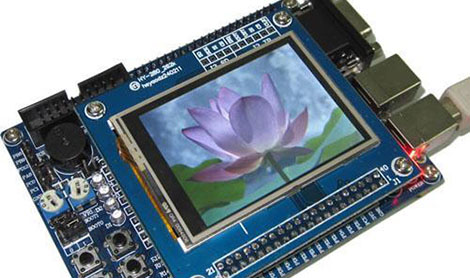
The boards in question usually include a 2.4″ or 3.2″ touch panel LCD, an STM32F103 ARM Cortex-M3 CPU, a microSD card connector, and sometimes a few other goodies like 16MB of Flash memory and an RS-232 port. An amazing amount of computational capability packaged into an easy-to-use form factor made even more awesome by their $40 price point.

Because these boards offer so much more than a common Arduino, a proper OS is in order. [Matt] looked over FreeRTOS and included a few demo programs for his Ubuntu-based VirtualBox image (available for download on [Matt]’s site, it’s a dropbox, email us if you need some hosting, [Matt]) Never mind, see below.

Programming these boards can be done over a serial interface, but a JTAG programmer such as a Bus Blaster makes things very, very easy.

You can check out a few demos [Matt] put together after the break. It’s a very cool development that is much more suited for being integrated into an electronics project than a Raspberry Pi or other such high-power ARM board, and something we hope to see more of in the future.

EDIT: You know what’s really good for hosting Linux distros? Torrents. That’s [Matt]’s distro and the HaD crew is seeding. Please seed.

Continue reading “Developing With EBay-sourced ARM + LCD Dev Boards”
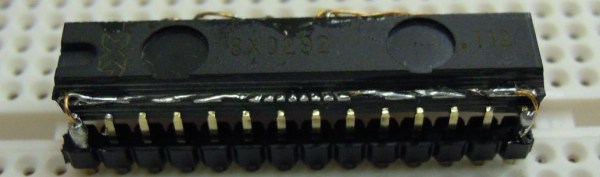
Turning A 600 Mil Chip To 300 Mil

We’ve seen a few builds featuring NXP’s LPC1114 microcontroller before. This chip – the only breadboard friendly ARM microcontroller available – comes in a ‘still a little too large for prototyping’ 600 mil, 28 pin package. We won’t hazard a guess why NXP chose this rather large package, but the good news is it’s possible to shave this chip down to the more common 300 mil, 28-pin package used by AVRs and PICs.

In the video tutorial of this procedure, the chip is first taped down to a desktop CNC mill. 150 mil on each side of the die are removed, exposing the very cool-looking pattern of leads coming out of the chip. This isn’t enough area to solder, so the chip had to be further milled to expose some of the internal wiring.

After soldering everything to a set of pins, the new 300 mil package is covered in epoxy putty, milled down again into a nice cube shape and painted. Yes, the modified chip does work, and no, we can’t figure out why NXP chose a 600 mil package for this microcontroller over the far more common 300 mil chip.

Video after the break. Tip ‘o the hat to [Ian] for sending this one in.

Continue reading “Turning A 600 Mil Chip To 300 Mil”

Rasperry Pi: Now Mostly Open Source

If you’ve been following the developments of building Android, Chromium, and other OSes for the Raspberry Pi, you’ll come across a common theme. The drivers for the Raspi’s chip are closed source and protected by Broadcom with an NDA. This limits the ability of devs to take on projects that involve messing around deep inside the CPU.

Today, this is no longer the case. The CPU on the Raspberry Pi is now the first ARM-based system with fully functional, vendor-provided drivers.

Previously, the drivers for OpenGL ES, OpenMax, and other goodies inside the ARM chip have been closed source, available only to the Raspberry Pi foundation and those willing to sign a non-disclosure agreement with Broadcom. With this release, the drivers are open source, allowing the devs behind the Android, Chromium, Haiku, *BSD, and the RISC OS to dig deep into the Broadcom drivers and get their projects working.

The new files are available in the Raspberry Pi git, just waiting for devs to take a look at it.

The Arduino Due Is Finally Here

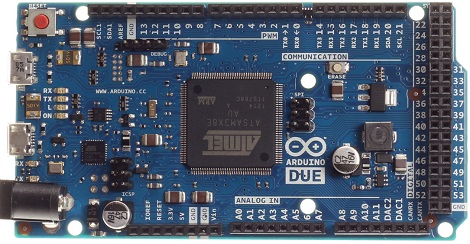
After a years-long wait, an ARM powered Arduino is finally due. The Arduino Due will finally be released this coming Monday.

On board the Arduino Due is an Atmel-sourced ARM Cortex M3 microcontroller running at 84 MHz. The Due has an impressive list of features including a USB 2.0 host, compatibility with the Android ADK (lest you still need an IOIO), 12 analog inputs with 12-bit resolution, 2 analog outputs running at 12 bits, a CAN interface, and more input pins than you can shake a stick at.

For a full list of features, you can grab this PDF we picked up when we saw the Due at Maker Faire NYC

This hardware update to the Arduino platform makes a lot of very cool builds very possible for even the beginner hardware hacker. Of course the Due will be used for controlling drones and UAVs, laser cutters and 3D printers, and playing WAV files from the analog outputs. The much improved hardware opens up a lot of other possible builds including making your own guitar pedals – DSP is a wonderful thing – and reading the telemetry from your car in real-time via the CAN bus.

Although it’s not available right now, you will be able to buy an Arduino Due for $49 USD this coming Monday at your favorite electronics retailers. 

Bringing Java To The World Of Microcontrollers

C is a beautiful language perfectly suited for development on low-power devices such as the 8-bit microcontrollers. With newer, more powerful ARM microcontrollers making their way onto the market and workbenches around the world, it was only fitting that Oracle got in on the action. They released a version of Java targeted at these newer, more powerful microcontrollers called Java ME embedded.

The new embedded version of Java has everything you would expect from a microcontroller development platform – access to GPIO pins, including SD cards and I2C devices. The new Java machine is designed for full headless operation and is capable of running on devices with as little as 130 kB of RAM and 350 kB of ROM.

As for the utility of programming a microcontroller in Java, it’s still the second most popular language, after spending the better part of a decade as the number one language programmers choose to use. The requirements of the new embedded version of Java are far too large to fit onto even the best 8-bit microcontrollers, but with a new crop of more powerful ARM devices, we’ll expect to see more and more ARM/Java projects making their way into the Hackaday tip line in the coming months.

Tip ‘o the hat to [roger] for sending this one in.

STM32 Driving A PCIe Video Card

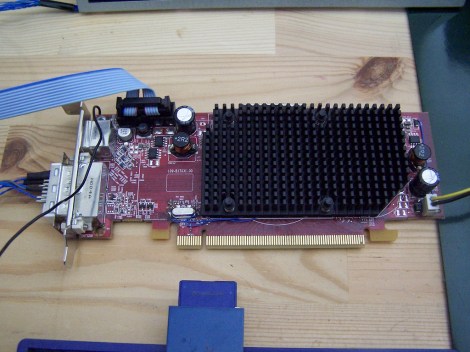
[Gpuhackr] chose his username to explain exactly how he spends his time. For instance, here he’s using an STM32 Discovery board to drive an AMD Radeon HD 2400 graphics card. The ARM microcontroller isn’t actually using the PCIe interface on the card. Instead, [Gpuhackr] has patched into the debugging interface built into the card itself. This isn’t quite as straight forward as it sounds, but if you do the wiring carefully it’s a pretty intersting way to connect an ARM to an LCD monitor.

This project would be almost impossible if it weren’t for the open source code which AMD has released. This lets him implement the card’s 3D rendering features. The demo directly programs the UVD Xtensa CPU which is on the video card. It draws a cube with color gradients on each side. The cube spins while the debug information is overlaid on the screen. In this case the ARM chip/board is really being used as a programmer to upload some custom firmware. But we think a real code-ninja could implement a communications protocol to open up a simple way to drive the card in real-time.

[Thanks uMinded]

A JavaScript Interpreter For ARM ‘micros

When programming a microcontroller to do your bidding, you only have two choices. You could write your code in a proper language such as C and cross-compile your source into a piece of firmware easily understood by a micro. Alternatively, your could load an interpreter on your microcontroller and write code via a serial connection. Interpreters are a really fast and easy method to dig in to the hardware but unfortunately most microcontroller interpreters available are based on BASIC or Forth.

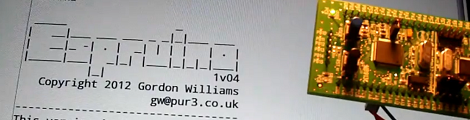
[Gordon] figured it’s not 1980 anymore, and interpreters for these relatively low-level languages aren’t a good fit with the microcontrollers of today. To solve this problem, he created Espruino, a JavaScript interpreter for the new batch of ARM development boards that have been cropping up.

Espruino is designed for the STM32VL Discovery board, although [Gordon] plans on porting his interpreter to the Arduino Due when he can get his hands on one. Installation is as easy as uploading any other piece of firmware, and even though [Gordon]’s STM32VL doesn’t have a USB port for a serial terminal, it’s a snap to connect a USB to TTL converter and get this interpreter working.

Espruino isn’t open source yet, only because [Gordon] would like to clean up his code and write a bit of documentation. He’d also like to make Espruino profitable so he can work on it full-time, so if anyone has an idea on how [Gordon] can do that, leave a note in the comments.