Hackaday Links Column Banner

Hackaday Links: July 5, 2020

Remember all the hubbub over Betelgeuse back in February? For that matter, do you even remember February? If you do, you might recall that the red giant in Orion was steadily dimming, which some took as a portent of an impending supernova. That obviously didn’t happen, but we now seem to have an explanation for the periodic dimming: an enormous dark spot on the star. “Enormous” doesn’t begin to describe this thing, which covers 70% of the face of a star that would extend past Jupiter if it replaced the sun. The dimming was originally thought to be dust being blown off the star as it goes through its death throes, but no evidence could be found for that, while direct observations in the terahertz range showed what amounted to a reduction in surface temperature caused by the enormous star spot. We just think it’s incredibly cool that Betelgeuse is so big that we can actually observe it as a disk rather than a pinpoint of light. At least for now.
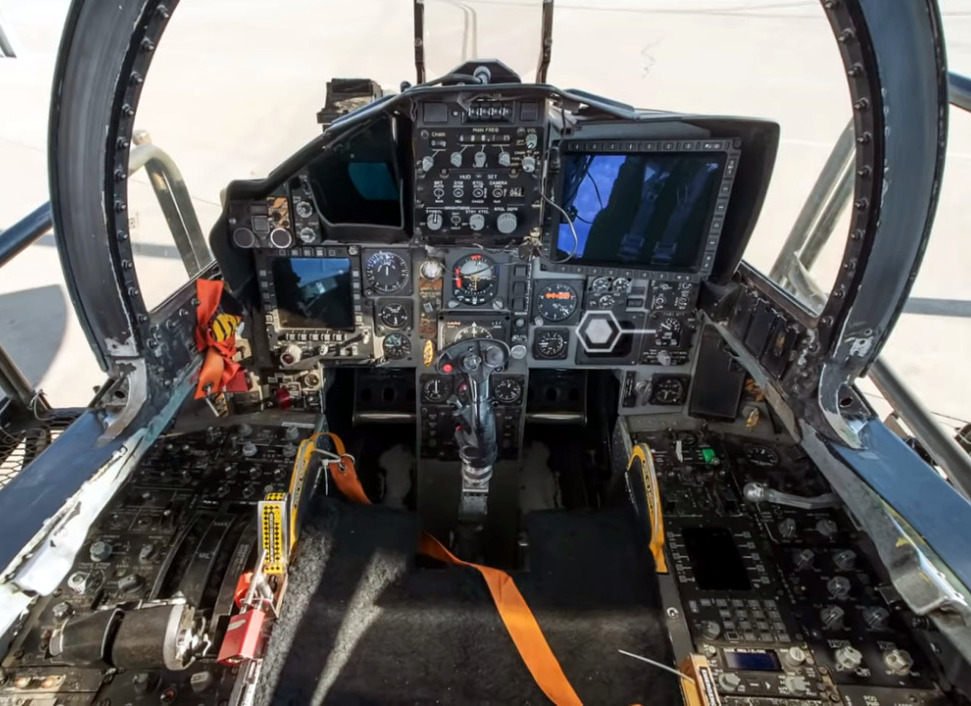
F-15c cockpit
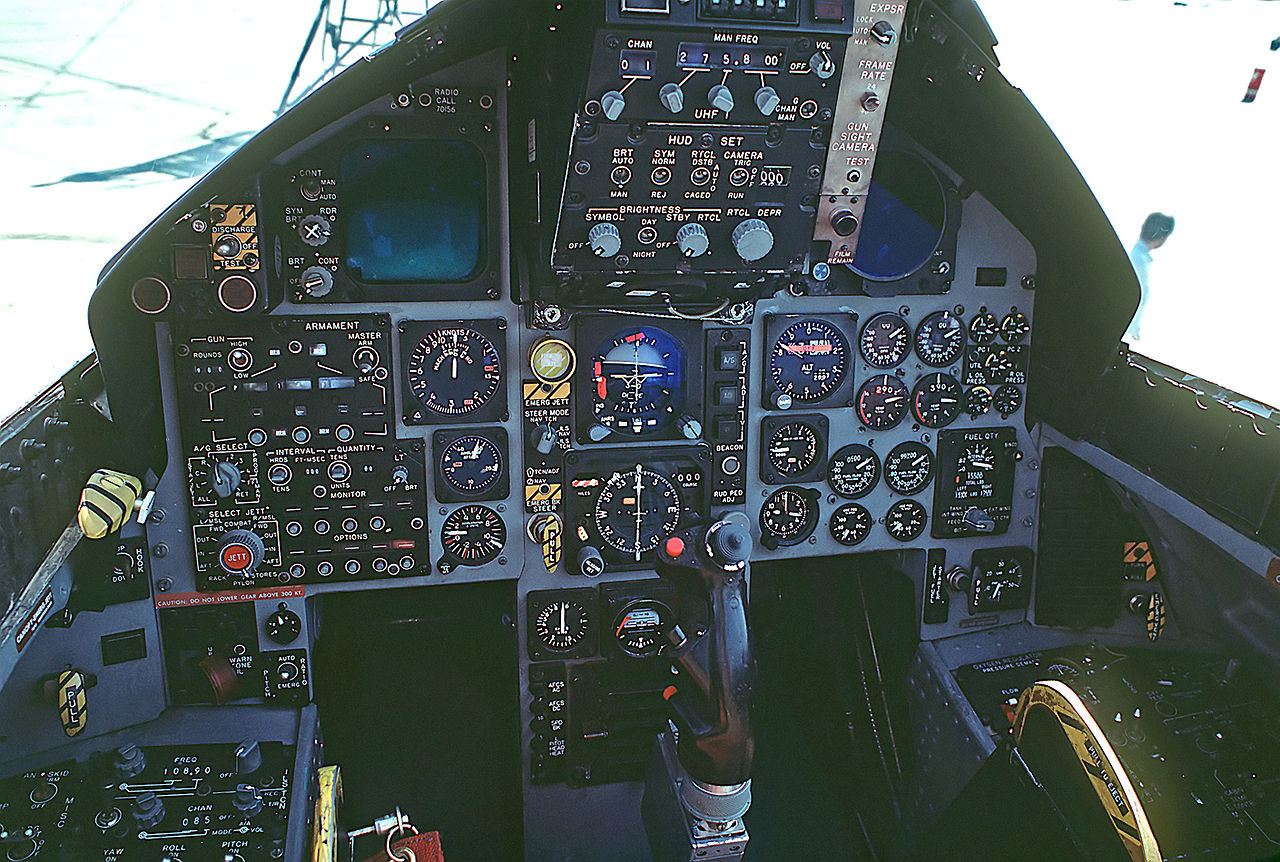
F-15a cockpit

If you think you’ve seen some challenging user interfaces, wait till you get a load of the cockpit of an F-15C Eagle. As part of a new series on human interfaces, Ars Technica invited Col. Andrea Themely (USAF-ret.) to give a tour of the fighter she has over 1,100 hours on. Bearing in mind that the Eagle entered service in 1976 and has been continually updated with the latest avionics — compare the video with the steam gauges of the cockpit of an F-15A — its cockpit is still a pretty busy place. As much as possible has been done to reduce pilot load, with controls being grouped by function and the use of color-coding — don’t touch the yellow and black stuff! — and the use of tactile feedback. It’s a fascinating deep dive into a workplace that few of us ever get to see, and we’re looking forward to the rest of the series.

Sad news from Seattle, where the Living Computers: Museum + Labs is closing up shop. The announcement only says they’re closing “for now”, so there’s at least some hope that the museum will be back once the COVID-19 downturn has run its course. We hope they do bounce back; it really was a great museum with a lot of amazing hardware on display. The Vintage Computer Festival PNW was held there in its inaugural year, an event we covered and had high hopes for in the future. We hope for the best for these educational and cultural institutions, but we can’t help but fear a little for their future.
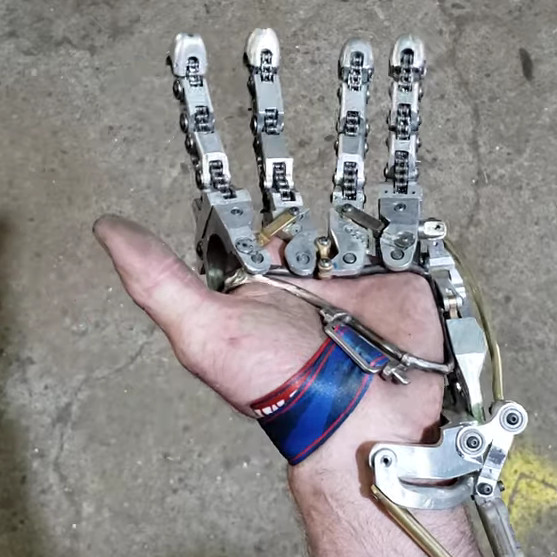
So you suffer a partial amputation of your left hand, leaving you with only your thumb and your palm. That raises an interesting conundrum: you haven’t lost enough to replace the hand with a prosthetic one, but you still don’t have any fingers. That appears to be what happened to Ian Davis, and so he built his own partial prosthetic to replace his fingers. There’s not much backstory on his YouTube channel, but from what we can gather he has gone through several designs, most of which are myomechanical rather than myoelectric. Through a series of complex linkages, he’s able to control not only the opening and closing of the fingers, but also to splay them apart. It’s all in the wrist, as it were — his input gestures all come from flexing and extending his hand relative to his forearm, where the prosthesis is anchored. This results in a pretty powerful grip — much stronger than a myoelectric hand in a head-to-head test. And the coolness factor of his work is just off the scale. We’re looking forward to more from Ian, and hopefully enough background information for a full story on what he has accomplished.
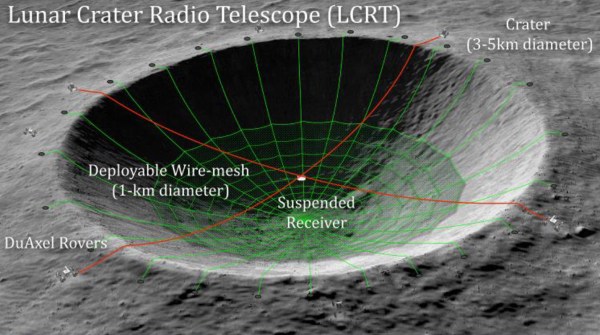
As A Matter Of Fact, It’s All Dark

While the dark side of the moon wasn’t seen by humans until the middle of the 20th century, that side of the moon isn’t always dark, just hidden from view of Earth by a quirk of gravity. The more appropriate name for the other half of the moon is the “far side”, but while it gets just as much sunshine as the near side does it is dark to one thing in particular: man-made radio waves. That, along with the lack of an atmosphere and ionosphere on the moon, makes it a perfect place for a new telescope.

This telescope isn’t like something you’d set up in your back yard, either. It’s more similar to the Aricebo Observatory in Puerto Rico which uses natural topography to help form the telescope. The proposed telescope on the far side of the moon would use a robot to deploy a net along a fairly large crater to act as a parabolic dish, while another robot would suspend the receiver above the crater. The large size is necessary for viewing deep into space, but is also because of the low-frequency radio signals they hope to capture.

Building a dish like this on the moon is sure to be no easy task, especially since remote control on the far side of the moon is difficult for precisely the reasons that make this a good location for a telescope. But with an appropriate amount of funding and some sufficiently autonomous robots it should be possible. Plus, you never know what you’ll find when looking deep into space.

Arduino Drives Astronomy Dome

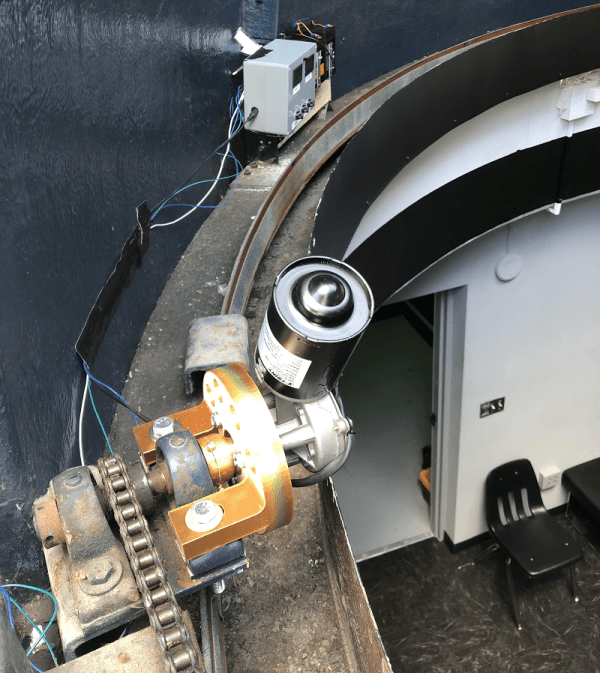
The South Florida Science Center recently added a new ten-inch telescope and turned to [Andres Paris] and his brother to replace the hand-cranked dome door system. They turned to an Arduino along with some beefy motor drivers. You can see some videos of the beast in operation, below.

According to a Reddit post, the brothers picked up a 5A 12V motor but decided to overdesign and selected an H-bridge that would handle 20A peak current. An IR remote allows the operator to open and shut the door and reed switches sense the extremes of the door’s motion.

Continue reading “Arduino Drives Astronomy Dome”

OpenAstroTracker Turns Your DSLR Into An Astronomy Instrument

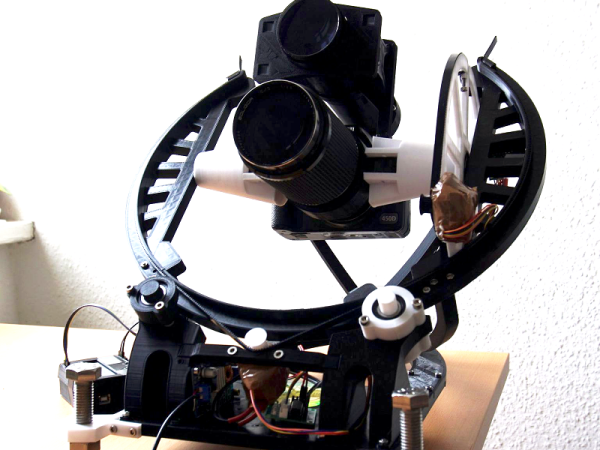
If you want to take beautiful night sky pictures with your DSLR and you live between 15 degrees and 55 degrees north latitude you might want to check out OpenAstroTracker. If you have a 3D printer it will probably take about 60 hours of printing, but you’ll wind up with a pretty impressive setup for your camera. There’s an Arduino managing the tracking and also providing a “go to” capability.

The design is over on Thingiverse and you can find code on GitHub. There’s also a Reddit dedicated to the project. The tracker touts its ability to handle long or heavy lenses and to target 180 degrees in every direction.

Continue reading “OpenAstroTracker Turns Your DSLR Into An Astronomy Instrument”

The Spitzer Space Telescope Ends Its Incredible Journey

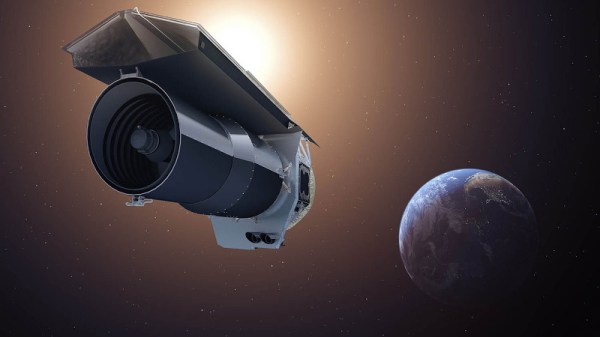
Today, after 16 years of exemplary service, NASA will officially deactivate the Spitzer Space Telescope. Operating for over a decade beyond its designed service lifetime, the infrared observatory worked in tandem with the Hubble Space Telescope to reveal previously hidden details of known cosmic objects and helped expand our understanding of the universe. In later years, despite never being designed for the task, it became an invaluable tool in the study of planets outside our own solar system.

While there’s been no cataclysmic failure aboard the spacecraft, currently more than 260 million kilometers away from Earth, the years have certainly taken their toll on Spitzer. The craft’s various technical issues, combined with its ever-increasing distance, has made its continued operation cumbersome. Rather than running it to the point of outright failure, ground controllers have decided to quit while they still have the option to command the vehicle to go into hibernation mode. At its distance from the Earth there’s no danger of it becoming “space junk” in the traditional sense, but a rogue spacecraft transmitting randomly in deep space could become a nuisance for future observations.

From mapping weather patterns on a planet 190 light-years away in the constellation Ursa Major to providing the first images of Saturn’s largest ring, it’s difficult to overstate the breadth of Spitzer’s discoveries. But these accomplishments are all the more impressive when you consider the mission’s storied history, from its tumultuous conception to the unique technical challenges of long-duration spaceflight.

Continue reading “The Spitzer Space Telescope Ends Its Incredible Journey”

Habitable Exoplanets Hack Chat

Join us on Wednesday, January 15 at noon Pacific for the Habitable Exoplanets Hack Chat with Alberto Caballero!

Many of the major scientific achievements of the last 100 years or so have boiled down to problems of picking out a signal from the noise. Think about analyzing the human genome, for instance: we each have something like two meters of DNA coiled up inside each cell in our body, and yet teasing out the information in a single gene had to wait until we developed sufficiently sophisticated methods like PCR and CRISPR.

Similarly, albeit on the other end of the scale, the search for planets beyond our solar system wasn’t practical until methods and instruments that could measure the infinitesimal affect a planet’s orbit on its star were developed. Once that door was unlocked, reports of exoplanets came flooding in, and Earth went from being a unique place in the galaxy to just one of many, many places life could possibly have gotten a foothold. And now, the barrier for entry to the club of planet hunters has dropped low enough that amateur astronomers are getting in on the action.

Alberto Caballero is one such stargazer, and he has turned his passion for astronomy into an organized project that is taking a good, hard look at some of our nearest stellar neighbors in the hope of finding exoplanets in the habitable zone. The Habitable Exoplanet Hunting Project is training the instruments in 33 observatories around the globe on ten stars within 100 light-years, hoping to detect the faint signal that indicates an orbiting planet. They hope to add to the list of places worthy of exploration, both from Earth via optical and radio telescopes, and perhaps, someday, in person.
Continue reading “Habitable Exoplanets Hack Chat”

Chandrayaan-2 Found By Citizen Scientist; Reminds Us Of Pluto Discovery

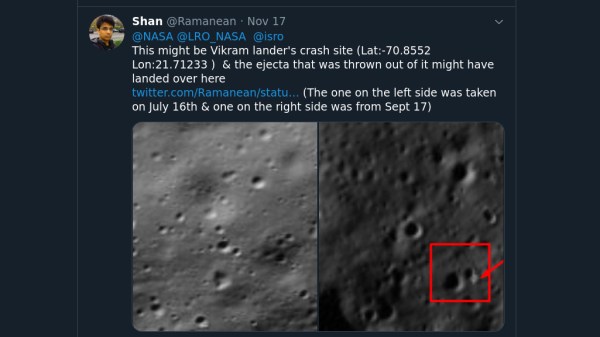
What does Pluto — not the dog, but the non-Planet — have in common with the Vikram lunar lander launched by India? Both were found by making very tiny comparisons to photographs. You’d think landing something on the moon would be old hat by now, but it turns out only three countries have managed to do it. The Chandrayaan-2 mission would have made India the fourth country. But two miles above the surface, the craft left its planned trajectory and went radio silent.

India claimed it knew where the lander crashed but never revealed any pictures or actual coordinates. NASA’s Lunar Reconnaissance Orbiter took pictures several times of the landing area but didn’t see the expected scar like the one left by the doomed Israeli lander when it crashed in April. A lot of people started looking at the NASA pictures and one Indian computer programmer and mechanical engineer, Shanmuga Subramanian, seems to have been successful.

Continue reading “Chandrayaan-2 Found By Citizen Scientist; Reminds Us Of Pluto Discovery”