A Laser Audio Transmitter

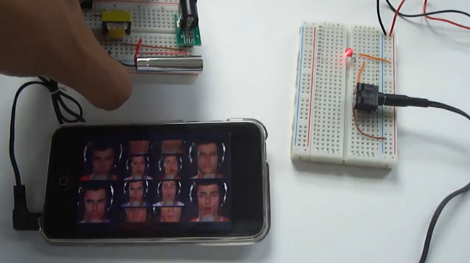
Here’s a way of transmitting audio that makes it virtually impossible for someone else to listen in. Instead of sending radio waves bouncing all over creation, this uses the focused light of a laser to transmit audio. In the image above you can see the silver cylinder which houses the laser diode. It is focusing the beam on a light dependent resistor to the right which looks almost like a red LED due to the intensity of the light.

The simplicity of this circuit is fascinating. On the receiving end there is no more than the LDR, a 1.5V power source, and a headphone jack. The transmitter is not much more complicated than that. It includes an audio output transformer which boosts the resistance of the audio signal. This increase in resistance ensures that the laser diode modulates enough to affect the LDR on the receiving end. The transmitter uses a 3.3V supply. Check out the video after the break to hear the high quality of audio coming through the setup.

Once you’re done playing around with the transmitter you might try turning the laser into a remote control for your stereo.
Continue reading “A Laser Audio Transmitter”

Turn Your Old Bluetooth Headphones Into A DIY Car Audio Receiver

wireless-car-audio

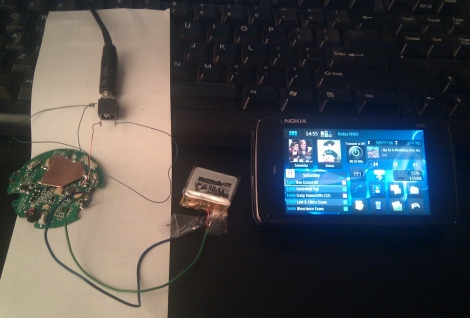
[Tim] drives a 1995 Mitsubishi TS Magna, which is equipped with a less than stellar accessory package he lovingly calls a “poverty pack”. He outfitted his ride with an aftermarket head unit that can support the Bluetooth A2DP profile, provided he buys the ridiculously overpriced kit sold by Pioneer. Reluctant to shell out more money on an audio kit than his car is worth, he whipped up his own Bluetooth kit for far less than Pioneer’s asking price.

He had a set of Nokia Bluetooth headphones that he was willing to part with, so he disassembled them to see how he might interface with his car stereo. Connecting the headset to his head unit was a relatively easy task, but he had to work a bit harder to get his Bluetooth receiver powered properly.

After both undervolting and then nearly cooking his wireless audio rig, [Tim] managed to get things operating to his liking. He says that the audio is a touch quieter than he would like at the moment, so he will likely be revising his design in the near future. For now however, he can stream tunes from his phone while he cruises around town.

Toorcamp: Bliplace 2.0

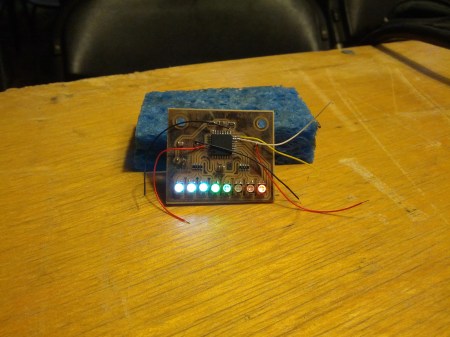
We’ve shown [Tanjent]’s Bliplace 1.0 in the past. He handed out a few hundred of the open source audio toys at Burning Man. At Toorcamp, he’s been showing off an improved 2.0 version of the project. This one has a more powerful microcontroller and many more RGB LEDs.

The device uses the ATMega328 and an electret microphone to sample ambient noise. It the processes the sound into a light pattern which is displayed on the line of RGB LEDs. The demo that I saw showed the LEDs synchronized to bass frequencies, which it could pick up at a range from the large sub-woofers at Toorcamp. It’s powered by a CR2032 coin cell battery, which means it can be worn as a neat audio toy.

This prototype version was etched in his kitchen but [Tanjent] is working on making a production version of the PCB. He plans to release it as a surface mount soldering kit.

Robot Servo Control Using Smartphone Audio Jack

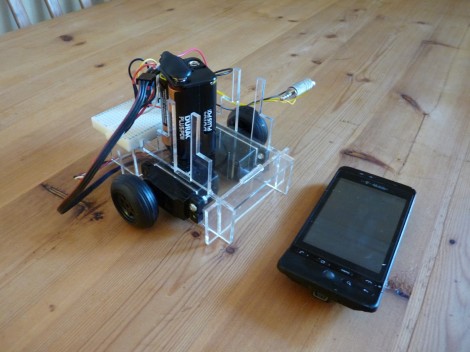
[Jim] has an old Android phone he’d like to use as a Robot brain. It’s got a lot of the things you’d want in a robot platform; WiFi, Bluetooth, a camera, an accelerometer, etc. But he needed some way to make the mobile, mobile. What he came up with is a chassis with servos that can be controlled by the phone’s audio port.

To start his adventure he crafted a square wave audio file in Audacity and then played it back on the Android music player. By monitoring the output on an oscilloscope he found the wave was well produced, with peaks of about 1V. With that in mind he designed a circuit using two transistors to amplify the signal, thereby creating a usable input for the servo motors. Each motor has one of these circuits connected to it, with the left and right channels from the audio jack driving them separately. In the clip after the break you can see he even wrote a simple Android app to extend the idea to a more usable level.

This is a similar technique as used by the recon robot we saw about a year ago.

Continue reading “Robot Servo Control Using Smartphone Audio Jack”

Adding Bluetooth Audio Playback To A Toyota Matrix

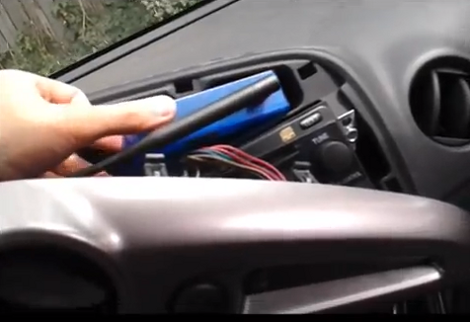
In this project [Ryan] shows how he added Bluetooth audio to the stock stereo of his Toyota Matrix. The work he did with his add-on hardware is quite good. And the installation was surprisingly easy. For example, the dashboard bezel which is hanging in the foreground of this picture simply pulls off without the need for any tools. Also, the CD changer input for the stereo is what he uses to patch into the system. It just happened to have a 0.1″ pin header so finding a connector that would work wasn’t a problem.

As for the add-on hardware, he built his own circuit board around an ATmega168 microcontroller and Bluegiga WT32 Bluetooth module. To connect to the car’s data system he went with an RS485 driver chip. It’s not quite the right part but it works well enough for his purposes. So far he can get audio playback working and plans to add support for hands free phone calls and displaying audio track information. Hey, maybe he’ll even add some extra shake-based automation; who knows?

Get a look at the install in the clip after the break.

Continue reading “Adding Bluetooth Audio Playback To A Toyota Matrix”

Stiltwalker Beat Audio ReCAPTCHA

This talk from the 2012 LayerOne conference outlines how the team build Stiltwalker, a package that could beat audio reCAPTCHA. We’re all familiar with the obscured images of words that need to be typed in order to confirm that you’re human (in fact, there’s a cat and mouse game to crack that visual version). But you may not have noticed the option to have words read to you. That secondary option is where the toils of Stiltwalker were aimed, and at the time the team achieved 99% accurracy. We’d like to remind readers that audio is important as visual-only confirmations are a bane of visually impaired users.

This is all past-tense. In fact, about an hour before the talk (embedded after the break) Google upgraded the system, making it much more complex and breaking what these guys had accomplished. But it’s still really fun to hear about their exploit. There were only 58 words used in the system. The team found out that there’s a way to exploit the entry of those word, misspelling them just enough so that they would validate as any of up to three different words. Machine learning was used to improve the accuracy when parsing the audio, but it still required tens of thousands of human verifications before it was reliably running on its own.

Continue reading “Stiltwalker Beat Audio ReCAPTCHA”

DIY Spring And Plate Reverb

If you’re running your own recording studio, you’re going to need a lot of gear that seems excessively esoteric to the non-musically inclined. A rack full of synth gear looks just like any other cabinet of technology you would find in a server room. Electronic music is, for the most part, very utilitarian looking, but there are a few pieces that add a very nice aesthetic touch to any studio. [Peter] made two great looking pieces of hardware – both reverbs – that significantly add to the decor of his studio. As a bonus, they also sound really good.

[Peter]’s spring reverb (Dutch, Google translate) works just the same as any other spring reverb; a speaker puts some music into a slightly stretched spring, and this sound is picked up by another transducer at the opposite end. For this build, [Peter] used a Slinky and a piece of PVC pipe left over from a bathroom remodel. Adding a few jacks, pots, and a preamp, [Peter] had a very nice and extremely large spring reverb.

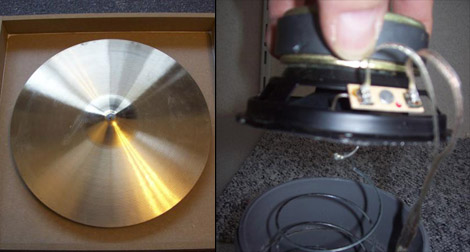
The plate reverb (translation) is also a staple of pro recording studios around the globe. This reverb is somewhat similar to a spring reverb, except the spring is replaced with a tuned metal plate. [Peter] used a cymbal from a drum set for this piece of kit. Two speakers are attached to the back of the cymbal, one feeds a sound into the cymbal, the other speaker picks up those sounds and sends it to the mixing board.

There’s a lot of really cool musical DIY projects over on [Peter]’s site, along with a few audio demos for each of his DIY projects. We’ve included his reverb demos after the break, feel free to give those a listen.

Thanks go to [geekabit] for sending this one in.

Continue reading “DIY Spring And Plate Reverb”