AND!XOR’s DEF CON 29 Electronic Badge Is An Assembly Puzzle

For years I’ve looked forward to seeing each new unofficial hardware badge that comes out of the #Badgelife powerhouse known as AND!XOR. A mix of new and interesting components, alternate-reality game, and memes, you never know what they’re going to throw down.

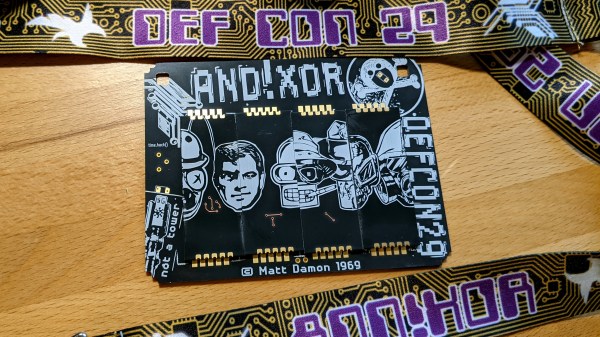
A bubble pack landed on my desk on Thursday with the newest offering, the AND!XOR electronic badge built for DEF CON 29, happening this weekend as a hybrid in-person and online conference. While each previous year upped the ante on complexity and manufacturing magic tricks, it’s no surprise considering the uncertainty of both the global pandemic and global chip shortage that they took a different tack. What we have here is a badge hacking puzzle that challenges you to just figure out how to put the thing together!

Continue reading “AND!XOR’s DEF CON 29 Electronic Badge Is An Assembly Puzzle”

Joker Monitor Keeps An Eye On Hazardous Gas Levels

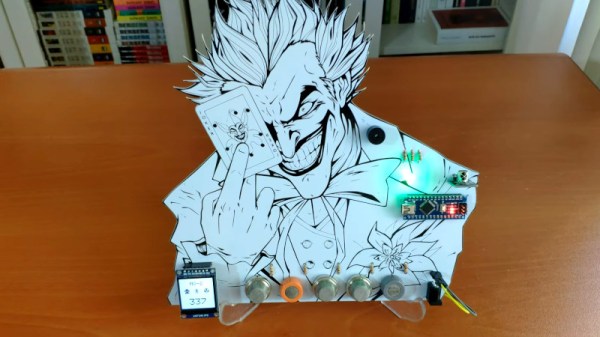
The Joker is a popular character in the Batman franchise, and at times uses poisonous gases as part of his criminal repertoire. That inspired this fun project by [kutluhan_aktar], which aims to monitor the level of harmful gases in the air.

The project doesn’t use just one gas sensor, but several! It packs the MQ-2, MQ-3, MQ-4, MQ-6, and MQ-9. This gives it sensitivity to a huge variety of combustible gases, as well as detecting carbon monoxide. The sensors are read by an Arduino Nano, which displays results on an RGB LED as well as an attached IPS screen.

Readings from each sensor can be selected by using an infrared remote. In order to best work as a safety device, however, it could be more useful to have the Arduino automatically cycle through each sensor, checking them periodically and raising an alarm in the event of a high reading.

The whole project is built on a custom PCB which is artfully constructed with an image of the Joker himself. It helps to make the project a bit more of a display piece, and speaks to the aesthetic skills of its creator.

It’s a fun build, and one that could be mighty capable with a few software tweaks. With that said, if you’re working in a space with real hazards from combustible gases, it may be worth investing in some properly rated safety equipment rather than relying on an Arduino project.

Incidentally, if you’d like to improve the results from using such gas sensors, we’ve looked at that in the past. Video after the break.

Continue reading “Joker Monitor Keeps An Eye On Hazardous Gas Levels”

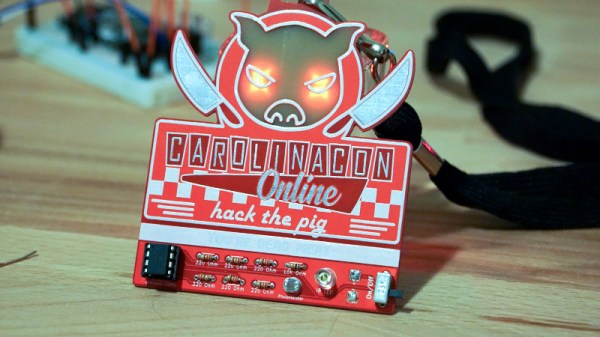
Hiding Behind The Silkscreen: The Carolinacon 2021 Badge Has A Secret

The pandemic may have taken away many of our real-world events, but as they’ve gone online their badge teams have often carried on regardless. One of these comes from Carolinacon, and it’s decided to eschew the bleeding edge of electronic wizardry and instead push slightly at the boundaries of PCB art. It contains a hidden message in a copper layer behind a band of white silkscreen, which is revealed by a set of LEDs on the reverse of the board shining through the translucent FR4.

Electronics-wise it’s a pretty simple design, sporting only an ATtiny microcontroller and a photoresistor alongside the LEDs, and with the secret message being triggered when the badge is placed in the dark. The conference’s pig logo is eye-catching, but it has no pretences towards being a dev board or similar. The technique of LEDs behind copper and silkscreen is an interesting one though, and something that we think could bear more investigation in future designs. It’s pleasing to see that there are still new avenues to be taken in the world of PCB-based art.

This isn’t the first time this event has had an eye-catching badge, we’ve covered one of their previous offerings.

WebSerial: Browser Based Development For Your Boards And Electronic Badges

For years, one of the most accessible and simplest-to-implement methods of talking to a dev board has been to give it a serial port. Almost everything has serial in some form, so all that’s needed is to fire up a terminal. But even with that simplicity, there are still moments when the end user might find a terminal interface a little daunting. Think of a board aimed at kids for example, or an event badge which must be accessible to as many people as possible.

We’ve seen a very convenient solution to this problem in the form of WebUSB, but for devices without the appropriate USB hardware there’s WebSerial, an in-browser API for communicating with serial ports including USB-to-serial chips. [Tom Clement] argues that this could serve as the way forward for event badges. Best of all it can be a retro-fit to enable in-browser development for older badges or dev boards with a serial port.

The boards on which he demonstrates the technique are the series of event badges running the badge.team firmware platform including his own i-Pane from CampZone 2019 and going right back to the SHA 2017 badge, but there’s no reason why the same technique can’t be extended to other boards.

There’s a snag with all this though, sadly only browsers in the Chrome family support it at the time of writing, with no plans from Mozilla and apple, and silence from Microsoft. So things look likely to stay that way. It is however inevitable that in time there will be commercial products taking advantage of it via the use of cheap USB to serial chips, so perhaps the case to incorporate it will make itself.

Header: Mobius, Public domain.

A Four-Year-Old Event Badge Makes An Environmental Sensor

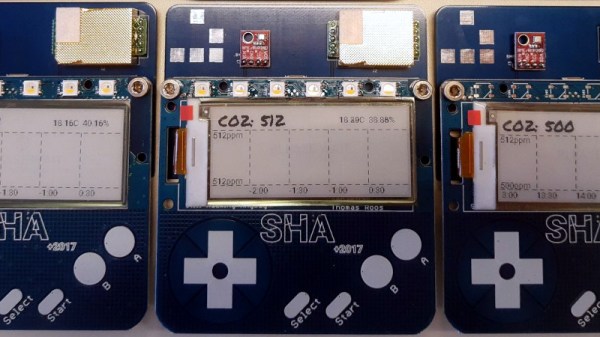
By now we’re all used to the requirements imposed by the pandemic, of social distancing and wearing masks indoors. But as [polyfloyd] and the rest of the board at Bitlair hackerspace in Amersfoort in the Netherlands were concerned, there are still risk factors to consider when inside a building.  Without fresh air the concentration of virus-bearing droplets can increase, and the best way they could think of to monitor this was to install a set of CO2 sensors. To run them they didn’t need to buy any new hardware, instead they turned to a set of event badges, from 2017s SHA hacker camp.

This badge sported an ESP32 module with an e-ink screen, and of most interest for this project it still has a supported software platform and comes with a handy expansion connector on the rear. The commonly-available MH-Z19 infra-red CO2 sensor and BME280 humidity sensor fit on a PCB that follows the shape of the badge with a protrusion at the top on which they appear as an integrated unit. Processing those readings is a MicroPython badge app that issues warnings via MQTT and plots a CO2 graph on the screen. Everything is available, both the hardware in a GitHub repository and the software as a badge.team app.

We applaud anyone who makes use of an event badge for a project, and especially so for using one years after the event. The SHA badge and its descendants are uniquely suited to this through their well-supported platform, so if you have one in a drawer we’d urge you to pull it out and give it a try.

Bringing Full Colour PCB Art To Production

One of the Holy Grails in the world of electronic badges has been full-colour PCB art as a logical progression from the limited palette of traditional PCB artwork. In the progression towards achieving this goal there have been a variety of techniques applied, and it’s become an expensive commercial possibility rather than an unachievable dream. Has it become practical for mere mortals then? [Tom Clement] has put together a write-up of his progression towards achieving full-colour PCB artwork on a limited production run , and it makes for a fascinating read.

The board in question is the Pixel badge, an improved commercial version of the CampZone 2019 I-Pane badge we reviewed last year. It’s a very bright large multicolour LED matrix that has caught the eye of campgoers at events ever since the original, and has generated enough demand for a new production run. As well as a few electronic enhancements it replaces the original’s dithered monochrome silkscreen rear art with a full-colour design, and it is that with which the write-up is concerned.

It starts with UV printing, and goes through the various iterations of the process until a satisfactory result is achieved. We learn about the effect of reflow temperatures on UV printing inks, it seems that white ink discolours with temperature and the inventive solution is to transfer all the whites to the PCB silkscreen layer. He closes with a discourse on alignment, and we start to appreciate the achievement behind producing this badge. A colour print isn’t necessary for the Pixel’s eye-searing light show, but the point of badges is as much to show off the cutting edge of the art.

As the regular Hackaday reader will know, colour PCB art is a long-time topic of interest here at Hackaday.

When Only The Tiniest Of Violins Will Do

Playing the tiniest of violins may be a phrase to encapsulate the complete lack of sympathy as someone unpleasant receives their just deserts, but have any of you ever considered how such a feat might be achieved? Unless you’re an unusually talented virtuoso with the bow, it’s difficult to believe that such a small instrument could be played with ease, even if it were to be available in the first place.

Happily a solution is at hand to all those minuscule stringed instrument woes, courtesy of [Alexandra Covor], who has created a miniature PCB violin that is after a fashion playable. It may not be a conventional instrument with a horsehair bow and traditional sounding mechanism, but its electronic voice should still deliver enough to delight.

At the heart of the violin-shaped PCB is an ATtiny85 and a piezoelectric buzzer, and just where you might expect them are a set of strings made from wire attached to the PCB. The instrument can play stored tunes, but since the strings are hooked up to an analogue input on the microcontroller, it can be played as a touch instrument. Finally a pair of LEDs behind the translucent FR4-only F-holes complete the look. It’s fair to say that Itzhak Perlman and his ilk are safe from challengers bearing this instrument, but it’s still an eye-catching piece of PCB art.

This isn’t the first tiny violin that’s been featured here, some others are much smaller.