DIY CNC Dust Collection Really Sucks!

CNCdust-main2

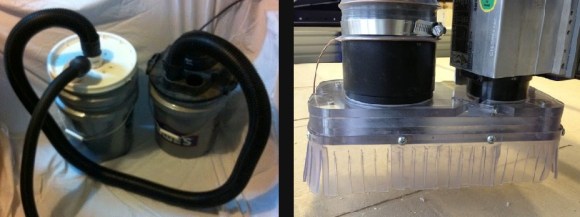
CNC Routers are great. If you’ve ever used one you know this but you also know that they will cover the machine and everything around it with a layer of dust. It is certainly possible to use a shop vac to suck up the dust coming from the router, however, the only problem with that is the shop vac’s filter will clog with dust and lose suction, defeating the intent of your vac system.

CNCdust-assembled2[Mike Douglas] was ready to step up his CNC game and decided to make his own dust separator. This design is extremely simple and only uses a couple 5 gallon buckets, a few PVC fittings and pieces of wood. To keep the cost down and the style up, the accompanying ‘shop-vac’ is also made from 5 gallon bucket with a vacuum lid. The project is well documented so head over to his site and check out the build process.
black

Continue reading “DIY CNC Dust Collection Really Sucks!”

A 3-Axis Paper Cutting Mini Laser

LaserCutter

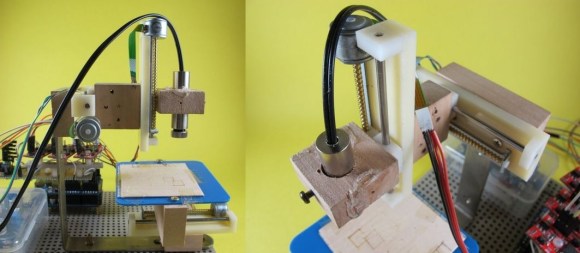
Laser are awesome, and so are projects that use lasers. A recent Instructable by [kokpat] gives an overview of how to create a fully functional laser paper cutter using CDROM stepper motors and an Arduino.

What is special about this build, is that it showcases how easy it can be to build a 3-axis mechanical system used for laser cutters, CNC machines, and 3D printers. Using a stepper stage that consist of a motor screw with a nut slider based carriage, the mechanical system can be put together quite easily and cost effectively. Luckily, from an electronics and software perspective, everything is quite standardized with the proliferation of the RepRap and similar machines. Simply pick any three stepper drivers, find the most pertinent firmware, and voilà! You’re done! Well, almost. Don’t forget a 100mW violet laser!

We have seen a ton of really cool laser cutters before, but this has to be one of the cheapest. See the laser cutter in action after the break.

Continue reading “A 3-Axis Paper Cutting Mini Laser”

DAGU: The Standalone CNC Controller

CNC

In terms of user interfaces, 3D printers are far, far beyond the usual CNC machine. It’s difficult to find a new, commercial 3D printer without some sort of display, set of buttons, and an SD card slot for loading G Code and running a printer. For CNC routers, though, you’re usually dealing with a parallel port interface connected to an old computer.

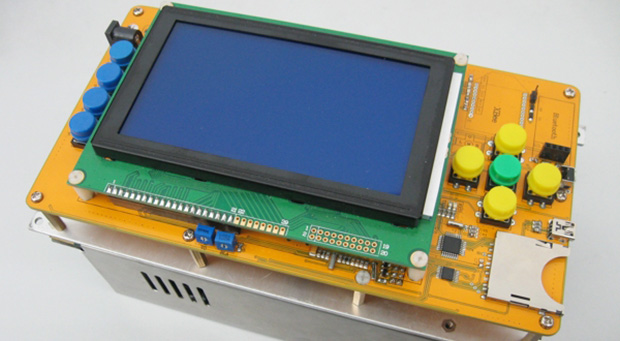
DAGU hopes to change that by providing a huge 240×128 LCD display, a bunch of buttons, and an SD card slot for loading G Code directly from an SD card. This is a fully functional controller, able to deliver 3.5 A to each stepper motor winding.

Right now DAGU is in the prototype stage, but already there are some really interesting features: the interface allows for a basic preview of the job before it begins, and should be somewhat affordable. At least as cheap as using an old computer for CNC control, anyway.

Video demo of the use and operation of DAGU below.

Continue reading “DAGU: The Standalone CNC Controller”

Chinese 3020 CNC Machine Gets Some Upgrades

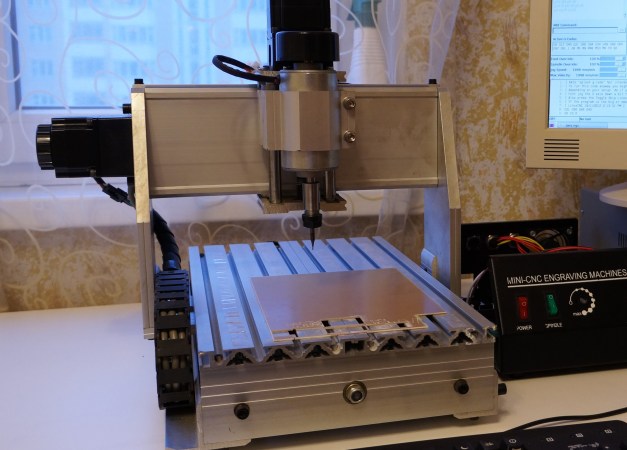
If you frequent any CNC Forums out on the ‘web you’ll find that these Chinese 3020 CNC routers are generally well received. It is also common opinion that the control electronics leave something to be desired. [Peter]’s feelings were no different. He set out to make some improvements to his machine’s electronics such as fixing a failed power supply and adding PWM spindle control and limit switches.

[Peter] determined that the transformer used in the power supply was putting out more voltage from the secondary coil than the rest of the components could handle. Instead of replacing the transformer with another transformer, two switch mode power supplies were purchased. One powers the spindle and the other is for the stepper motors. So he wasn’t guessing at the required amperage output of the power supplies, [Peter] measured the in-operation current draw for both the steppers and spindle motor.

Continue reading “Chinese 3020 CNC Machine Gets Some Upgrades”

4 Axis Delta Router Says Hello World

deltaRouter

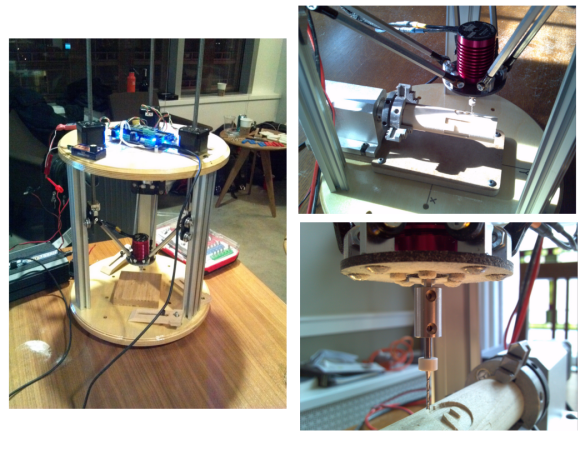
[Bart] stood upon the shoulders of the delta 3D printer giants and created this 4 axis delta router. The router was originally created for ORD Camp, an invite only hackers gathering. Each year he creates a new thing with one main purpose: to spark conversation. In his own words “Practicality and suitability are way down the list, so go ahead and snark away. If you do, you are missing the point.”

[Bart] did things a bit differently with his delta. For motors, he went with non captive steppers. “Non captive” means that rather than a shaft, the motor has a hollow threaded nut which rotates. A lead screw (usually with an acme thread) is passed through this nut. As the motor’s nut turns, the screw is pushed or pulled through the motor, creating a linear actuator. The only major downside is that a non captive stepper motor can’t be adjusted by hand. The screw doesn’t turn and neither do any external parts of the motor. For structure, the router uses MakerSlide and v-grove wheels. The spindle is a simple brushless hobby motor and 30 amp speed control. Rather than the outrunner motors we’ve seen lately, [Bart] wisely chose an inrunner motor normally used on R/C cars. Inrunners generally have less torque than their outrunner counterparts, but they make up for this in RPM. [Bart’s] motor is capable of 30,000 RPM, which is plenty for spindle duty. We think the motor bearings will probably need an upgrade, as the original motor bearings weren’t designed for side loads. For a controller, [Bart] utilized an  Azteeg X3 running Repetier.

The router made a great showing at camp, and [Bart] decided it needed a 4th axis. He sourced a rotary axis from eBay. To keep the software simple, he connected the rotary axis to the extruder outputs on his controller. He was then able to hack the mach3 wrapped rotary post processor to output extruder commands. The results look great. [Bart] says the system definitely needs a tailstock, and we agree. We’re looking forward to the next update on this machine!

Continue reading “4 Axis Delta Router Says Hello World”

Cheap, Resourceful DIY Mini CNC Router/Mill Contraption

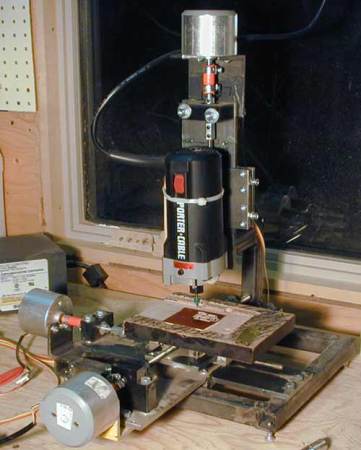
Few Hackaday Readers would disagree with the classic phrase: Necessity is the mother of invention. That statement is certainly no exaggeration when it comes to this mini 3-axis CNC Machine. The builder, [Jonathan], needed a way to prototype circuit boards that he designed. And although he admittedly doesn’t use it as much as he intended, the journey is one of invention and problem solving.

[Jonathan] started from the ground up with his own design. His first machine was a moving gantry style (work piece doesn’t move) and ended up not performing to his expectations. The main problem was alignment of the axis rails. Not becoming discouraged, [Jonathan] started on version 2. This time around the work piece would move in the X and Y directions like a conventional vertical milling machine. The Porter-Cable laminate trimmer would move up and down for the Z axis. It is clear that the frame is built specifically for this project. Although not the prettiest, the frame is completely functional and satisfactorily stiff for what it needs to do.

Continue reading “Cheap, Resourceful DIY Mini CNC Router/Mill Contraption”

This SMD Reflow Hot Air Gun Hangs Around Your Workbench

smd_reflow_hot_air_gun_nc_80

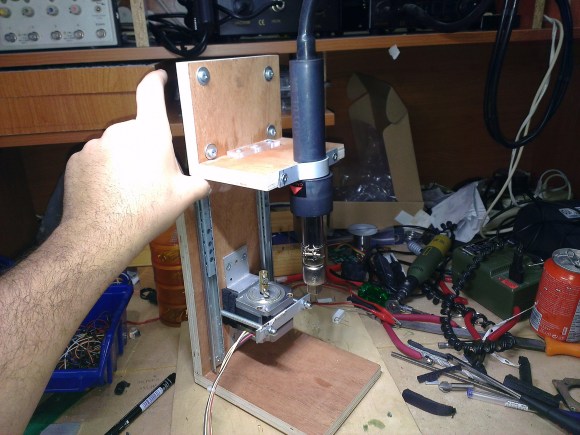
Has reflowing surface mount components got you down? [Giorgos] is currently working on a project that will lift your spirits…. well at least your hot air gun. Tired of manually holding his heat gun in one hand and IR thermometer in the other, [Giorgos] set out to create a device to alleviate just that. Although not completed yet, it appears the machine’s intent is to hold the heat gun at an appropriate height above the work piece in order to achieve the correct reflow temperature. He doesn’t say how the height of the hot air gun will be controlled. We’d like to see a microcontroller adjust the height of the hot air gun depending on the temperature of the component to be reflowed. [Giorgos] gives an extremely detailed account of his build process. Make sure to check out all four pages of the project post!

We’ve seen a lot of interesting work from [Giorgos] over the years like this capacitive touch-pad entry system.

[via Dangerous Prototypes]