PlayStation 3 Controller Made Fully Remappable

[Hazer] managed to take a PlayStation 3 SixAxis controller and modify it so that all of the buttons can be remapped in hardware. Aside from this being really cool, he had a good reason for doing it. Regular readers should remember the feature regarding [Chuck Bittner’s] internet petition calling for button mapping as a feature in all games. As the industry still hasn’t taken up the torch in this area, [Hazer] developed this mod for [Chuck] to use and has released it for any others out there who wish to give it a try.

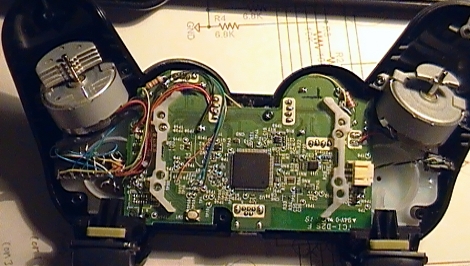
The hardware alterations are pretty hardcore. On the left of the image, just below the rumble motor, a DIP microcontroller is nestled dead-bug style. This is a PIC 18F14K50. It’s running a bootloader, and has its own USB port on the opposite side of the controller. By cutting traces and soldering to vias, this chip intercepts button presses and shoots them off to the controller’s processor based on alternative mapping stored in EEPROM. There’s a helper app that lets you plug the controller into a computer to specify what each button does, including features like toggle for the buttons. Check out [Chuck’s] thoughts on the hardware in the video after the break.

Continue reading “PlayStation 3 Controller Made Fully Remappable”
SNES Gamepad Coversion To USB

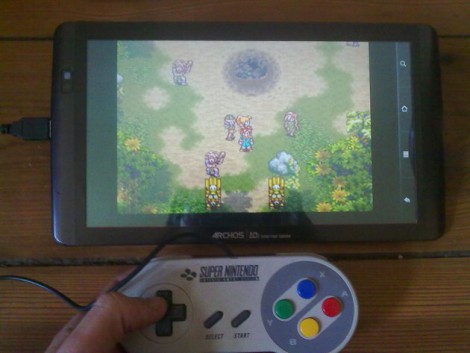
[Kekszumquadrat] wanted to use a classic controller to play emulator games on his Android tablet so he set out to convert an SNES gamepad to connect via USB. He found an old USB keyboard at a yard sale for about 3 Euros. He knew that the emulator he prefers has the option of remapping all the inputs to keyboard keys which means a USB keyboard has all of the electronics he would need to pull this off.

Once he had separated the keyboard circuitry from the case [Kekszumquadrat] plugged it into his Linux box and used Xev to establish how the keyboard matrix is set up. Xev is a common package that opens up an active window on the X desktop. When run from command line, any events that happen to the window will be echoed along with verbose data about that event. When it comes to keypresses, you’ll get the keycode you need. He simply shorted columns and rows until he found the desired mapping, then it was on to soldering.

The SNES controllers are very simple devices. As we’ve seen with previous projects, they use a serial-to-parallel shift register to gather button data and send it to the console. [Kekszumquadrat] simply soldered between button traces and keyboard matrix contacts. Once he finished, the keyboard parts were tucked inside of the controller case and he’s left with a USB controller that appears to be unaltered.

Using Classic Game Controllers With A Wii

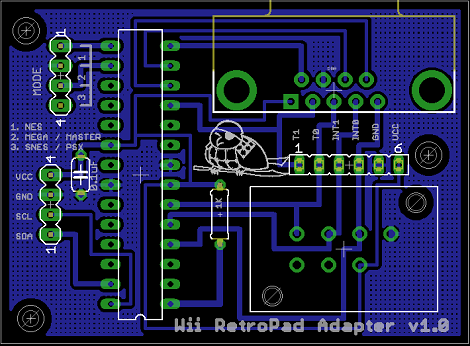
[Bruno]’s Wii RetroPad Adapter was sent into the tip line, and we’re loving the possibility of using Playstation 2, Genesis, NES and SNES controllers with our Wii.

While there are commercial solutions that connect an NES or SNES controller to a Wii, everything connects to the GameCube port and there is no adapter for Sega or Playstation controllers. For his build, [Bruno] used an ATmega168 to read data from the classic controllers and translate that to the Wiimote I2C bus. Think of it as a new classic controller with the same form factor your 8-year-old self knew and loved.

The schematic for the build is very simple and [Bruno] has all the software out in the open. Even the PCB is single sided and looks like it would be a great candidate for a homebrew PCB. There’s no indication [Bruno] is trying to monetize his creation, so he’s either doing right, or so very wrong. Check out the Dualshock 2/Mario 3 demo of this board after the break.

Continue reading “Using Classic Game Controllers With A Wii”

Broken Xbox 360 Converted Into An Arcade Controller

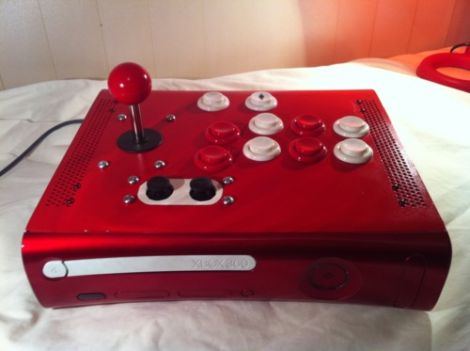
xbox_360_arcade_controller

Like many Xbox 360s out there, [Aaron’s] console succumbed to the dreaded three red lights of death. Since it seemed to be unrepairable, there wasn’t a lot that could be done with it other than throw it out. Rather than be wasteful however, [Aaron] thought of a great way to reuse the console’s outer shell.

He’s a big fan of fighting games, and as everyone knows, this genre is best played with an arcade-style controller. The 360’s shell seemed to be just about the right size, so he gutted it and got busy constructing his own arcade controller. With the console cleared out, he installed all of his arcade bits, wiring them to a stripped third-party Xbox controller.

He installed a four port USB hub to the front of the console, enabling use of the 360’s USB ports, and rewired the power button to trigger the Xbox Guide button. A shiny coat of paint later, and he was ready to play.

Keep reading to see a short video of [Aaron’s] arcade stick in action, and check out the picture gallery he put together of the controller’s construction.

Continue reading “Broken Xbox 360 Converted Into An Arcade Controller”

Bass Hero Combines Guitar Hero With Dance Dance Revolution


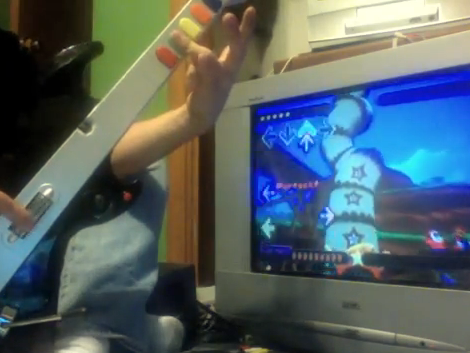
Standing up to play Dance Dance Revolution type games is sooooo much work. Thankfully, [Jebadiah0001] is taking the strenuous exercise component out of the game by altering a guitar controller to play dancing games.

He’s calling it Bass Hero because the DDR games only use four inputs, reducing the guitar controller to four string buttons like an electric bass would have. His implementation uses a GameCube controller to connect to the console. He took it apart to get at the button connections. Each string button on the guitar is connected on one side to a button on the GC controller, the other side is a common connection. But instead of pulling those straight to ground, he routes that signal through the strumming actuator. This way the player can get the correct buttons ready, then strum at just the right time to complete the circuit.

It certainly makes the harder levels of DDR quite a bit easier. See for yourself in the video after the break.

Continue reading “Bass Hero Combines Guitar Hero With Dance Dance Revolution”

Driving Game Steering Wheel Controller Without The Wheel

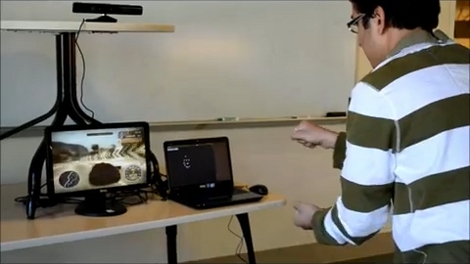
For some reason this project makes us think of the Light Cycles in Tron. You know, the bike forms around the rider after they grab onto the wand that makes up its controls? Certainly you’re not going to see a car form out of thin air, but this driving controller let you grab onto nothing to control a racing game.

You can see that it uses a Kinect to map the body of the player and convert your movements into motion control. The demo video embedded below the fold shows the calibration step, followed by the available control options. Pushing the steering wheel forward turns on the nitrous, leaning forward or back accelerates and brakes, and a few arm signals let you navigate the game menus.

This works by mapping gestures to keystrokes. [Rajarshi Roy] tells us that there’s a very raw code package available in their repository but the plan is to clean it up this weekend. They will also work on a Wiki, documentation, and a tutorial on teaching the software new gestures.

We just don’t know what we like better, seeing the kinect extended as a gaming controller like this one, or using it in robotics like that quadcopter.

Continue reading “Driving Game Steering Wheel Controller Without The Wheel”

Building A Brushless Motor Controller

brushless_motor_controller

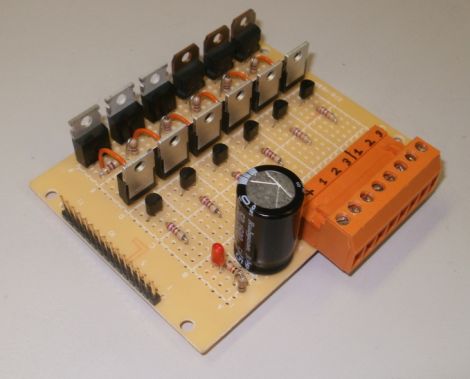
Brushless motors and the way in which they are controlled can be a bit of an enigma to those just starting out in hobby electronics. [Andrew] from spingarage thought it would be helpful to put together a quick tutorial showing how he built a simple brushless motor controller in about a day’s time. He constructs everything on protoboard from components he acquired at RadioShack in order to demonstrate the ease of sourcing parts and building a brushless motor driver.

While he skips most of the theory behind brushless motor control itself, he does touch on the signaling these motors require for movement as well as how motor position is determined. Specifically, he expands on how half-bridges can be used to create the sine wave signaling required by a single motor input, as well as how three of these can be combined to drive a brushless motor.

The post is the first in a series of posts about brushless motors, so we should see some code examples and some practical applications in the near future.