Nixie-display Brings More Wiring Madness

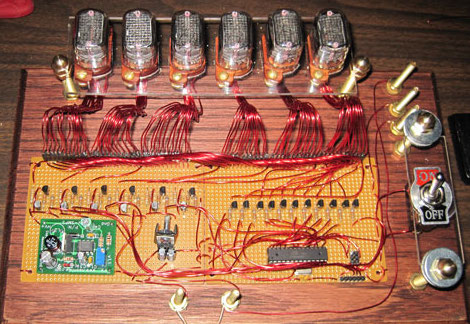
[Tim Anderson] whipped up this nixie tube display using epoxy-coated wires. He’s certainly giving the wire-wrapped LED display a run for its money. He ground the epoxy off the end of each wire using a Dremel before soldering them. We thought you could solder right through the epoxy but maybe not. Was this easier than wire wrapping would have been? We’d bet that because of the voltages wire wrapping wasn’t an option here. That board on the left is the 180V power supply for the tubes with an AVR chip running the Arduino bootloader to the right. After the break there’s a brief demo of data being pulled down over a serial connection. [Tim] also has some plans to add an atomic clock module to this setup sometime down the road.
BAMF2010: DIY Electroluminescent Displays

[youtube=http://www.youtube.com/watch?v=jPclj5lbz48]

In this video from Maker Faire, [Jon Beck] of CLUE — the Columbia Laboratory for Unconventional Electronics — demonstrates the unexpected ease of creating custom electroluminescent (EL) displays using materials from DuPont and common t-shirt screen printing tools. Eagle-eyed reader [ithon] recognized the Hack a Day logo among the custom shapes, which escaped our notice at the time. Sorry, Jon! Very cool project, even if the setup is a bit steep. You’ll find links to materials at the project site.

If the interviewer seems especially sharp, that’s because it’s none other than [Jeri “Circuit Girl” Ellsworth], who makes transistors from scratch and designed the C64 DTV. We’re not worthy!

Illuminated Moveable Type

[vimeo=http://vimeo.com/10437744]

[Rob Stewart] put in a lot of time and built this lighted display at great expense. It displays four letter words using a word association algorithm to pick the next term to show. What interests us is the motorized display. It is made up of fluorescent tubes but they’re not fixed in place. Each can be rotated, as well as moved along a linear path to form any letter in the alphabet. Check out [Rob’s] build logs for the details on how he pulled it all together.

[Thanks Hugo via Engadget and Switched]

RGB Display Development

[SeBsZ] tipped us off that he’s working on a display using RGB LEDs. He’s etched some nice surface mount controller boards to carry the ATmega8 microcontroller and NXP PCA9635 drivers. This setup uses the I2C bus to address each expansion board of 5 LED modules. Theoretically this hardware would allow for 638 RGB modules but because of power and refresh rate issues he’s set his sights on reaching somewhere between 100-125, a total of about 25 expansion boards.

There’s not a ton to show off yet. But we expect big things from the project. Partly because one of his goals is to generate a display that can be rolled up and easily moved, and partly because his large-scale light bulb displays are so impressive. Take a look at the video of his 60-bulb unit after the break.

Continue reading “RGB Display Development”

Record Player Display Sans POV

At first glance we thought this record player had been modified to serve as a persistence of vision device. The device looks very much like an unmodified turntable but it has four tracks worth of display space in it. The messages are actually glowing and don’t depend on a POV effect. Instead, the table has been coated with phosphorescent paint that will glow after being exposed to bright light. The needle has been replaced by a small PCB with downward facing LEDs on it. A microcontroller pulses the lights to expose the paint in patterns that make up the messages. This is the same concept we saw with the Ghost Matrix but this iteration is silent, and the control circuitry is less apparent.

The video after the break is a must-watch. The 60 character long messages are beautiful to watch rotate into the display. Unlike a POV display, ambient light will greatly interfere with the effectiveness of this method. That being said, what a wonderful party decoration this would be if mounted on a wall in a rather dark room.

Continue reading “Record Player Display Sans POV”

72 LED Persistence Of Vision Globe

HaD-pov-globe

[Ben] told us about his POV globe yesterday. We took a look and saw just one photo and the code with no real explanation of his project. He certainly set to work over night and now we see all the goodies we look for in a great build log. He even threw the Hackaday logo up for our enjoyment. His build is well executed and he found some creative ways around the common problems in these projects. We take a closer look after the break. Continue reading “72 LED Persistence Of Vision Globe”

SMD LED Matrix

3573544803_03000843fc

Everyone loves a good LED matrix hack, and we’ve seen our fair share, but never a 16 by 24 hand soldered SMD one. [bear24rw] and his team needed a project reflecting the interests of one of his classes, being an EE major, an LED matrix was just the ticket. Based on this instructable, he was able to cobble together a driver board; the code however was unacceptable, and he came up with a double buffer array solution. You can grab the eagle file and source code here, while you’re at it check out a quick video after the break.

Continue reading “SMD LED Matrix”