Swapping Speedometer Needle For LEDs

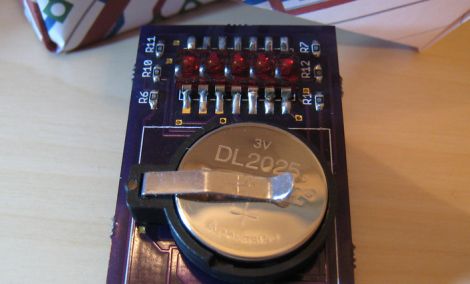
[Ah2002] didn’t like the shaky needle in his car’s speedometer so he replaced it with a ring of LEDs. The old speedometer had a cable which rotated along with the gearbox for mechanical speed measurement. By connecting the stepper motor from a printer instead of this cable, a voltage is generated that fluctuates with the speed of the car. The fluctuation is linear so a given voltage measurement can be directly associated with one particular speed. By using a trimpot to calibrate the input voltage, [Ah2002] connected the signal to an LM3914 dot/bar display driver. These can be chained together, lighting a string of outputs based on the single voltage input. The result is the board seen above, which was covered with a printed paper graph in the final assembly.

Judging from the video after the break, we’d bet there was some distracted driving during the calibration process. The driver appears to be holding the video recorder, and since a cellphone GPS was used during calibration we wonder if [Ah2002] was adjusting the trimpot, looking at the GPS, and driving all at once. It’s a fairly awesome hack, but do be careful when you’re working on something like this.

Continue reading “Swapping Speedometer Needle For LEDs”

Syyn Labs’ Glowing DNA

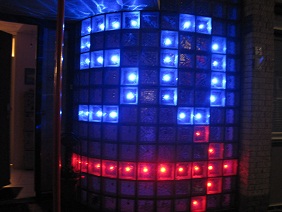
This beautiful music syncronized double helix was made by Syyn labs. Last time we saw them, they had created that amazing rube goldberg style music video for OK Go. This 100 foot long LED DNA strand took over 1000 combined man hours to build. It took 512 LEDs, 32 LED controllers, 4 Arduinos, 4 computers, over a mile of wire and a very dedicated team, which included [Eliot Phillips]. It takes input from beatmatching/VU software as well as a 32 button console or an iPad. You can catch a video of it in action after the break, and they plan on releasing a timelapse of the build in the near future.

Continue reading “Syyn Labs’ Glowing DNA”

Launchpad Takes Ultra Low Power To The Extreme

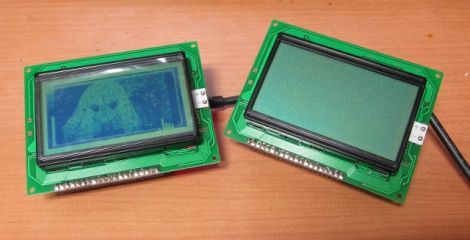
We’ve all known the MSP430s under the Launchpad are designed to be low power, but who wants to bet how long the chip can last on only 20F worth of capacitors? A couple of hours? A day at max? [Kenneth Finnegan] setup a MSP430 with supercaps to find out. To make sure the chip is actually running, [Kenneth] programmed it to count from 0 to 9 over a period of 10 seconds, and then reset. To get it ultra low power, the chip is in sleep mode most of the time, and a raw low current LCD is used to display the output. While [Kenneth] simply checks the chip every few hours to see if it’s still counting, a setup much like the Flash Destroyer, tracking a clock and then storing the current value would get a more exact time of death. Either way, it’s been over 3 weeks…and still counting. Video after the rift.

Continue reading “Launchpad Takes Ultra Low Power To The Extreme”

Motorcycle Rear-view With In-helmet Display

Want to see what’s behind you when riding your sport bike without taking your eyes off the road? They make rear view cameras for that but [Nescioqd] wanted a rear display right in his helmet (PDF). He started by mounting a rear-pointing camera on the back of the bike, powered from the 12V feed for the taillight. On the display side of things he picked up a Myvu Crystal wearable display. This is like a pair of glasses that have small LCD screens were the lenses should be. [Nescioqd] removed one lens and mounted it inside the helmet.

Since the display resides inside the helmet there is some concern about being able to see at night with a bright screen below your eyeball. [Nescioqd] actually ran into the opposite problem at first, bright sunlight makes it difficult to see the image on the LCD screen. He fixed this by picking up a dark tinted helmet visor (the easiest solution) but we’d love to see a photoresistor used to regulate the backlight level.

It would be interesting to see both screens used, with rear-view on one side and an instrument display on the other.

Gas Plasma Pinball Display

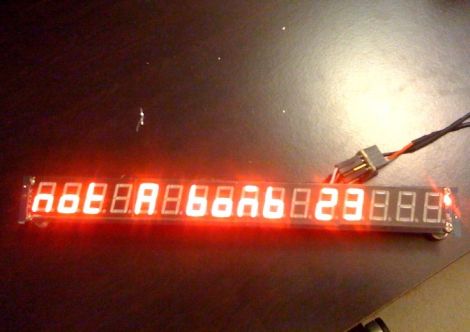
[Whoopjohn] decided to build a driver board for a display he pulled from a pinball machine. You’ve probably seen these used to scroll both score and messages using a total of sixteen 15-segment digits. We’d love to get our hands on one, and you might too but where? [Whoopjohn] notes that these were usually installed two-per machine and the driver boards were run close to their maximum ratings. That means that somewhere there’s a collection of broken machines with working displays. If you do plan to make this happen, you should be able to figure out the circuit based on this commented board layout (pdf).

PET-Gaming Computer Module

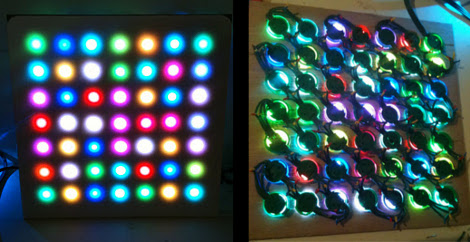
This 64×48 full color LED display goes much further than we expected at first glance. The display is actually a computer with a Zilog eZ80F91 core utilizing an FPGA for the hardware interface. Some nifty applications currently built include mostly games, but there is also visualizations, network file systems, video streaming, and even a MIDI synth.

It originally looked to be more of a console, with controllers, game pads, and cartridges, but the latter ended up not working out. What else would you do with a giant LED display?

Spin Peggy, Get 3D POV

We put a temporary ban on posting POV projects after receiving several LED spheres back in May. But we had to lift the injunction after seeing this superb Volumetric 3D POV display by [Wes Faler] and [Don Smith].

Their creative use of several readily available components adds to the alluring setup; the central elements being just a box fan and Peggy kit from EMSL. The video after the jump doesn’t really do the project justice, but if you missed it at Maker Fair Detroit and can’t make your own it’s the best you’re going to get.

Continue reading “Spin Peggy, Get 3D POV”