Hackaday Links Column Banner

Hackaday Links: October 3, 2021

It’s one thing to speculate about what’s happening with the Mars helicopter Ingenuity, but it’s another to get an insider’s view on recent flight problems. As we previously reported, Ingenuity is starting to face a significant challenge, as a seasonal atmospheric pressure drop on Mars threatens to make the already rarefied air too thin to generate useful lift. Mission controllers tested the chopper at higher rotor speeds, and while that worked, later attempts to fly using that higher speed resulted in an abort. The article, written by one of the NASA/JPL engineers, is a deep dive into the problem, which occurred when Ingenuity sensed excessive wiggle in two of the servos controlling the rotor swashplate. The thought is that accumulated wear in the servos and linkages might be causing the problem; after all, Ingenuity has made thirteen flights so far, greatly exceeding the five flights originally programmed for it. Here’s hoping they can adapt and keep the helicopter flying, but whatever they do, it’ll have to wait a few weeks until Mars completes its conjunction and pops back out from behind the Sun.

With all the attention understandably paid to the recent 20th anniversary of the 9/11 terror attacks, it’s easy to forget that barely a month after that day, a series of what appeared to be follow-on attacks started: the Anthrax Attacks. Members of Congress and media outlets were targeted via the mail with highly refined anthrax spores, leading to the deaths of five people, with dozens more injured and exposed to anthrax. IEEE Spectrum has an interesting article that goes into some of the technology that was rapidly deployed in an attempt to sanitize the mail, including electron beam and X-ray irradiation to kill any spores. The article also points out how this wasn’t the first time people were afraid of the mail; outbreaks of yellow fever in 1899 led to fumigation of the mail with sulfur, after perforating it with a wicked-looking paddle.

Attention PCB-design newbies — now’s your chance to learn the entire PCB design process from the ground up, with the guidance of industry professionals. TeachMePCB is back again this year, offering to teach you everything you need to know about properly laying out a PCB design in pretty much any EDA software you want. The course requires a two- to five-hour commitment every week for two months, after which you’ll have designed a PCB for a macropad using a Raspberry Pi Pico. The course facilitator is Mark Hughes from Royal Circuits, who did a great Hack Chat with us last year on PCB finishes. This seems like a great way to get up to speed on PCB design, so if you’re interested, act soon — 460 people are already signed up, and the deadline is October 10.

Some of us really love factory tours, no matter what the factory is making. All the better when the factory makes cool electronics stuff, and better still when it’s our friends at Adafruit showing us around their New York City digs. True, it’s a virtual tour, but it has pretty much become a virtual world over the last couple of years, and it’s still a great look inside the Adafruit factory. Hackaday got an in-person tour back in 2015, but we didn’t know their building used to be a Westinghouse radio factory. In fact, the whole area was once part of the famed “Radio Row” that every major city seemed to have from the 1920s to the 1960s. It’s good to get a look inside a real manufacturing operation, especially one that’s right in the heart of a city.

And finally, those with a fear of heights might want to avoid watching this fascinating film on the change-out of a TV transmitter antenna. The tower is over 1,500′ (450 m) tall, lofting an aging antenna over the flat Florida terrain. Most of the footage comes from body-mounted cameras on the riggers working the job, including the one very brave soul who climbed up the partially unbolted antenna to connect it to the Sikorsky S64 Skycrane helicopter. It’s a strange combination of a carefully planned and slowly executed ballet, punctuated by moments of frenetic activity and sheer terror. The mishap when releasing the load line after the new antenna was placed could easily have swept the whole rigging crew off the antenna, but luckily nobody was injured.

Continue reading “Hackaday Links: October 3, 2021”

Hackaday Links Column Banner

Hackaday Links: September 19, 2021

Things might be getting a bit dicey out in Jezero crater for Ingenuity. The little helicopter that could is starting to have trouble dealing with the thinning Martian atmosphere, and may start pressing against its margin of safety for continued operation. Ingenuity was designed for five flights that would all take place around the time its mothership Perseverance touched down on Mars back in February, at which time the mean atmospheric pressure was at a seasonal high. Over the last few months, the density of the Martian atmosphere has decreased a wee bit, but when you’re starting with a plan for a pressure that’s only 1.4% of Earth’s soupy atmosphere, every little bit counts. The solution to keeping Ingenuity flying is simple: run the rotors faster. NASA has run a test on that, spinning the rotors up to 2,800 RPM, and Ingenuity handled the extra stresses and power draw well. A 14th flight is planned to see how well the rotors bite into the rarefied air, but Ingenuity’s days as a scout for Perseverance could be numbered.

If you thought privacy concerns and government backdoors into encryption technology were 21st-century problems, think again. IEEE Spectrum has a story about “The Scandalous History of the Last Rotor Cipher Machine,” and it’s a great read — almost like a Tom Clancy novel. The story will appeal to crypto — not cryptocurrency — fans, especially those fascinated by Enigma machines, because it revolves around a Swiss rotor cipher machine called the HX-63, which was essentially a refinement of the original Enigma technology. With the equivalent of 2,000-bit encryption, it was considered unbreakable, and it was offered for sale to any and all — at least until the US National Security Agency sprung into action to persuade the inventor, Boris Hagelin, to shelve the HX-63 project in favor of electronic encryption. The NSA naturally helped Hagelin design this next generation of crypto machines, which of course all had backdoors built into them. While the cloak and dagger aspects of the story — including a possible assassination of Boris Hagelin’s son in 1970, when it became clear he wouldn’t “play ball” as his father had — are intriguing, the peek inside the HX-63, with its Swiss engineering, is the real treat.

One of the great things about the internet is how easy it is to quickly answer completely meaningless questions. For me, that usually involves looking up the lyrics of a song I just heard and finding out that, no, Robert Plant didn’t sing “Whoopie Cat” during Misty Mountain Hop. But it also let me answer a simple question the other day: what’s the largest single-piece metal object ever created? I figured it would have to be a casting of some sort, and likely something from the middle of the previous century. But as it turns out, the largest casting ever appears to have been manufactured in Sheffield, England in 2015. The company, Sheffield Forgemaster International, produced eleven castings for the offshore oil industry, each weighing in at over 320 tonnes. The scale of each piece is mind-boggling, and the technology that went into making them would be really interesting to learn about. And it goes without saying that my search was far from exhaustive; if you know of a single-piece metal part larger than 320 tonnes, I’ll be glad to stand corrected.

Have you heard about “teledriving” yet? On the face of it, a remote-controlled car where a qualified driver sits in an office somewhere watching video feeds from the car makes little sense. But as you dig into the details, the idea of remotely piloted cars starts to look like one of those “Why didn’t I think of that?” ideas. The company behind this is called Vay, and the idea is to remotely drive a ride-share vehicle to its next customer. Basically, when you hail a ride, a remote driver connects to an available car and drives it to your location. You get in and take over the controls to drive to your destination. When you arrive, another remote drive pilots the car to its next pickup. There are obvious problems to work out, but the idea is really the tacit admission that all things considered, humans are way better at driving than machines are, at least right now.

Coaxcopter To Carry Man

One of the major perks of all the affordable flight controllers and motors available from the hobby market is that you can really experiment with some crazy aircraft designs. [amazingdiyprojects] is experimenting with a coaxial helicopter design, with the goal off possibly using for a manned version in the future. (Video link, embedded below.)

The aircraft uses a pair of coaxial counter-rotating motors with large propellers, with several redundant control surfaces below the propellers. One of the theoretical advantages of this arrangement, compared to the more conventional quadcopter type designs, is redundancy. While a quadcopter will start tumbling when a single motor fails, this design will still be able to descend safely with just one motor.

It is also not dependent on the main motors for yaw, pitch and roll control. In multirotors, the motors need to keep a significant amount of the motor’s available power in reserve to increase torque at a moment’s notice for attitude control. This craft can use all the available thrust from the motors for lift, since control is provided by the control surfaces. There are five sets of redundant control surfaces below the propellers, each set connected to a separate flight controller.

Another advantage of this design is efficient for a given footprint, since one large propeller will always be more efficient than multiple smaller propellers. One of the goals for [amazingdiyprojects] is to fit the full size craft in a shipping container or on a trailer for transport without dissasembly.

[amazingdiyprojects] has built manned drones before, using both electric motors and internal combustion engines. And don’t miss the most gonzo wind tunnel ever at 7:00 in the video below. Continue reading “Coaxcopter To Carry Man”

helicopter

Re-Engineering An RC Helicopter Via Tinkercad

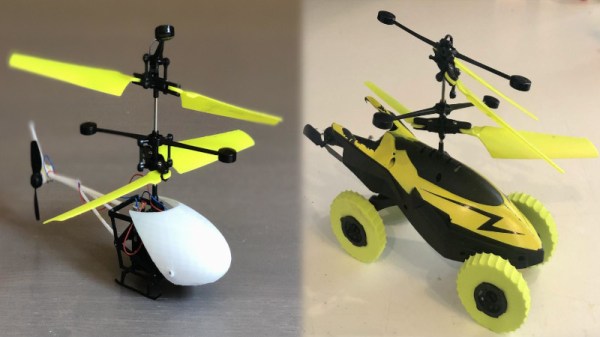
Radio control toys can be great fun to play with. However, at the bottom end of the market, sometimes you find you’ve bought something that just doesn’t work quite right. [saulemmetquinn] found that with a cheap RC helicopter, and set about re-engineering the design in Tinkercad.

The entire frame of the original helicopter was discarded, replaced with one made out of CAD-designed and 3D printed components. The end result is far lighter and less cumbersome than the original design, while also managing to look a lot more like an actual helicopter. It also served to correct some of the problems which [saulemmetquinn] stated made the original toy difficult to fly.

Assembling your own tiny helicopter motors and mechanisms would be quite difficult, and time consuming. [saulemmetquinn] was instead able to leverage the good parts of the original design, and build something better from that. It’s very much the essence of hacking, right there.

We’ve seen other toy helicopters hacked too, like the famous Syma S107G. If you’ve got your own tiny flying hacks, be sure to drop us a line.

Hackaday Links Column Banner

Hackaday Links: June 27, 2021

When asked why he robbed banks, career criminal Willie Sutton is reported to have said, “Because that’s where the money is.” It turns out that a reporter made up the quote, but it’s a truism that offers by extension insight into why ATMs and point-of-sale terminals are such a fat target for criminals today. There’s something far more valuable to be taken from ATMs than cash, though — data, in the form of credit and debit card numbers. And taking a look at some of the hardware used by criminals to get this information reveals some pretty sophisticated engineering. We’d heard of ATM “skimmers” before, but never the related “shimmers” that are now popping up, at least according to this interesting article on Krebs.

While skimmers target the magnetic stripe on the back of a card, simmers are aimed at reading the data from card chips instead. Shimmers are usually built on flex PCBs and are inserted into the card slot, where traces on the device make contact with the chip reader contacts. The article describes a sophisticated version of shimmer that steals power from the ATM itself, rather than requiring a separate battery. The shimmer sits inside the card slot, completely invisible to external inspection (sorry, Tom), and performs what amounts to man-in-the-middle attacks. Card numbers are either stored on the flash and read after the device is retrieved, or are read over a Bluetooth connection; PINs are stolen with the traditional hidden camera method. While we certainly don’t condone criminal behavior, sometimes you just can’t help but admire the ingenuity thieves apply to their craft.

In a bit of foreshadowing into how weird 2020 was going to be, back in January of that year we mentioned reports of swarms of mysterious UAVs moving in formation at night across the midwest United States. We never heard much else about this — attention shifted to other matters shortly thereafter — but now there are reports out of Arizona of a “super-drone” that can outrun law enforcement helicopters. The incidents allegedly occurred early this year, when a Border Patrol helicopter pilot reported almost colliding with a large unmanned aerial system (UAS) over Tucson, and then engaged them in a 70-mile chase at speeds over 100 knots. The chase was joined by a Tucson police helicopter, with the UAS reaching altitudes of 14,000 feet at one point. The pilots didn’t manage to get a good look at it, describing it only as having a single green light on its underside. The range on the drone was notable; the helicopter pilots hoped to exhaust its batteries and force it to land or return to base, but they themselves ran out of fuel long before the drone quit. We have to admit that we find it a little fishy that there’s apparently no photographic evidence to back this up, especially since law enforcement helicopters are fairly bristling with sensors, camera, and spotlights.

When is a backup not a backup? Apparently, when it’s an iCloud backup. At least that’s the experience of one iCloud user, who uses a long Twitter thread to vent about the loss of many years of drawings, sketches, and assorted files. The user, Erin Sparling, admits their situation is an edge case — he had been using an iPad to make sketches for years, backing everything up to an iCloud account. When he erased the iPad to loan it to a family member for use during the pandemic, he thought he’s be able to restore the drawings from his backups, but alas, more than six months had passed before he purchased a new iPad. Apparently iCloud just up and deletes everythign if you haven’t used the account in six months — ouch! We imagine that important little detail was somehere in the EULA fine print, but while that’s not going to help Erin, it may help you.

And less the Apple pitchfork crowd think that this is something only Cupertino could think up, know that some Western Digital external hard drive users are crying into their beer too, after a mass wiping of an unknown number of drives. The problem impacts users of the WD My Book Live storage devices, which as basically network attached storage (NAS) devices with a cloud-based interface. The data on these external drives is stored locally, but the cloud interface lets you configure the device and access the data from anywhere. You and apparently some random “threat actors”, as WD is calling them, who seem to have gotten into some devices and performed a factory reset. While we feel for the affected users, it is worth noting that WD dropped support for these devices in 2015; six years without patching makes a mighty stable codebase for attackers to work on. WD is recommending that users disconnect these devices from the internet ASAP, and while that seems like solid advice, we can think of like half a dozen other things that need to get done to secure the files that have accumulated on these things.

And finally, because we feel like we need a little palate cleanser after all that, we present this 3D-printed goat helmet for your approval. For whatever reason, the wee goat pictured was born with a hole in its skull, and some helpful humans decided to help the critter out with TPU headgear. Yes, the first picture looks like the helmet was poorly Photoshopped onto the goat, but scroll through the pics and you’ll see it’s really there. The goat looks resplendent in its new chapeau, and seems to be getting along fine in life so far. Here’s hoping that the hole in its skull fills in, but if it doesn’t, at least they can quickly print a new one as it grows.


Ingenuity Completes Fourth Flight On Mars, Gets A New Mission

It’s the same on Mars as it is here — just when you’re getting used to your job, the bosses go and change things up.

At least that’s our read on the situation at Jezero crater, where the Mars Ingenuity helicopter has just had its mission upgraded and extended. In a Friday morning press conference, the Ingenuity flight team, joined by members of the Perseverance team and some NASA brass, made the announcement that Ingenuity had earned an extra 30 sols of flight time, and would be transitioned from a mere “technology demonstrator” to an “operations demonstration” phase. They also announced Ingenuity’s fourth flight, which concluded successfully today, covering 266 meters and staying airborne for 117 seconds.

Continue reading “Ingenuity Completes Fourth Flight On Mars, Gets A New Mission”

Helicopter Is Full Of Compressed Air

[Tom] likes to build little helicopters and decided to build one that runs on compressed air. (Video, embedded below.) Turns out it was a little harder than he thought. Originally, he was trying for a compressed air quadcopter. He’d already worked with an air turbine, but putting on a vehicle that can lift itself into the air turns out to have a lot of hidden gotchas.

[Tom] went through a lot of design considerations to arrive at the helicopter design. He considered counter-rotating props, but there were a host of problems involved. He finally settled on a single prob with a tail rotor that resides on the far end of a long boom to allow the resulting lever arm to reduce the work required of the tail rotor.

Continue reading “Helicopter Is Full Of Compressed Air”