Fixing POST Errors With A Single Key

one_key_keyboard

Instructables user [Mike Craghead] was in the middle of building a very compact public computer kiosk when he ran into a problem with the processor fan. It was too big for the enclosure and had to be swapped out with a fan that did not allow the motherboard to monitor its rotational speed.

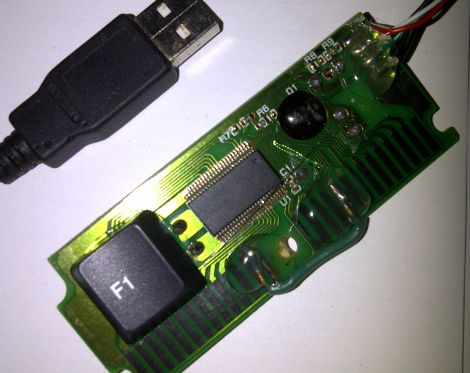
Motherboards don’t like this situation very much, and each time the computer was started, it would hang at the BIOS screen waiting for someone to press the F1 key to continue. Knowing that everything was just fine, and that there were no BIOS options which would allow him to ignore the error, he crafted a simple solution to the problem.

Since the computer just needed someone to press the F1 key, he figured he could rig up a small dongle that would always hold down the key for him. After verifying that the OS would ignore the stuck key, he tore apart a keyboard and traced the circuit matrix to identify which pins he had to short in order to represent the F1 key press.

Satisfied with his handiwork, he plugged the board into his computer and found that everything worked just fine. Sure it might not be the most elegant solution to the problem, but it gets the job done at a cost of zero dollars – you can’t beat that!

BAMF2011: Keyboards Built From Scratch

As the most direct interface between computer and programmer, keyboards can be a deeply personal, sometimes almost religious thing. Some find solace in their vintage IBM Model M, or luxurious leather keyboard, but maker [Carol Chen] took things into her own hands, quite literally. [Carol]’s Maker Faire exhibit has a half dozen specimens of interesting commercial tactile and ergonomic options…but [Chen]’s personal keyboard, where she commits to her work as a full-time coder, has been made to her own exacting specifications.

Continue reading “BAMF2011: Keyboards Built From Scratch”

Uber Keyboard Hides Security Tools In Plain Sight

uber_keyboard

[EverestX] works in the Security industry and is often required to recover or penetrate various systems for a variety of reasons. He wanted to create an all-in-one tool that he could easily carry from job to job which would provide him with several essential functions. He required that the device house a bootable operating system through which he can perform his work, have an Internet connection capable of injection, and have enough storage capacity to back up passwords, images, etc.

He decided to build the system inside an old IBM M-type keyboard, which provides a solid typing experience and plenty of real estate for his various components. After converting the keyboard from PS/2 to USB, he installed a USB hub along with his flash drive and WiFi card.

Once he gets everything reassembled, it should prove to be a pretty stealthy and useful piece of equipment. A word to the wise – if you happen to see someone sneaking around your office with a 20-year old Type-M keyboard, be wary.

USB Keyboard Prankster

Being a long time prankster, [cyclonite] came up with this pretty clever hack in an old USB flash drive.

The drive was removed from its case, and the stock memory and controller was removed. On the back, an attiny 2313 is glued to the pcb, while resistors are swapped to work with the VUSB library. Wirewap wire is used to jumper all the needed points to the new micro controller on the back, and a temporary ICSP header was fitted on the end to load software.

What your’re left with is an innocent looking usb drive that, when plugged in, sets itself up as a keyboard then proceeds to toggle the caps lock on your victims computer every few minuets. Classic.

Join us after the break for a quick video.

Continue reading “USB Keyboard Prankster”

Alternate Keyboard Layouts – For Geekiness And Other Reasons

[BiOzZ] wanted to try a different keyboard layout than the ubiquitous Qwerty, so he grabbed an old keyboard and converted it to the Dvorak setup. This was accomplished by first popping off all of the keys from the black keyboard seen above, and boy did he find a mess underneath. It was nothing that a trip through the dishwasher (for the case only) wouldn’t fix, and the next step was to replace the keys in a different order. He found that a couple of them wouldn’t just go back in a different place, but had to be rotated 90 degrees to fit. Not a huge problem, you can see that he overcame the visual speedbump of letters facing the wrong way by adding his own letter labels. From there he walks us through the process of getting Windows to switch to the Dvorak layout.

I went through a similar process at the end of last year. I was experiencing a lot of pain in my hands from my prolific feature writing here at Hackaday so I chose to try out the Colemak keyboard. The white keyboard above is the one I repurposed using that layout. I found it quite easy to switch between two keyboard layouts using Ubuntu. After you’ve set it up in the keyboards dialog a layout icon appears on the panel. It wasn’t hard to pick the new key locations up, but it did reduce my typing speed by a factor of 8. In the end I found that adjusting my chair height and keeping my hands warm did the trick and I’m back on the Qwerty where I belong.

Jittering Hexapod Dances To The Strokes Of Your Bluetooth Keyboard

Here’s a small but functional hexapod that is controlled via Bluetooth. [Sigfpe] started with the hexapod kit sold by Polulu and added a BlueSMiRF modem to get the little guy’s communications up and running. But since the bot is merely three servos, a microcontroller board, sensors, and miscellaneous parts it’s an easy build for most electronic hobbyists.

Check out the video after the break to see the delightful dance it can perform at your bidding. When we first looked at the project we thought that the keyboard was directly paired with the bot for control, but a look at the code makes us think the computer is controlling it after processing keystrokes. Either way the BlueSMiRF should have no problem pairing with other Bluetooth devices so it’s just a matter of coding to get it taking commands from your device of choice. We’d love to see Android control but for the really hard-core code monkeys we think this should be voice controlled with a Bluetooth headset.

Continue reading “Jittering Hexapod Dances To The Strokes Of Your Bluetooth Keyboard”

Theremin Midi Board Is Like Using Autotune

[Steve Hobley] built a Theremin interface board that tracks pitch and volume. Using this setup he’s able to pass data over a midi interface which effectively converts the instrument into a non-contact midi controller. As we joked in the headline, this does allow for the use of autotune, by snapping notes that are sharp or flat to the center of the nearest pitch. But you should watch the video after the break to see [Steve] show off the other features as well. A keyboard can be used to seed a starting pitch, with arpeggios of several different tonalities built on top of it based on the input from the Theremin.

Want the details? Unfortunately you’ll have to pay for the schematics. But the concept is still just as interesting to read about, even if you don’t know what went into the system. Continue reading “Theremin Midi Board Is Like Using Autotune”